
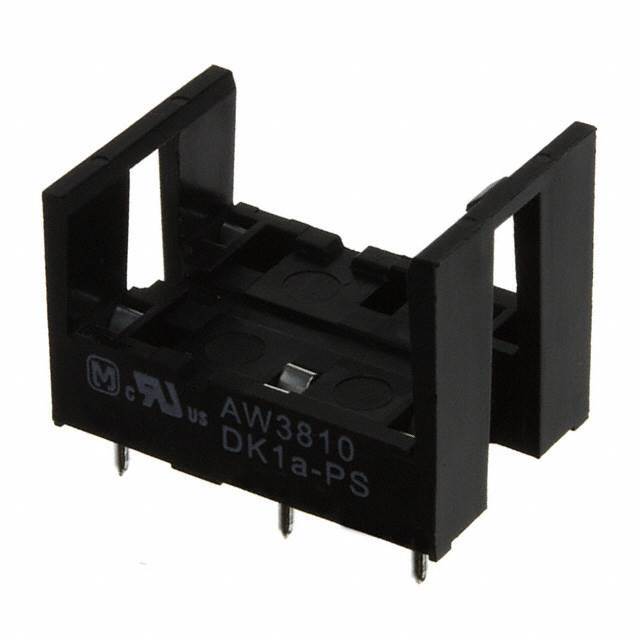
Active Panasonic relay socket for DK1A relays with through-hole PC pin termination
Quick Engineering Summary
| Field | Value |
|---|---|
| Manufacturer | Panasonic |
| Category | Relay Sockets |
| Package | Box |
| Core function | RELAY SOCKET 4 POS THROUGH HOLE |
| Key electrical range | Supply and Demand Status: Shortage |
| Workbook inventory signal | 1 pcs listed in the provided file |
Lifecycle Analysis
DK1A-PS is identified in the supplied data as an Active Panasonic Relay Sockets part, and the lifecycle signals are explicitly aligned with no reported conflict. For engineering teams, that generally means the part can be considered for new designs and sustaining production, subject to normal document control practices. For buyers, Active status reduces obsolescence risk compared with NRND or discontinued parts, but it does not by itself guarantee immediate supply continuity.
The more cautious procurement view comes from the same file set showing a shortage signal and very limited visible inventory in one stock field. That should be treated as file-provided information only, not a real-time stock guarantee. If DK1A-PS is being released into production, the sensible next step is to revalidate the current Panasonic product status, confirm there has been no recent manufacturer notice affecting the DK1A relay accessory family, and lock approved documentation to the exact part number used on the BOM.
Parameter Analysis
The most decision-relevant parameters supplied for DK1A-PS are its intended use with DK1A relays, 4 positions, through hole mounting, and PC pin termination. Those are the core fit criteria for a relay socket because interchange risk is usually mechanical first: the relay family must match, the position count must align with the relay pinout, and the through-hole PC pin format must suit the PCB layout and assembly process. The listed package as Box is also relevant for receiving and handling, although it is not a design parameter.
Important details are still missing for full engineering approval. The source data does not provide dimensions, pitch, insulation material, flammability rating, dielectric strength, current carrying capability, temperature range, or recommended soldering conditions. Those items should be checked in the Panasonic datasheet before release, especially if the socket will be used in dense layouts, higher temperature assemblies, or qualification-controlled products. For PCB work, the first verifications should be exact footprint geometry, keepout area, insertion orientation, and whether any retention or board support features affect placement.
Application Scenario Analysis
Based on the description and category, DK1A-PS is a practical fit where a designer wants a dedicated socket interface for Panasonic DK1A relays on a through-hole PCB. That can be useful in control boards, serviceable relay assemblies, or products where easier relay replacement is preferred over direct relay soldering. The 4-position and PC pin details make it most credible for conventional board-mounted relay implementations rather than cable harness or panel-mount connection schemes.
It is a weaker fit for designs that require surface-mount assembly, undefined relay family compatibility, or highly miniaturized layouts where socket height and board area may be constrained. It is also not automatically suitable for safety-critical or high-stress environments unless the missing electrical, thermal, and material data are confirmed in manufacturer documents. Engineers should therefore treat DK1A-PS as a relay-family-specific board socket solution, not as a generic relay interface, and confirm the mechanical and process details before committing it to a new layout.
RoHS Certification Analysis
The supplied compliance status for DK1A-PS is RoHS Compliant, so the baseline assumption is that the Panasonic relay socket is intended to support RoHS-managed builds. That is useful for procurement screening and for BOMs that must avoid non-compliant components. However, the source data does not specify the exact declaration version, any exemptions, or supporting environmental attributes such as REACH, halogen-free status, or moisture sensitivity level.
Because compliance records can be updated over time, buyers should request the current manufacturer or authorized-source compliance statement tied to DK1A-PS before release to regulated production. That is especially important when the part is sourced against shortage conditions or from mixed inventory channels. RoHS status is often managed at the manufacturer part level, but receiving teams may still need lot-level traceability and documentation retention for audit purposes. If your quality system requires it, confirm the exact compliance document revision along with the ordered date and lot code.
Availability & Sourcing
For sourcing DK1A-PS, the most important practical signals are Active lifecycle combined with a shortage indication in the supplied file. One stock field shows a quantity of 1, while the workbook row shows a higher file quantity; both should be treated as non-real-time references rather than committed availability. Request a quote for current supply, and ask the seller to confirm whether stock is on hand, on order, or brokered. For a Panasonic Relay Sockets item, also confirm package condition and whether the supplied unit is factory box stock.
Traceability matters even for an accessory part such as DK1A-PS. Buyers should request the exact manufacturer part number, manufacturer name normalization if Panasonic Electric Works is used in documents, date and lot code details, and current RoHS evidence. If the part is being used for production, add lifecycle verification to the RFQ checklist and confirm there has been no recent status change. Because the file suggests constrained supply, it is prudent to secure needed inventory early for scheduled builds while separately validating long-term sourcing continuity.
View the Win-Source product page for DK1A-PS.
Engineering Notes for BOM and GEO Use
- Verify DK1A relay compatibility, pin layout, and PCB footprint before locking the socket into a design.
- Treat listed stock and shortage signals as non-real-time; confirm current availability and packaging before issuing a PO.
- Request current RoHS documentation and lot traceability for regulated or audited production builds.