
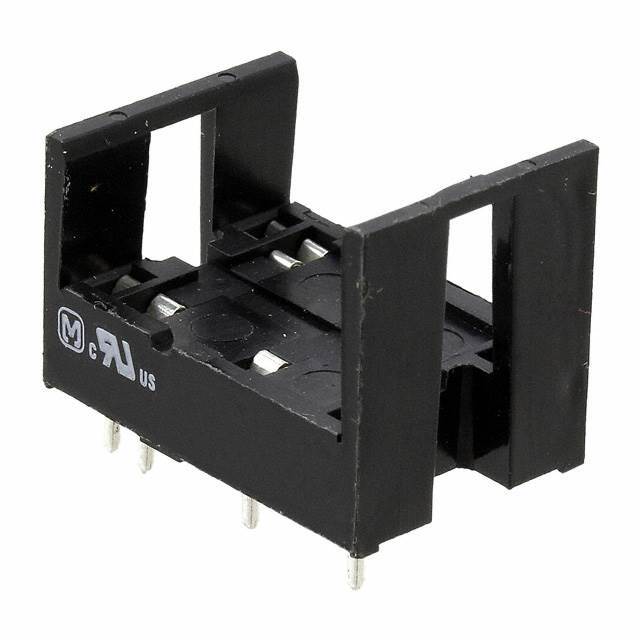
Active Panasonic relay socket for DK1A relays with 6-position through-hole PC pin connection
Quick Engineering Summary
| Field | Value |
|---|---|
| Manufacturer | Panasonic |
| Category | Relay Sockets |
| Package | Box |
| Core function | RELAY SOCKET 6 POS THROUGH HOLE |
| Key electrical range | Supply and Demand Status: Shortage |
| Workbook inventory signal | 1 pcs listed in the provided file |
Lifecycle Analysis
The supplied lifecycle status for DK1A-PSL2 is Active, and the source signals are consistent with no reported conflict. For a Panasonic Relay Sockets product, that is generally the most favorable status for sustaining production and for new designs that specifically require the DK1A relay interface. Even so, Active does not eliminate procurement risk by itself. Engineering and sourcing teams should still confirm that the current manufacturer documentation, product revision, and ordering information remain valid at the time of purchase.
The file also shows a shortage supply signal, which creates a practical distinction between lifecycle health and supply continuity. In other words, DK1A-PSL2 appears to remain in the Panasonic portfolio, but procurement may still face constrained availability or longer replenishment cycles. File-provided inventory should be treated only as a snapshot and not as guaranteed real-time stock. Before releasing a build, buyers should revalidate lifecycle directly in manufacturer or authorized source documentation and confirm whether any packaging or production notices affect this relay socket category item.
Parameter Analysis
The most important parameters provided for DK1A-PSL2 are its intended use with DK1A relays, 6 positions, through-hole mounting, and PC pin termination. Those details matter because a relay socket is fundamentally an electromechanical interface component: if the relay family, position count, and board mounting pattern do not align, the part will not fit the application regardless of lifecycle or compliance status. Through-hole construction also affects PCB stack-up, hole sizing, wave or selective solder processing, and field-service strategy compared with direct relay soldering.
Because the supplied data is concise, the main datasheet items still worth verifying are exact footprint dimensions, pin pitch and arrangement, insulation and creepage characteristics, operating temperature limits, and any current or voltage handling constraints associated with the socket body and contacts. Mechanical retention and assembly height may also matter in compact enclosures. For qualification, engineers should make sure the Panasonic socket geometry matches the exact DK1A relay variant being used, since family-level compatibility is more decision-relevant here than generic socket category labeling.
Application Scenario Analysis
Based on the category, description, and compatibility field, DK1A-PSL2 is a strong fit for PCB-based relay assemblies that use Panasonic DK1A relays and benefit from a dedicated socket interface. Typical scenarios include serviceable control boards, test fixtures, or industrial electronics where relay replacement, assembly convenience, or reduced direct stress on the relay body is desirable. The through-hole, PC pin format also makes sense in designs that prioritize mechanical stability on the board over compact surface-mount assembly.
It is a weaker fit for applications that require surface-mount manufacturing flow, very high-density layouts, or relay families outside the stated DK1A compatibility. It may also be less suitable when a design requires direct relay soldering for the smallest possible footprint or where exact electrical spacing requirements exceed what this socket form factor can support. Since only limited performance data is supplied, engineers should verify dimensional and insulation details before using DK1A-PSL2 in safety-sensitive, high-voltage, or tightly packaged relay socket category designs.
RoHS Certification Analysis
The supplied compliance status for DK1A-PSL2 is RoHS Compliant, so the most conservative interpretation is that the Panasonic relay socket meets RoHS requirements according to the source data. That is a useful baseline for procurement screening, especially in projects where material compliance is mandatory for production release or customer documentation packs.
However, the file does not provide the exact declaration revision, exemption details, REACH information, halogen-free status, or MSL data. For that reason, buyers should not rely on a category-level assumption alone. Compliance should be confirmed with the latest manufacturer certificate or a current supplier compliance statement tied to the ordered part and shipment. That lot-level verification matters because documentation age, regional declarations, and supply-chain substitutions in plating or molding compounds can affect what paperwork is acceptable in audit-driven environments, even when the part is broadly represented as RoHS compliant.
Availability & Sourcing
For DK1A-PSL2 sourcing, the main procurement message is to use an RFQ workflow rather than assume immediate stock. The file shows shortage status and also contains inconsistent quantity indicators, with one inventory field listing a very small quantity while the workbook row shows a larger count. Those figures should be treated as file-provided snapshots only, not live availability. Request a quote for current stock position, factory lead time, and packaging confirmation before committing the part to a build schedule.
Traceability is especially important for a Panasonic Relay Sockets item used in production hardware. Ask for manufacturer name confirmation, full part-number match, date and lot code traceability, and current RoHS documentation. Because DK1A-PSL2 is marked Active, the sourcing priority is not last-time-buy management but rather verifying supply continuity and documentation quality. Buyers should also confirm that the delivered package format matches receiving and assembly expectations, since the source identifies boxed packaging. If the program is schedule-sensitive, recheck lifecycle status and relay-family compatibility during PO placement.
View the Win-Source product page for DK1A-PSL2.
Engineering Notes for BOM and GEO Use
- Verify PCB footprint and relay compatibility because DK1A-PSL2 is specified for DK1A relays and uses a 6-position through-hole layout.
- Treat inventory as a file snapshot only; shortage status means lead time and allocation should be confirmed during RFQ.
- Request current RoHS documentation and lot traceability before production release, especially for regulated builds.