
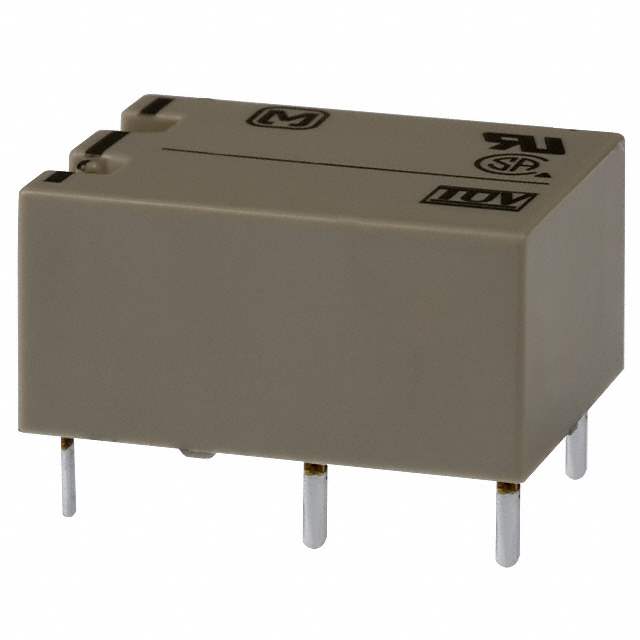
Panasonic power relay guide covering lifecycle, key relay parameters, RoHS status, and sourcing checks
Quick Engineering Summary
| Field | Value |
|---|---|
| Manufacturer | Panasonic |
| Category | Power Relays, Over 2 Amps |
| Package | 50 |
| Core function | RELAY GEN PURPOSE DPST 8A 3V |
| Key electrical range | Coil Current: 66.7mA; Coil Power: 200 mW; Coil Resistance: 45 Ohms; Coil Voltage: 3VDC |
| Workbook inventory signal | 1 pcs listed in the provided file |
Lifecycle Analysis
DK1A1B-L2-3V is identified in the supplied data as an Active Panasonic power relay, and the lifecycle inputs are consistent across the file. That is the most favorable status for procurement because it generally supports both new design consideration and ongoing production builds. Even with an Active status, engineering and sourcing teams should still confirm that the latest Panasonic datasheet, agency files, and internal approval records match the exact suffix and packaging being purchased.
The source also shows a limited supply-and-demand signal and file-provided stock entries, including a very small visible inventory count in one location. Those figures are useful as a planning indicator but should not be treated as guaranteed real-time availability. For production planning, treat DK1A1B-L2-3V as active but require order-time lifecycle revalidation, especially if the program depends on a narrow approved vendor list, specific lot continuity, or long service support windows.
Parameter Analysis
The most important electrical point for DK1A1B-L2-3V is its 3VDC latching dual-coil design. Supplied data lists 66.7 mA coil current, 200 mW coil power, 45 ohm coil resistance, and a maximum turn-on voltage of 2.1 VDC. These values matter because the relay drive circuit must provide a reliable pulse at the correct voltage while respecting startup tolerance, supply droop, and any transistor or MOSFET losses in the control path. A latching relay can reduce steady-state coil power, but it also requires correct set and reset control logic.
On the load side, the relay is described as a general purpose DPST-NO/NC type with 8A contact rating and maximum switching voltage of 250VAC or 125VDC. Through-hole mounting, PC pin termination, fully sealed construction, and 10 ms operate and 8 ms release times point to a board-mounted electromechanical switching role rather than high-density or ultra-fast switching. Before release, verify the exact contact material and the load rating details from manufacturer documents, especially resistive versus inductive load capability, dielectric strength, insulation resistance, and any required PCB creepage or clearance constraints.
Application Scenario Analysis
Based on the category, description, and relay specifications, DK1A1B-L2-3V is a strong fit for board-level power switching where a low-voltage control circuit must command moderate AC or DC loads. Examples include general equipment control, power path isolation, appliance or industrial subassemblies, and other designs that benefit from a latching relay to reduce continuous coil consumption. The fully sealed construction may also be helpful in assemblies where cleaning or environmental exposure is a concern, subject to manufacturer process guidance.
It is a weaker fit for applications needing very high switching frequency, silent solid-state behavior, miniature surface-mount assembly, or wide ambient margin above 65 degrees C. It may also be a weak fit where the system cannot easily generate the proper dual-coil latching drive sequence. If the end product has demanding compliance, surge, or inductive load requirements, the buyer should verify the detailed relay qualification data and agency approvals for the exact Panasonic part number rather than assuming family-level suitability.
RoHS Certification Analysis
The supplied compliance status for DK1A1B-L2-3V is RoHS Compliant, so the part can be treated as having a positive RoHS signal at the source-data level. For many procurement workflows, that is enough to move forward to quotation and document collection, but it should still be supported by the latest manufacturer declaration when the part is used in regulated products or customer-audited builds.
No exemption details, REACH declaration, halogen-free information, or moisture sensitivity data were provided in the file. Because of that, teams should avoid extending the available compliance claim beyond RoHS itself. For production traceability, request the current Panasonic compliance statement tied to the exact part number and preferably to the delivered lot or date code when product-level conformance records are required. That extra step is especially useful when approved vendor processes require evidence beyond a catalog-level RoHS label.
Availability & Sourcing
For DK1A1B-L2-3V, the practical sourcing posture is to request a quote and confirm current availability before committing to builds. The file shows limited supply-and-demand status, a workbook quantity signal, and tube or rail packaging with 50 pieces per package. Those details are helpful for planning incoming inspection and line handling, but they are not a substitute for a current stock check. Buyers should specify the exact Panasonic manufacturer name, full part number, required packaging, and any documentation needs in the RFQ.
Traceability should be part of the sourcing process for this power relay. Ask for manufacturer identification, date and lot code information, packaging condition, and storage history, especially because the source data includes dry storage and humidity-protection notes. Since the open-market fake-threat indicator is elevated in the file, distributor or broker screening controls matter. Request RoHS evidence, confirm Active lifecycle status at order time, and obtain the latest datasheet and approval references before using DK1A1B-L2-3V in production or service builds.
View the Win-Source product page for DK1A1B-L2-3V.
Engineering Notes for BOM and GEO Use
- Verify latching dual-coil drive behavior against your control circuitry before PCB release.
- Confirm contact arrangement, switching voltage, and load profile suitability for the intended 8A relay application.
- Request traceability and current stock confirmation because file data shows limited supply signals.