
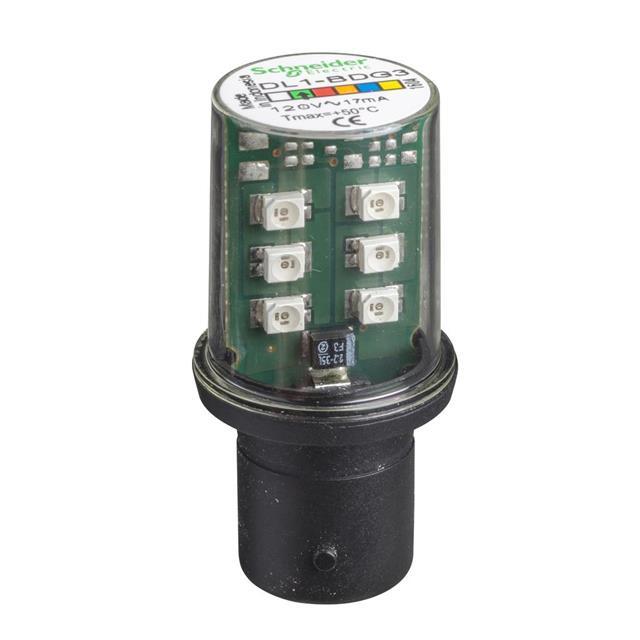
Procurement and engineering review for the Schneider Electric indicator bulb DL1BDG3
Quick Engineering Summary
| Field | Value |
|---|---|
| Manufacturer | Schneider Electric |
| Category | Stack Lights, Beacons, Indicators |
| Package | Box |
| Core function | BULB GREEN LED STEADY |
| Key electrical range | Supply and Demand Status: Shortage; Voltage - Supply: 120VAC |
| Workbook inventory signal | 2 pcs listed in the provided file |
Lifecycle Analysis
DL1BDG3 is best treated as Discontinued for both engineering and procurement decisions. The source data shows a lifecycle conflict in wording, with one signal marked EOL and two others marked Discontinued, but none of the signals support an Active or low-risk interpretation. For Schneider Electric Stack Lights, Beacons, Indicators hardware, that means DL1BDG3 should not be selected for new product development unless the manufacturer revalidates supply status in writing.
For sustaining production or field service, the practical issue is continuity rather than initial design fit. Buyers should confirm whether the part is still orderable through any authorized channel, whether a formal last-time-buy notice exists, and whether the exact revision remains unchanged. A file-provided inventory signal is present, but it should be treated only as a snapshot rather than real-time availability. If ongoing support depends on DL1BDG3, planning should include documented lifecycle verification and an internal risk review before committing production demand.
Parameter Analysis
The most decision-relevant parameters for DL1BDG3 are the 120VAC supply rating, green light color, steady illumination function, LED lamp type, wire-lead termination, and bulb form factor. Together, these indicate a mains-voltage indicator element intended for visual status signaling rather than low-voltage logic-level integration. The 120VAC rating is particularly important because it drives insulation expectations, wiring practices, and compatibility with the host stack light or indicator assembly.
The green steady output suggests straightforward machine-state or process indication where flashing or audible signaling is not required. Wire leads matter for installation method, field replacement procedure, and strain relief within the enclosure. The source data also references one stack, which helps frame expected use in a single indication position, but it does not provide critical mechanical or electrical details such as current draw, power consumption, luminous intensity, dimensions, ingress protection, operating temperature, or agency approvals. Those items should be verified in Schneider Electric documentation before approving DL1BDG3 for maintenance stocking or integration review.
Application Scenario Analysis
Based on the category, description, and available specifications, DL1BDG3 is a strong fit for industrial visual indication tasks in stack lights, beacons, or panel-mounted signaling assemblies that require a green steady LED bulb at 120VAC. Typical scenarios include machine run indication, normal-state status display, or line-condition signaling where a continuous green visual output is appropriate. The Schneider Electric product context also supports use in industrial automation and controls environments rather than consumer or portable equipment.
DL1BDG3 is a weaker fit where the design requires multi-mode signaling, low-voltage DC operation, integrated electronics, or enhanced environmental data that must be formally qualified. It is also not a good fit for new platform designs due to the discontinued lifecycle. Since the available data does not include brightness, environmental sealing, shock or vibration performance, or mounting dimensions, engineers should avoid assuming suitability for outdoor, high-temperature, washdown, or safety-critical indication without manufacturer documents. For maintenance use, confirm that the host assembly was originally designed for this exact bulb style and voltage class.
RoHS Certification Analysis
The RoHS picture for DL1BDG3 is not clean enough to treat as settled. One source field identifies the part as RoHS Compliant, while another specification field explicitly states RoHS Non-Compliant. Because these two statements directly conflict, the safest sourcing position is to classify RoHS status as requiring verification rather than assuming compliance from a family-level label.
For discontinued Schneider Electric Stack Lights, Beacons, Indicators parts, compliance ambiguity can become more significant because older inventory may have been built under different material declarations or documentation practices. Buyers should request current manufacturer-backed compliance evidence tied to the specific part number and, where possible, the delivered lot. If internal compliance workflows require a standard declaration, obtain that before release to production or service stock. In the absence of harmonized documentation, DL1BDG3 should not be represented internally as confirmed RoHS compliant.
Availability & Sourcing
Availability for DL1BDG3 should be approached as a controlled RFQ process rather than a routine catalog buy. The source data shows discontinued status, a shortage signal, and a file-provided stock quantity of 2, but that quantity is not guaranteed real-time. For Schneider Electric indicator procurement, request a quote for current availability and ask the supplier to confirm whether stock is on hand, in transfer, or subject to prior sale.
Because DL1BDG3 is lifecycle-constrained, traceability matters as much as physical stock. Ask for manufacturer name confirmation, full part marking, packaging condition, date and lot code details, and any available chain-of-custody records. The listed package style is box, which should also be verified against the actual shipment configuration. Before issuing a purchase order, confirm lifecycle status, RoHS documentation, and fit to the target assembly. For discontinued material, source carefully, verify manufacturer notices, and align procurement with maintenance demand rather than open-ended production commitments.
View the Win-Source product page for DL1BDG3.
Engineering Notes for BOM and GEO Use
- Treat DL1BDG3 as discontinued despite mixed EOL wording and avoid it in new designs.
- Verify 120VAC compatibility, wire-lead termination, and mechanical fit in the target stack light assembly.
- Resolve the RoHS compliant versus non-compliant conflict with current manufacturer documentation before purchase.