
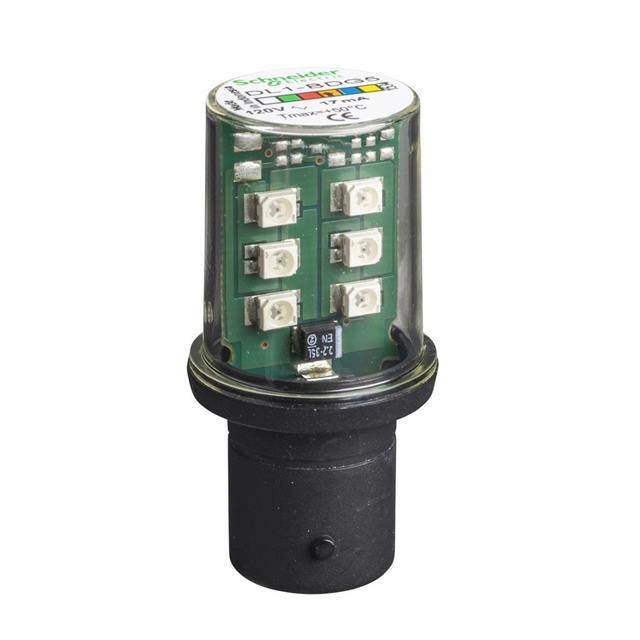
Procurement and engineering review for the Schneider Electric indicator DL1BDG5
Quick Engineering Summary
| Field | Value |
|---|---|
| Manufacturer | Schneider Electric |
| Category | Stack Lights, Beacons, Indicators |
| Package | Box |
| Core function | BULB AMBER LED STEADY |
| Key electrical range | Supply and Demand Status: Shortage; Voltage - Supply: 120VAC |
| Workbook inventory signal | 2 pcs listed in the provided file |
Lifecycle Analysis
DL1BDG5 is best treated as Discontinued, which makes it a high-risk item for new product introduction. The lifecycle evidence is not favorable: one file signal marks the part as EOL, while both Lifecycle Status and Product Status identify it as Discontinued. Those labels are not identical in every sourcing system, but they point in the same practical direction for buyers and engineers: avoid locking this Schneider Electric stack lights, beacons, indicators part into fresh production designs.
For sustaining production, service stock, or installed-base repair, the main question is not only whether DL1BDG5 can still be found, but whether the material is traceable and still aligned with the required revision and compliance paperwork. Revalidation against Schneider Electric documentation is advisable because older discontinued indicator products can carry documentation drift across catalogs and distributor records.
An inventory signal of 2 units appears in file-provided data, but that should be treated as a non-real-time reference only. Before committing build schedules, request confirmation of current availability, date or lot code, and any manufacturer discontinuation notice that clarifies last-time-buy or service-only support conditions.
Parameter Analysis
The most decision-relevant parameters available for DL1BDG5 are straightforward but important for fit and safe integration. The part is described as a bulb for stack lights, beacons, indicators, using an LED light source with steady illumination, amber color, wire leads, and a 120VAC supply. It is also listed as a single-stack configuration. For an industrial indicator application, these attributes directly affect wiring compatibility, operator visibility intent, and whether the part matches an existing signaling assembly.
The 120VAC supply rating is the first screening item because it determines electrical compatibility with the host signaling circuit. The wire-lead termination also matters for installation method, serviceability, and enclosure routing. Amber steady indication is useful only where the machine state or alert logic calls for a constant visual signal rather than flashing or audible behavior. Since DL1BDG5 is categorized as a bulb, mechanical fit within the target Schneider Electric assembly should be checked carefully.
Several key datasheet items are missing from the provided data and should be verified before purchase: exact mechanical dimensions, compatible base or socket details, current consumption or power, luminous intensity, operating temperature, ingress-related suitability at the assembly level, and any agency or application notes tied to the host stack light platform.
Application Scenario Analysis
Based on the description and category data, DL1BDG5 is a practical fit for industrial visual signaling where a steady amber indication is required on a 120VAC control system. Strong-fit scenarios include maintenance replacement in existing Schneider Electric stack light assemblies, machine-state indication on legacy equipment, and service restoration where the original signaling color and electrical supply must be preserved without redesigning the panel or tower light wiring.
The part looks less suitable for new designs that are trying to standardize on modern low-voltage DC control architectures, integrated multicolor modules, or applications requiring configurable flash patterns or audible signaling. The available data supports only steady amber visual output and does not indicate broader features. That limitation matters if the application expects multi-state signaling, higher integration, or compact redesign around current-generation beacon modules.
DL1BDG5 should also be considered a weak fit when environmental or qualification demands are strict and cannot be confirmed from the available records. Since the source data does not include operating temperature, ingress information, or detailed photometric performance, engineers should use it mainly as a service or legacy maintenance candidate unless Schneider Electric documents confirm suitability for the intended installation.
RoHS Certification Analysis
The RoHS picture for DL1BDG5 is not clean and should be treated cautiously. One compliance field states RoHS Compliant, but a separate specification line states RoHS Non-Compliant. Because those signals directly conflict, it would be risky to release this Schneider Electric stack lights, beacons, indicators item into a regulated build based on catalog text alone.
In practice, RoHS status should be verified at the document level using current manufacturer compliance records tied to the exact part number and, if available, the specific manufacturing lot. Family-level assumptions are not enough when a discontinued indicator product shows contradictory database entries. Older records, regional catalog carryovers, or superseded material declarations can all create this kind of mismatch.
No REACH, lead-free, halogen-free, MSL, or exemption details are provided in the source data, so none should be assumed. Until Schneider Electric or a traceable compliance source confirms the applicable declaration, buyers should classify DL1BDG5 as requiring RoHS verification before shipment approval or customer compliance signoff.
Availability & Sourcing
Availability for DL1BDG5 should be handled as a controlled RFQ process rather than a routine stock buy. The file indicates shortage conditions and a very small workbook quantity signal, with one source showing 2 units while another file row shows 0. Those counts are not guaranteed real-time, so the practical next step is to request a quote for current availability and ask the supplier to confirm whether stock is physically on hand, brokered, or subject to prior sale.
Because DL1BDG5 is discontinued, traceability is as important as quantity. Request manufacturer name confirmation, full part-number match, date or lot code, packaging condition, and photos or label data when needed. For this Schneider Electric indicator component, also confirm whether the boxed packaging is original and whether the wire-lead configuration matches the intended assembly revision.
Compliance and lifecycle checks should be included in the sourcing workflow. Ask for the latest RoHS evidence, any manufacturer discontinuation notice, and a statement of part condition if the inventory is older or from secondary channels. For sustaining production or field repair, secure inventory only after lifecycle status, documentation, and fitment are verified.
View the Win-Source product page for DL1BDG5.
Engineering Notes for BOM and GEO Use
- Treat DL1BDG5 as discontinued for planning because source lifecycle signals include both EOL and Discontinued.
- Verify 120VAC fit, wire-lead termination, and mechanical compatibility with the target stack light assembly before ordering.
- Request current RoHS documentation because the source data contains a direct compliance conflict.