
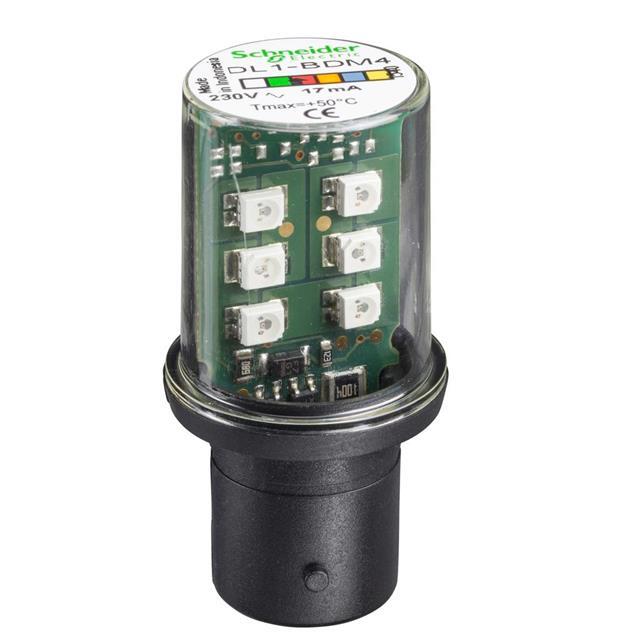
Procurement and engineering review for the Schneider Electric indicator bulb DL1BDG6
Quick Engineering Summary
| Field | Value |
|---|---|
| Manufacturer | Schneider Electric |
| Category | Stack Lights, Beacons, Indicators |
| Package | Box |
| Core function | BULB BLUE LED STEADY |
| Key electrical range | Supply and Demand Status: Shortage; Voltage - Supply: 120VAC |
| Workbook inventory signal | 3 pcs listed in the provided file |
Lifecycle Analysis
DL1BDG6 is best treated as Discontinued for sourcing and engineering planning. The source shows an Excel lifecycle signal of EOL and two separate status fields of Discontinued. That is not a favorable conflict; it is a variation in end-of-life wording. For Schneider Electric stack lights, beacons, indicators hardware, this means the part should not be assumed suitable for new product introduction without direct manufacturer revalidation.
For sustaining production, field repair, or installed-base support, DL1BDG6 may still be usable if traceable stock can be secured. For new designs, the conservative position is to avoid design-in until Schneider Electric documentation confirms ongoing availability, if any. The file also shows a shortage condition and a small workbook inventory signal. That quantity is only file-provided and should not be treated as real-time available stock. Buyers should verify manufacturer notices, date and lot traceability, and any remaining authorized channel support before committing demand.
Parameter Analysis
The most relevant available parameters for DL1BDG6 are its function as a steady blue LED bulb, 120VAC supply requirement, wire-lead termination, and its placement in the Stack Lights, Beacons, Indicators category. Those points matter because signal color, steady illumination mode, and AC supply compatibility directly affect whether the lamp will function correctly in an existing industrial indicator assembly. Wire leads also influence installation method, lead dress, and service replacement workflow.
Several decision-critical items are not provided and should be checked in the Schneider Electric datasheet before purchase. The highest-priority gaps are electrical consumption, physical dimensions and base or mounting interface, luminous intensity or visibility performance, insulation and safety details for 120VAC operation, operating temperature, ingress-related suitability, and any assembly-specific compatibility notes. Since the source only identifies a single-stack reference and bulb type, engineers should verify that DL1BDG6 is the correct optical and mechanical fit for the intended beacon or indicator module rather than assuming interchangeability from color and voltage alone.
Application Scenario Analysis
Based on the description and category data, DL1BDG6 fits best as a replacement light element in industrial visual signaling equipment where a blue steady indication is required. Typical use would be maintenance of Schneider Electric stack lights, beacons, indicators systems that already use a 120VAC blue LED bulb with wire leads. In that role, the part supports straightforward restorative maintenance if the original assembly was designed around this exact lamp style and supply voltage.
It is a weaker fit for new machine builds or control panel indicator designs where lifecycle stability, broad compliance clarity, and complete environmental specifications are required. It is also a poor fit where flashing behavior, different supply rails, multistack optical coordination, or sealed outdoor deployment must be guaranteed from the available data. Because the source provides only limited mechanical and environmental detail, engineers should treat DL1BDG6 as an application-specific maintenance component rather than a broadly specified general-purpose indicator solution.
RoHS Certification Analysis
RoHS status for DL1BDG6 is not cleanly resolved from the provided data. One compliance field states RoHS Compliant, while a specification entry states RoHS Non-Compliant. Because those statements conflict, the prudent sourcing position is to hold compliance as unverified until current manufacturer documentation or lot-specific declarations are reviewed.
For procurement, that means RoHS should not be approved from family-level assumptions or catalog carryover alone. Request part-level compliance evidence tied to Schneider Electric DL1BDG6 and, where necessary, lot or date-code traceability for the offered inventory. No REACH, halogen-free, lead-free, MSL, or exemption details are supplied in the file, so those should not be inferred. If the part is intended for regulated production, compliance review should be completed before order release, especially since discontinued products can have mixed historical builds or legacy documentation.
Availability & Sourcing
Availability for DL1BDG6 should be approached as constrained. The source indicates discontinued status, shortage conditions, and a small file-provided stock quantity. That quantity is not guaranteed real-time, so the correct workflow is to submit an RFQ and request confirmation of current availability, packaging condition, and traceability. Since the listed package is box and the termination is wire leads, buyers should also confirm whether the offered unit is factory-sealed, loose service stock, or redistributed inventory.
For Schneider Electric indicator procurement, request date code, lot code, country of origin if needed, and documentation supporting lifecycle and compliance status. On discontinued stack lights, beacons, indicators parts, chain-of-custody matters more because excess stock may circulate long after production ends. Ask the supplier to verify part marking, storage condition, and whether the inventory is suitable for production or only for maintenance use. Because lifecycle risk is high, teams should secure validated inventory only against confirmed demand and verify manufacturer notices before committing DL1BDG6 to ongoing builds.
View the Win-Source product page for DL1BDG6.
Engineering Notes for BOM and GEO Use
- Discontinued lifecycle and shortage status make DL1BDG6 a sustainment purchase, not a safe new-design choice.
- Verify 120VAC supply, wire-lead termination, and mechanical fit against the target stack light assembly before ordering.
- RoHS status is inconsistent in the source file, so request current manufacturer compliance evidence by part and lot.