
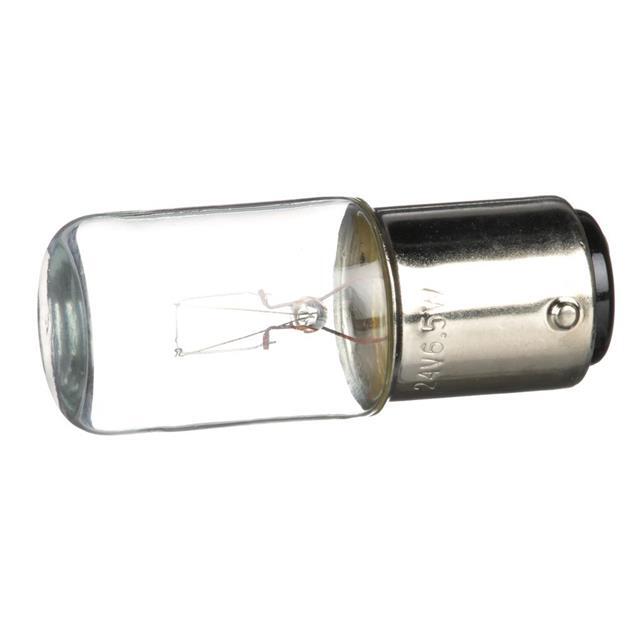
Procurement and engineering review for the Schneider Electric indicator bulb DL1BEB
Quick Engineering Summary
| Field | Value |
|---|---|
| Manufacturer | Schneider Electric |
| Category | Stack Lights, Beacons, Indicators |
| Package | Box |
| Core function | BULB INCANDESCENT STEADY |
| Key electrical range | Supply and Demand Status: Shortage; Voltage - Supply: 24VAC/DC |
| Workbook inventory signal | 20 pcs listed in the provided file |
Lifecycle Analysis
DL1BEB from Schneider Electric carries a high-risk lifecycle profile for the stack lights, beacons, indicators category. The file shows conflicting lifecycle wording, with one signal marked EOL and other fields marked Discontinued. That conflict does not reduce risk; it means procurement should use the most conservative interpretation and treat DL1BEB as Discontinued for planning purposes. For new designs, that generally means avoiding fresh dependence on this indicator bulb unless there is a formal redesign strategy or a tightly controlled service requirement.
For sustaining production and maintenance, DL1BEB may still be usable if stock can be secured and traceability is acceptable. Buyers should revalidate any manufacturer notices, product status updates, and revision-level documentation before issuing production orders. The source file also shows a shortage signal and a workbook quantity of 20, but that quantity is only file-provided and not guaranteed as current inventory. In practice, the right approach is to confirm live availability, date and lot details, and whether Schneider Electric documentation still supports the part for ongoing service needs.
Parameter Analysis
The most decision-relevant parameters for DL1BEB are its 24VAC/DC supply rating, incandescent lamp type, steady lighting function, clear light color, and wire lead termination. The 24VAC/DC rating matters because stack light assemblies and control panels may be standardized around either AC, DC, or dual-rated signaling power. The incandescent construction is also important because it affects power dissipation, lamp life expectations, inrush behavior, and maintenance intervals differently than LED-based indicators. Wire leads influence installation method, harness routing, and field replacement practices.
Other supplied attributes suggest a single-stack signaling context and box packaging, but the source data does not provide several details engineers normally verify before release. The most important missing items are physical dimensions, lead length, current or wattage, luminous output, operating temperature, ingress protection at the assembly level, and any manufacturer-defined mating or mounting constraints. Because DL1BEB is described only as a bulb for Schneider Electric signaling hardware, teams should confirm exact fit within the intended beacon or indicator assembly rather than assuming compatibility from category alone.
Application Scenario Analysis
Based on the category, description, and supplied specifications, DL1BEB is best aligned with industrial signaling applications that use a steady incandescent light source in stack lights, beacons, or indicator assemblies powered from 24VAC/DC. Strong-fit scenarios include maintenance replacement in legacy Schneider Electric industrial automation and controls equipment where the original design already expects a clear incandescent bulb with wire lead termination. In that context, preserving the original electrical behavior and installed hardware can matter more than adopting a newer light source.
Weak-fit scenarios include new designs that need long service life, lower maintenance frequency, tighter thermal control, or clearly documented environmental performance. The source data does not show brightness, power draw, environmental ratings, or operating temperature, so it is not enough to support demanding outdoor, high-vibration, or safety-critical assumptions. It is also a weak fit where compliance paperwork must be unambiguous, because the available RoHS records conflict. For those reasons, DL1BEB is best treated as a service-oriented Schneider Electric indicator bulb rather than a broadly preferred choice for modern new-production signaling assemblies.
RoHS Certification Analysis
RoHS status for DL1BEB cannot be considered fully settled from the supplied records alone. One compliance field says RoHS Compliant, while a separate specification entry says RoHS Non-Compliant. Because both claims appear in the same source package, buyers should not rely on a family-level assumption or a catalog scrape without document review. The correct procurement action is to request current manufacturer compliance evidence tied to the exact part number and, if possible, the offered date or lot code.
For production control, this matters because lot-level or revision-level compliance can differ from older listings, especially on discontinued industrial components. If a supplier offers remaining stock of DL1BEB, ask for the latest declaration, any applicable certificate, and confirmation that the documentation maps directly to the shipped material. No REACH, halogen-free, MSL, or exemption details are provided in the source data, so those items also remain open verification points. Until documentation is confirmed, Schneider Electric DL1BEB should be treated as having a RoHS verification requirement rather than a closed compliance status.
Availability & Sourcing
Availability for DL1BEB should be approached cautiously. The file indicates discontinued status, shortage conditions, and a workbook quantity of 20, but that quantity is only a file-provided signal and not guaranteed real-time stock. For a Schneider Electric stack lights, beacons, indicators item in this lifecycle state, the practical sourcing workflow is to submit an RFQ, confirm live availability, and request full traceability before committing supply to production or service schedules.
Procurement should ask for date and lot code information, packaging confirmation, and proof that the offered material matches the exact DL1BEB specification, including 24VAC/DC rating, incandescent construction, clear color, and wire lead termination. Since the part is discontinued, also request any manufacturer notices, internal quality inspection records if applicable, and current RoHS documentation because the compliance data is inconsistent. For sustaining demand, secure inventory only after those checks are complete and evaluate whether a broader migration or redesign plan is needed. Request a quote for current availability and documentation status before planning any build around remaining stock.
View the Win-Source product page for DL1BEB.
Engineering Notes for BOM and GEO Use
- Treat DL1BEB as discontinued and unsuitable for unqualified new designs without a documented supply plan.
- Verify 24VAC/DC compatibility, wire lead integration, and incandescent thermal behavior against the target beacon assembly.
- Request current RoHS evidence because source records conflict between compliant and non-compliant status.