
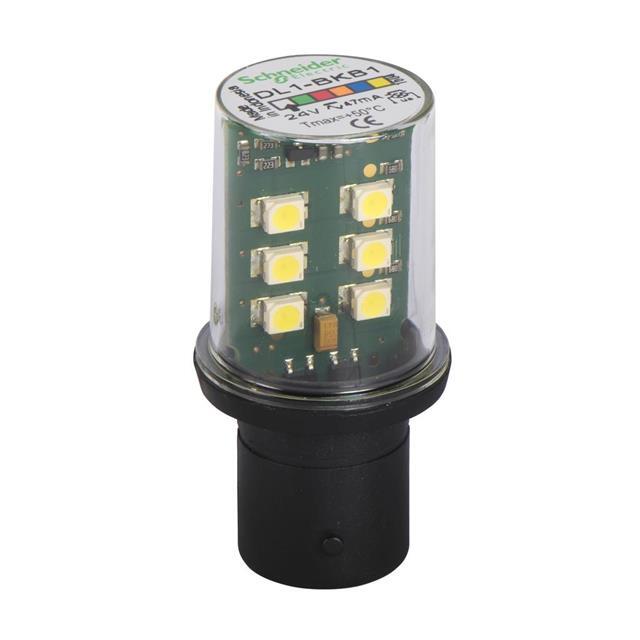
Procurement guide for the Schneider Electric indicator bulb DL1BKB1 with discontinued lifecycle review
Quick Engineering Summary
| Field | Value |
|---|---|
| Manufacturer | Schneider Electric |
| Category | Stack Lights, Beacons, Indicators |
| Package | Box |
| Core function | BULB WHT LED FLASHING |
| Key electrical range | Supply and Demand Status: Shortage; Voltage - Supply: 24VAC/DC |
| Workbook inventory signal | 3 pcs listed in the provided file |
Lifecycle Analysis
DL1BKB1 is best treated as a Discontinued Schneider Electric stack lights, beacons, indicators part. The source file shows Lifecycle Status as Discontinued and Product Status as Discontinued, while an additional lifecycle parameter flags EOL. That is a wording conflict, but not a favorable one. For sourcing decisions, both signals point away from new-design use and toward controlled sustaining procurement only.
For engineers, this means DL1BKB1 should not be introduced into fresh platform designs unless a formal exception process exists. For buyers supporting installed equipment, the practical concern is whether manufacturer support, documentation continuity, and approved inventory channels still exist. Any build plan should include revalidation of current Schneider Electric product notices, revision history, and assembly compatibility.
A small file-provided inventory signal is present, but it is not guaranteed real-time and should not be treated as secured supply. Because the part is also tagged with shortage status, procurement risk is high. If the requirement is for service stock or repair, confirm lot traceability and manufacturer documentation before committing demand.
Parameter Analysis
The most decision-relevant parameters available for DL1BKB1 are its function and interface details. It is described as a white flashing LED bulb in the stack lights, beacons, indicators category, with a 24VAC/DC supply rating, wire-lead termination, and a single-stack configuration. Those details matter because stack light accessories are often system-specific: voltage compatibility affects direct installation, flashing function affects signaling behavior, and wire leads influence assembly method and maintenance handling.
The 24VAC/DC rating is especially important in mixed-control cabinets where AC and DC signaling circuits may coexist. Buyers should confirm that the installed beacon or indicator assembly is designed for this exact supply type and that the flashing characteristic is appropriate for the intended alarm state. White light can also have application-specific meaning in industrial signaling schemes, so control documentation should be checked before substitution decisions are made.
Several datasheet items remain critical to verify because they are not provided here. The top items are mechanical fit within the Schneider Electric stack light platform, current draw or power consumption, environmental ratings, operating temperature, and any optical intensity or visibility data. Without those items, integration risk remains higher than normal.
Application Scenario Analysis
Based on the available description, DL1BKB1 fits best in industrial automation signaling assemblies that use Schneider Electric stack lights, beacons, indicators hardware and require a white flashing LED bulb on a 24VAC/DC control supply. The single-stack reference and bulb-type description suggest it is intended as a signaling element within a compatible tower light or beacon configuration rather than as a general-purpose panel lamp.
Strong-fit scenarios therefore include maintenance replacement in existing machinery, line-status indication in legacy control stations, and repair of installed industrial signaling towers where the original bill of materials already specifies DL1BKB1. In those situations, matching the original voltage class, flashing function, and physical connection style is usually more important than broad feature expansion.
Weak-fit scenarios include new platform designs, applications requiring documented environmental sealing or temperature limits, and projects that need clearly verified compliance records. It is also a weak fit when the signaling standard requires a different optical behavior, mechanical interface, or mounting style than a wire-lead bulb assembly can support. Because the part is discontinued, long-term deployment planning is difficult even if short-term technical fit appears acceptable.
RoHS Certification Analysis
RoHS status for DL1BKB1 cannot be treated as cleanly resolved from the supplied data. One source field states RoHS Compliant, but a specification entry explicitly lists RoHS Non-Compliant. Because these statements conflict, the safest procurement position is to mark RoHS as unverified until current documentation is obtained from Schneider Electric or from a traceable authorized source.
This matters because family-level assumptions are not enough for controlled industrial builds. Compliance can vary by production lot, revision, or regional documentation set, especially on older or discontinued signaling components. For that reason, a buyer should request the latest certificate of conformity or manufacturer compliance statement tied to the exact part number and, where possible, the offered date or lot code.
No REACH, lead-free, halogen-free, or MSL data is supplied here, so those topics should not be assumed. If a project has environmental reporting requirements, RoHS review should be bundled with broader compliance verification before approving DL1BKB1 for service inventory or field replacement.
Availability & Sourcing
Availability for DL1BKB1 should be approached as a constrained sourcing exercise rather than routine replenishment. The source data shows discontinued lifecycle status, shortage indication, and a very small file-provided stock signal. That quantity is only a file snapshot and is not guaranteed real-time, so buyers should use an RFQ workflow to confirm current availability before planning repairs or production support.
When requesting a quote for this Schneider Electric stack lights, beacons, indicators part, ask for date and lot code information, full traceability, packaging condition, and confirmation of the exact part marking. Since the listed package is box and the termination style is wire leads, receiving inspection should also verify physical condition and suitability for the intended assembly process. For obsolete material, documentation quality often matters as much as unit availability.
Because DL1BKB1 is discontinued, the right call to action is to source carefully and verify manufacturer notices before committing. Request current lifecycle confirmation, RoHS evidence, and any available manufacturer documents alongside availability. If the need is recurring rather than one-time service, secure validated inventory only after those checks are complete.
View the Win-Source product page for DL1BKB1.
Engineering Notes for BOM and GEO Use
- Treat DL1BKB1 as discontinued for planning and avoid releasing it into new production designs.
- Verify 24VAC/DC supply compatibility, wire-lead termination, and mechanical fit in the target stack light assembly.
- Request current RoHS evidence because source data conflicts between compliant and non-compliant status.