
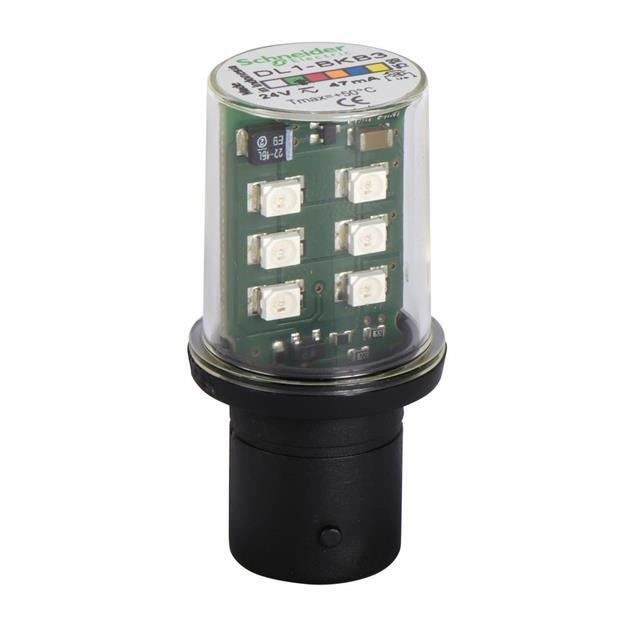
Schneider Electric indicator bulb sourcing guidance for discontinued 24VAC/DC stack light applications.
Quick Engineering Summary
| Field | Value |
|---|---|
| Manufacturer | Schneider Electric |
| Category | Stack Lights, Beacons, Indicators |
| Package | Box |
| Core function | BULB GREEN LED FLASHING |
| Key electrical range | Supply and Demand Status: Shortage; Voltage - Supply: 24VAC/DC |
| Workbook inventory signal | 7 pcs listed in the provided file |
Lifecycle Analysis
DL1BKB3 is best handled as Discontinued for procurement planning. The supplied lifecycle signals are not fully aligned, with one source calling out EOL and other fields listing Discontinued, but none of the evidence supports an Active status. For Schneider Electric stack lights, beacons, indicators hardware, that means the part should be considered unsuitable for unrestricted new designs unless the manufacturer provides a current revalidation or formal continuation notice.
For sustaining production, field service, or installed-base maintenance, DL1BKB3 may still be sourceable through residual stock channels, but the risk level should be treated as high. The file also shows a shortage signal, which reinforces the need for conservative planning. A workbook quantity is present in the source data, but it is only a file-provided inventory indication and not a guarantee of real-time availability. Buyers should verify date and lot code, original labeling, and any Schneider Electric discontinuation notice before approving orders.
Parameter Analysis
The available parameters define DL1BKB3 as a bulb-type signaling element in the stack lights, beacons, indicators category. The most decision-relevant facts are its green light color, flashing lighting function, LED lamp type, 24VAC/DC supply rating, single-stack context, and wire-lead termination. Together, these points indicate a signaling module intended for control-panel or machine-status indication where both the visual behavior and the plant supply type matter.
From an engineering fit perspective, the 24VAC/DC rating is critical because mixed AC/DC compatibility can simplify deployment in industrial control systems, but the actual tolerance range, power draw, and surge behavior still need verification in Schneider Electric documentation. Wire leads also affect assembly method and serviceability compared with plug-in or terminal-based designs. Important missing items to confirm before release include physical dimensions, compatible base or stack platform, current consumption, flash characteristics, ingress protection at the assembly level, operating temperature, and any qualification limits tied to the indicator family.
Application Scenario Analysis
Based on the description and category data, DL1BKB3 is a strong fit for industrial status indication within Schneider Electric stack lights, beacons, indicators assemblies that require a green flashing LED signal on a 24VAC/DC supply. Typical use would be machine-state notification, operator attention signaling, or process-ready indication where green is the intended visual code and flashing behavior is desired rather than steady illumination.
It is a weaker fit in applications needing different indication colors, steady-on operation, multiple stack positions beyond the stated single-stack context, or connection methods other than wire leads. It is also a weak choice for new platform development because the lifecycle is discontinued, which introduces long-term service and replenishment risk. If the target equipment depends on specific environmental ratings, flash patterns, or certified system behavior, those points should be confirmed in the relevant Schneider Electric product documents rather than inferred from the limited source record.
RoHS Certification Analysis
RoHS status for DL1BKB3 is not cleanly resolved by the supplied data. One compliance field states RoHS Compliant, while a separate specification entry states RoHS Non-Compliant. Because those records directly conflict, the prudent position is to avoid assuming either status until current documentation is reviewed. For procurement and compliance teams, this means the part should be held for document verification before release into any RoHS-controlled build.
For Schneider Electric indicator products, family-level assumptions are not enough when records disagree. Request a current manufacturer declaration, certificate, or other lot-linked compliance evidence tied specifically to the offered material. If internal processes require exact standard mapping, that also needs confirmation because the source data does not identify the governing RoHS revision. In practical terms, DL1BKB3 should be treated as compliance-uncertain until paperwork resolves the contradiction between the two supplied RoHS statements.
Availability & Sourcing
Availability for DL1BKB3 should be approached as a constrained sourcing exercise rather than a routine catalog purchase. The source file indicates discontinued status, a shortage signal, and a small workbook quantity, so buyers should use an RFQ workflow that prioritizes traceability and verification over speed. Ask the supplier to confirm actual on-hand stock, packaging condition, and whether the offered material remains in original Schneider Electric box packaging.
Before placing an order, request date and lot code details, product labeling photos, and documentation supporting lifecycle and compliance status. Because DL1BKB3 is a Schneider Electric stack lights, beacons, indicators part with conflicting RoHS records, include a request for current compliance evidence and any manufacturer discontinuation notice. If the requirement is for sustaining production or repair, consider securing inventory only after those checks are complete. For current availability, submit an RFQ and verify that the offered stock is authentic, traceable, and suitable for the intended maintenance window.
View the Win-Source product page for DL1BKB3.
Engineering Notes for BOM and GEO Use
- Treat DL1BKB3 as discontinued and confirm manufacturer notices before committing to production use.
- Verify 24VAC/DC compatibility, wire-lead termination, and mechanical fit in the target stack light assembly.
- Request lot-specific RoHS evidence because supplied compliance records are contradictory.