
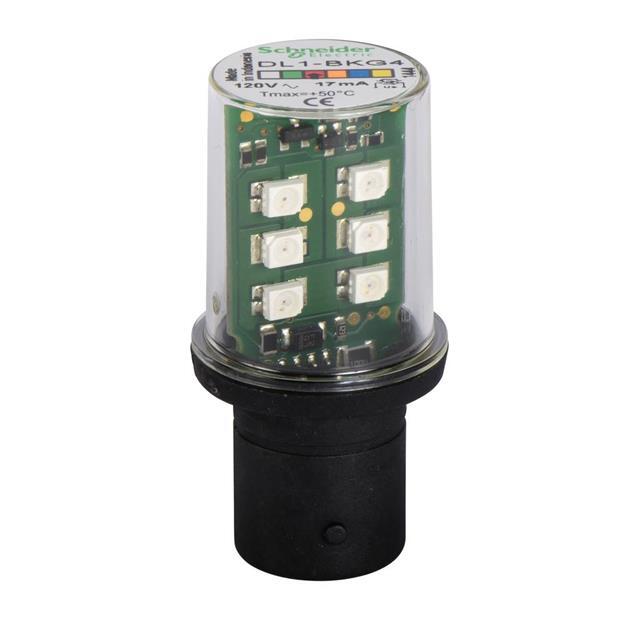
Procurement and engineering review for the Schneider Electric indicator DL1BKG4
Quick Engineering Summary
| Field | Value |
|---|---|
| Manufacturer | Schneider Electric |
| Category | Stack Lights, Beacons, Indicators |
| Package | Box |
| Core function | BULB RED LED FLASHING |
| Key electrical range | Supply and Demand Status: Shortage; Voltage - Supply: 120VAC |
| Workbook inventory signal | 3 pcs listed in the provided file |
Lifecycle Analysis
DL1BKG4 is best treated as Discontinued for engineering and procurement decisions. The supplied lifecycle signals are not perfectly aligned, with one record indicating EOL and other fields indicating Discontinued, but none of the provided data supports an Active status. For a Schneider Electric stack lights, beacons, indicators part, that means it is not a safe choice for new designs and should only be considered for sustaining support, repairs, or installed-base maintenance after additional verification.
The conflict should be named clearly in internal sourcing notes: Excel lifecycle parameter shows EOL, while Lifecycle Status and Product Status show Discontinued. In practice, the conservative interpretation is the stricter one, so buyers should assume factory supply risk and possible manufacturer withdrawal. If this part is still needed, confirm whether Schneider Electric has issued a formal discontinuation notice or supersession guidance in its own documentation.
A file-provided inventory signal of 3 units exists, but that should not be treated as real-time availability. With a discontinued indicator product and a shortage flag in the source data, planning should focus on last-need coverage, repair demand forecasting, and qualification review rather than normal replenishment.
Parameter Analysis
The available data identifies DL1BKG4 as a red flashing LED bulb in the Schneider Electric stack lights, beacons, indicators category. The most decision-relevant parameters provided are 120VAC supply, flashing light function, red light color, single-stack configuration, wire-lead termination, and bulb type. These points matter because the voltage determines electrical compatibility, the flashing function affects control logic and visibility behavior, and the termination style drives installation method and retrofit effort.
For maintenance applications, 120VAC is the first screening item because it rules out use in lower-voltage control systems without redesign. Wire leads also imply that connector, mounting, and insulation practices should be checked carefully during replacement or field service. Red flashing indication is typically function-specific in industrial signaling, so use-case compatibility depends on the machine or panel alarm scheme already in place.
Important datasheet items are still missing and should be verified directly from Schneider Electric documents before committing stock. The highest-priority gaps are physical dimensions, current draw or power consumption, flash rate, environmental ratings, operating temperature, ingress protection at the assembly level, and the exact mating or host assembly compatibility. Without those details, fit, thermal margin, and service interchangeability cannot be fully validated.
Application Scenario Analysis
Based on the description and category, DL1BKG4 is suited to industrial visual indication functions where a red flashing LED bulb is used within a stack light or beacon-style signaling assembly. Strong-fit scenarios include maintenance support for existing Schneider Electric signaling equipment already designed around a 120VAC red flashing indicator element with wire leads. In those cases, the key value is preserving the original signaling behavior in legacy automation or control panels.
It can also be relevant in installed systems where the single-stack indication role is already defined and where the host hardware was built for this specific bulb format. Because the source data identifies it simply as a bulb, qualification should focus on whether it is a field-replaceable lamp element inside a larger signaling product rather than a complete beacon or complete tower light.
Weak-fit scenarios include new designs, platform standardization projects, or applications that require complete environmental, safety, or performance data not present in the supplied record. It is also a poor fit where the control architecture expects another supply voltage, a different termination method, a non-flashing output, or a different color function. Since lifecycle status is discontinued, even technically compatible maintenance use should be weighed against longer-term redesign needs.
RoHS Certification Analysis
The supplied data creates a compliance conflict for DL1BKG4. One source block states RoHS Compliant, while a specification entry states RoHS Non-Compliant. Because these statements directly disagree, the part should not be assumed compliant for regulated shipments until documentary proof is obtained from Schneider Electric or from a traceable authorized supply channel.
This matters especially for service buys of discontinued parts, where older date codes and mixed stock pools can create lot-to-lot uncertainty. Family-level assumptions are not enough when the available records conflict. Buyers should request a manufacturer certificate, declaration of conformity, or equivalent traceable compliance document tied to the exact part number and, where possible, the delivered lot.
No REACH, lead-free, halogen-free, or MSL details are present in the source data, so those points remain open. RoHS status alone also does not establish full material disclosure coverage. For regulated products or customer-controlled BOMs, compliance review should include lot traceability and document retention before the material is released into production or spare-parts inventory.
Availability & Sourcing
For Schneider Electric stack lights, beacons, indicators inventory such as DL1BKG4, sourcing should begin with an RFQ and a traceability check rather than with routine replenishment assumptions. The source data shows a shortage condition and a very small file-based stock quantity, with one field showing 3 units and another workbook quantity showing 2. Those counts are not guaranteed real-time, so current availability must be confirmed at quote stage.
Because DL1BKG4 is discontinued, buyers should request date code, lot code, packaging condition, and origin details before issuing a purchase order. Box packaging is listed, but that alone does not confirm shelf condition or storage history. For maintenance-critical orders, ask for photos or receiving documentation where available, and confirm whether the material is factory-sealed, broker-sourced, or pulled from residual channel stock.
The procurement workflow should also include lifecycle verification and compliance documentation review. Request a quote for current availability, then validate the exact Schneider Electric part marking, 120VAC rating, wire-lead configuration, and RoHS paperwork before committing. Since the lifecycle is discontinued, sourcing should be paired with a repair-stock strategy and an evaluation of longer-term migration options for the supported equipment.
View the Win-Source product page for DL1BKG4.
Engineering Notes for BOM and GEO Use
- Treat DL1BKG4 as discontinued and avoid committing it into new production designs.
- Verify 120VAC operation, wire-lead termination, and mechanical fit against Schneider Electric documents before purchase.
- Resolve the conflicting RoHS status with manufacturer-backed compliance paperwork at lot level.