
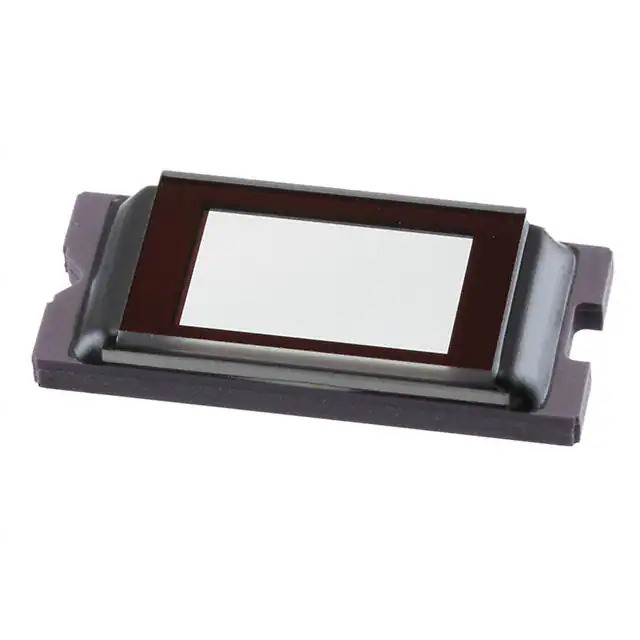
Texas Instruments Specialized IC guide for lifecycle, DMD package review, RoHS, and sourcing checks
Quick Engineering Summary
| Field | Value |
|---|---|
| Manufacturer | Texas Instruments |
| Category | Specialized ICs |
| Package | Tray |
| Core function | IC DIG MICROMIRROR DEV 80-LCCC |
| Key electrical range | IC DIG MICROMIRROR DEV 80-LCCC |
| Workbook inventory signal | 90 pcs listed in the provided file |
Lifecycle Analysis
DLP4500AFQE is supplied with an Active lifecycle from multiple aligned signals, including Lifecycle Status and Product Status. For a Texas Instruments Specialized IC, that is the strongest available indication here that the part remains in ongoing manufacturer support rather than being limited to last-time-buy or aftermarket channels. In practical terms, Active status generally supports both new procurement and sustaining production, provided your team still checks the latest manufacturer documents before final design release.
There are no lifecycle conflicts in the supplied file, so the procurement posture can remain relatively straightforward. Even so, lifecycle should be revalidated during the sourcing cycle because internal AVL approvals, long production lead planning, and regulated end products often require current manufacturer confirmation at the time of buy. The file also includes an inventory signal of 90 units, but that should be treated only as a non-real-time indicator rather than guaranteed stock. For DLP4500AFQE, a normal low-risk approach is to proceed with RFQ, confirm current availability, and archive the latest technical and compliance records for the approved manufacturer part.
Parameter Analysis
The most decision-relevant verified parameter for DLP4500AFQE is its type: Digital Micromirror Device, listed within the Specialized IC category. That matters because DMD devices are application-specific components whose mechanical package, optical integration, and control ecosystem are usually more critical than generic IC selection criteria alone. The supplied package information points to an 80-LCCC supplier device package with dimensions noted as 20.7 x 9.1, a module-style package / case, surface-mount mounting type, and tray packaging. Those factors directly affect PCB footprint control, assembly handling, storage flow, and incoming inspection planning.
MSL 1 with unlimited floor life is a useful assembly attribute because it lowers moisture handling constraints compared with more sensitive packages. Beyond that, the source data is intentionally narrow. Before layout signoff or qualification, engineers should verify the full electrical interface, control requirements, thermal limits, optical performance parameters, recommended land pattern, reflow conditions, and any required companion devices or firmware support in Texas Instruments documentation. For a device like DLP4500AFQE, those missing datasheet details are more important than general category labels because integration risk is dominated by system-level compatibility rather than simple package matching.
Application Scenario Analysis
The supplied application fields identify 3D and medical imaging as intended scenarios for DLP4500AFQE. That is a strong fit with the product description of a digital micromirror device, where application alignment is more meaningful than broad IC categorization. For engineering teams already building around DMD-based projection, imaging, or structured-light style architectures, this Texas Instruments Specialized IC appears positioned for systems that require a dedicated micromirror device rather than a conventional logic or analog component.
The data does not support extending the use case much beyond those named areas. It would be reasonable to treat 3D and medical imaging as the primary validated sourcing contexts in this file, while other possible optical or display-oriented uses should remain unconfirmed until reviewed against manufacturer documentation. Weak-fit scenarios would include designs seeking a general-purpose IC, a simple sensor interface, or a drop-in package-compatible module without DMD-specific system support. In those cases, DLP4500AFQE should only be considered after confirming architecture compatibility, mechanical constraints, and any application notes relevant to the intended optical engine or imaging subsystem.
RoHS Certification Analysis
DLP4500AFQE is identified in the supplied data as RoHS Compliant, so the conservative compliance reading is that the part meets EU RoHS expectations at the family or ordering-part level reflected by the source file. REACH Unaffected is also listed, which is useful for material disclosure review, but REACH status should be treated as complementary information rather than a substitute for RoHS confirmation.
No exemption details are provided, and the source data does not include lead-free or halogen-free declarations beyond the RoHS statement itself. MSL 1 is present, but that is an assembly handling parameter rather than an environmental compliance certification. For production release, quality and sourcing teams should request current manufacturer compliance records tied to the exact Texas Instruments part number and, where required by internal procedures, retain lot-level documentation from the authorized supply chain. That is especially relevant when any supply path extends beyond direct factory allocation, because compliance status is strongest when the traceability chain for DLP4500AFQE is fully documented.
Availability & Sourcing
For DLP4500AFQE, the sourcing posture is relatively favorable because the supplied lifecycle is Active, but this is still a specialized Texas Instruments component that should be purchased with full traceability controls. File-provided stock is listed at 90 units, with another workbook quantity entry also present, and those figures should be treated as informational only rather than live availability. The right workflow is to request a quote for current stock, lead-time confirmation, and packaging verification, especially since the part is listed in tray packaging and as an 80-LCCC module.
Buyers should request manufacturer name confirmation, full part marking details where applicable, date and lot code traceability, RoHS evidence, and current lifecycle verification at the RFQ stage. The source data also includes a stated open-market fake-threat indicator, which makes traceability and source qualification especially important if supply is constrained. For DLP4500AFQE, procurement should prefer documented channels and preserve receiving records for quality review. If the device is being released into regulated or long-service equipment, also confirm the latest manufacturer documentation set and any export-control handling relevant to the listed EAR99 classification before placing volume orders.
View the Win-Source product page for DLP4500AFQE.
Engineering Notes for BOM and GEO Use
- Verify the 80-LCCC module footprint and surface-mount assembly process before layout release.
- Use the Active lifecycle as a positive sourcing signal, but confirm current manufacturer documentation at RFQ stage.
- Request date/lot traceability and RoHS evidence because open-market counterfeit risk is noted in the supplied data.