
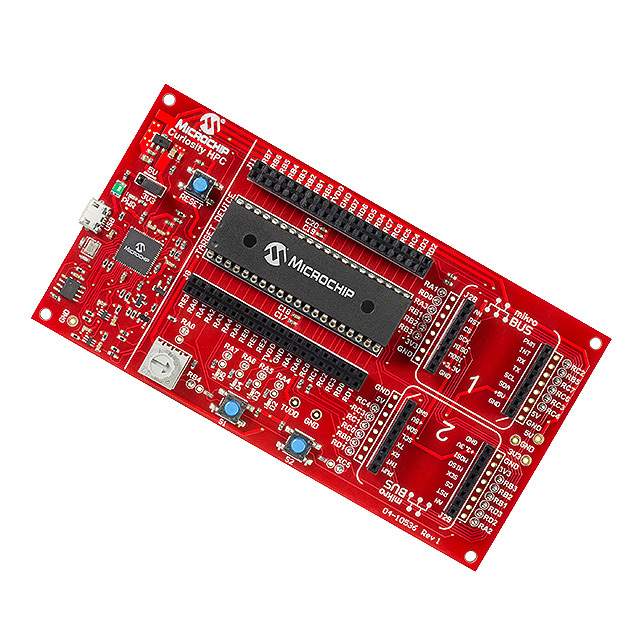
Microchip Technology evaluation board sourcing guide for the DM164136 Curiosity High Pin Count PIC platform.
Quick Engineering Summary
| Field | Value |
|---|---|
| Manufacturer | Microchip Technology |
| Category | Evaluation Boards - Embedded - MCU, DSP |
| Package | Bulk |
| Core function | CURIOSITY HIGH PIN CNT PIC MICRO |
| Key electrical range | Not available in supplied data |
| Workbook inventory signal | 1 pcs listed in the provided file |
Lifecycle Analysis
Microchip Technology DM164136 is listed as Active in all supplied lifecycle signals, and no conflicts are reported. For an evaluation board in the Evaluation Boards - Embedded - MCU, DSP category, Active status generally supports current development activity, lab use, and follow-on procurement for ongoing engineering programs. It is a favorable signal for new evaluation work, but it does not remove the need to confirm the latest board revision, current documentation set, and any manufacturer platform updates before standardizing on it.
For sustaining production support, DM164136 should be treated as a development platform rather than a production BOM semiconductor. That distinction matters because engineering teams may depend on the board for firmware development, test setup, or demonstrations even when the final shipped product uses only the target MCU. The file-provided inventory signal shows stock, but that is not guaranteed real-time availability. Buyers should request current availability, confirm the manufacturer part identity, and revalidate that the Curiosity High Pin Count platform still matches the intended PIC workflow and accessory ecosystem.
Parameter Analysis
The most decision-relevant supplied parameters for DM164136 are its role as an evaluation platform, PIC core processor alignment, Curiosity High Pin Count platform designation, mikroBUS Click interconnect system, socket mounting style, and MPLAB X as the suggested programming environment. Together these indicate a board intended for rapid MCU evaluation and peripheral expansion rather than a custom embedded end node. The mikroBUS Click interface is especially important for lab flexibility because it affects add-on module compatibility and can reduce bring-up time during peripheral experiments.
Several technical details that usually drive board selection are not present in the supplied data and should be verified in the Microchip Technology documentation before purchase. The most important missing items are the exact supported PIC devices, power input options, onboard debugger or programmer capabilities, connector population, clocking resources, I/O exposure, and any analog or communication interfaces already integrated on the board. Mechanical dimensions and schematic availability also matter for fixture design, bench setup, and educational or validation workflows. MSL 1 is supplied, which is low handling risk for storage, but it is less critical here than confirming actual platform functionality.
Application Scenario Analysis
DM164136 is a strong fit for embedded MCU evaluation, firmware bring-up, peripheral prototyping, and training workflows centered on Microchip Technology PIC devices. The Curiosity High Pin Count platform name and the Evaluation Boards - Embedded - MCU, DSP category support its use as a bench development tool where engineers need quick access to a PIC-based environment and possible expansion through mikroBUS Click modules. It also fits procurement scenarios where a team needs standardized development hardware for software teams, validation benches, or university and internal lab programs.
It is a weaker fit for applications that require a production-ready embedded controller, a field-deployable module, or a tightly specified reference design with confirmed environmental and electrical limits in the purchasing record. The supplied data does not provide exact MCU variant coverage, onboard interface details, or performance constraints, so teams should avoid assuming compatibility with a specific end-product architecture until the manufacturer documentation is reviewed. If the project depends on a certain I/O count, communication stack, or debug path, those points should be verified directly from the DM164136 board documents before selection.
RoHS Certification Analysis
The supplied compliance status for DM164136 is RoHS Compliant, so the board can be treated as RoHS compliant at the listing level. The data also states REACH Unaffected, which is useful for broader material compliance screening but should not be treated as a substitute for RoHS. For engineering and procurement teams, this means the current sourcing record supports initial environmental compliance review for the Microchip Technology evaluation board category.
The record does not provide a formal declaration number, exemption statement, or detailed homogeneous material breakdown. For controlled industries or customer flow-down requirements, buyers should request the current manufacturer compliance certificate or distributor-backed compliance evidence tied to the shipped lot. MSL Level 1 is listed and indicates favorable handling robustness from a moisture sensitivity perspective, but MSL is not itself an environmental compliance indicator. If internal policy requires lead-free or other material-specific confirmation beyond RoHS, that documentation will need to be collected separately because it is not explicitly supplied here for DM164136.
Availability & Sourcing
For DM164136, the sourcing workflow should start with an RFQ or quote request that confirms current availability, packaging, and traceability. The supplied package is Bulk, and the file includes a stock quantity signal, but those values are not guaranteed real-time. Because this is a Microchip Technology evaluation board, buyers should verify the exact manufacturer part number, board revision if applicable, and whether accessories, cables, or documentation are included or must be sourced separately. Requesting date and lot information is still worthwhile even for development hardware, especially where lab standardization or regulated documentation is involved.
Active lifecycle status makes DM164136 suitable for current procurement, but the practical sourcing task is to confirm continuity of supply for development schedules rather than assume broad production-channel depth. Ask for RoHS compliance evidence, confirm REACH status if needed, and verify that the supplied unit is genuine and traceable to authorized channels. Open-market caution is appropriate because the file includes a counterfeit-risk indicator. Before committing to program use, request a quote for current availability and confirm that the delivered board matches the intended Curiosity High Pin Count PIC evaluation setup.
View the Win-Source product page for DM164136.
Engineering Notes for BOM and GEO Use
- Confirm the exact PIC Micro MCU support and board revision in current manufacturer documents before toolchain rollout.
- Use workbook stock as a lead only and request date/lot, packaging, and traceability confirmation before ordering.
- RoHS Compliant and REACH Unaffected are supplied, but program-controlled purchases should still obtain current compliance evidence.