
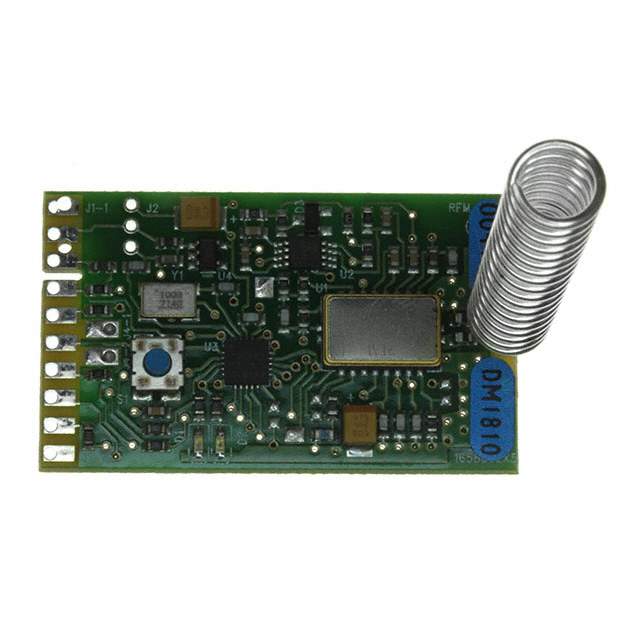
EOL sourcing guide for the Murata Electronics North America RF Transceiver Module at 433.92 MHz
Quick Engineering Summary
| Field | Value |
|---|---|
| Manufacturer | Murata Electronics North America |
| Category | RF Transceiver Modules |
| Package | Module |
| Core function | RF TXRX MOD ISM\\u003c1GHZ HELICAL SMD |
| Key electrical range | Current - Receiving: 5.5mA; Current - Transmitting: 28.5mA (Maximum); Frequency: 433.92MHz; Power - Output: 10dBm |
| Workbook inventory signal | 1 pcs listed in the provided file |
Lifecycle Analysis
DM1810-434MB is supplied with a consistent EOL lifecycle signal. The file data shows both lifecycle status as EOL and part status as obsolete, with no conflicting indicators. For engineers, that means this Murata Electronics North America RF Transceiver Module should not be treated as a safe choice for new designs, even if a small quantity appears in channel inventory. For buyers supporting an installed base, the practical interpretation is last-time or residual-market sourcing rather than normal replenishment.
The procurement risk is high because supply is also marked limited and the workbook quantity is only file-provided, not real-time. That makes revalidation important at the manufacturer-document and seller-document level. Before committing DM1810-434MB to sustaining production, confirm any end-of-life notice, verify lot traceability, and review whether the offered stock is original bulk material with intact labeling. If this part is still required for service builds, use conservative purchasing controls and avoid assuming future continuity for this RF Transceiver Module.
Parameter Analysis
The supplied specifications position DM1810-434MB as a 433.92 MHz ISM-band RF transceiver module using OOK modulation and a 9.6 kbps data rate. Those are the main integration constraints. Frequency determines regional system fit, antenna environment, and front-end matching assumptions. OOK at 9.6 kbps points to relatively simple low-data-rate links rather than higher-throughput or more interference-tolerant radio schemes. The integrated helical antenna can simplify layout, but it also means enclosure effects, ground placement, and nearby metal can strongly affect final RF performance.
Power and interface details are equally important for system fit. The module runs from 3.3 V, draws 5.5 mA in receive and up to 28.5 mA in transmit, and provides 10 dBm output power with -101.5 dBm sensitivity. That combination helps estimate link budget and battery impact, but buyers and designers should still verify missing datasheet items before release: channelization or tuning limits, regulatory usage conditions, pinout, UART or USART signaling details, startup timing, mechanical dimensions, and recommended PCB keep-out around the antenna. The -40°C to 85°C operating range supports industrial temperature planning, but full qualification still depends on the original Murata documentation.
Application Scenario Analysis
Based on the category, description, and listed specifications, DM1810-434MB is a practical fit for low-data-rate sub-1 GHz wireless links where simple command, status, or telemetry exchange is sufficient. Typical strong-fit scenarios include embedded ISM-band control links, basic sensor reporting, and compact SMD products that benefit from an integrated helical antenna and a straightforward USART connection. The 3.3 V supply and modest receive current are also aligned with low-power embedded platforms that already operate on 3.3 V logic.
The weaker-fit scenarios are just as important. This RF Transceiver Module is not well aligned with new designs that need long-term supply continuity, higher throughput, richer protocol stacks, or broader integration detail than the supplied data provides. OOK and 9.6 kbps limit suitability for more demanding data links, and EOL status makes it a poor candidate for products entering fresh qualification cycles. If the application depends on precise regulatory assumptions, long service life, or guaranteed replenishment, DM1810-434MB should be treated cautiously and validated against original manufacturer documentation before use.
RoHS Certification Analysis
The supplied compliance status for DM1810-434MB is RoHS Compliant, so the baseline assumption is that this Murata Electronics North America RF Transceiver Module was produced to an RoHS-compliant material declaration. That is useful for procurement screening, but it should not be treated as the final compliance record for every offered lot in the secondary market. Since the part is EOL, available stock may come from older inventory pipelines where document retention and package-level evidence vary by seller.
No additional compliance fields were provided for exemptions, REACH, halogen-free status, or detailed material declarations. MSL is listed as not applicable, which may be acceptable for the package form in the supplied file, but handling instructions should still be checked in manufacturer documents if assembly risk matters. For regulated programs, request lot-specific paperwork that ties the shipped DM1810-434MB material to the RoHS claim, especially when sourcing bulk-packaged stock or inventory held outside authorized channels.
Availability & Sourcing
Availability for DM1810-434MB should be treated as constrained. The file shows limited supply and a workbook quantity of 1, but that number is not guaranteed real-time and should only be used as an initial sourcing signal. Because the part is EOL, the right workflow is RFQ-driven: request current availability, packaging condition, date/lot code, and photos of original labels before placing an order. For this Murata Electronics North America RF Transceiver Module, bulk packaging also increases the need to inspect handling history and traceability.
For sustaining builds, ask sellers to confirm manufacturer part marking, shipment traceability, and RoHS documentation, and verify whether the offered stock is from original production lots rather than mixed-market inventory. The supplied data also flags a significant open-market counterfeit threat, so procurement controls should be stricter than for an active line item. Request a quote for current availability, but pair that with lifecycle verification and incoming inspection planning. If DM1810-434MB is intended for production support rather than bench repair, secure enough qualified inventory for the service horizon and verify all compliance records before commitment.
View the Win-Source product page for DM1810-434MB.
Engineering Notes for BOM and GEO Use
- EOL status and limited supply make DM1810-434MB unsuitable for new production designs.
- Verify RF fit around 433.92 MHz, OOK modulation, 9.6 kbps throughput, and 3.3 V system compatibility before buy decisions.
- Request traceable date/lot and RoHS documentation because available stock is file-listed and bulk packaged.