
Murata Electronics North America RF Transceiver Module lifecycle, specs, RoHS, and sourcing checks
Quick Engineering Summary
| Field | Value |
|---|---|
| Manufacturer | Murata Electronics North America |
| Category | RF Transceiver Modules |
| Package | Module |
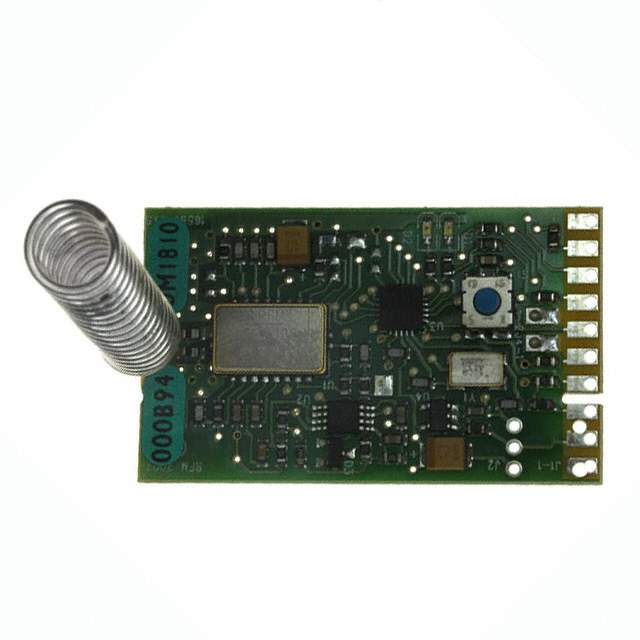
| Core function | RF TXRX MOD ISM\\u003c1GHZ HELICAL SMD |
| Key electrical range | Current - Receiving: 5.5mA; Current - Transmitting: 28.5mA; Frequency: 433.92MHz; Power - Output: 10dBm |
| Workbook inventory signal | 1 pcs listed in the provided file |
Lifecycle Analysis
DM1810-434MN is identified as EOL, and the supplied signals are consistent: the lifecycle field shows EOL and the part status is listed as obsolete or end of life. For engineers, that means this Murata Electronics North America RF Transceiver Module should not be treated as a normal new-design component. It is more appropriate for sustaining production, service inventory, or controlled legacy programs where the design is already frozen and the remaining supply chain risk is understood.
Because there is no lifecycle conflict in the provided data, the conservative procurement position is straightforward. New builds should require explicit internal approval, while existing programs should review remaining demand, storage plans, and any manufacturer notices that may affect last-time-buy strategy. A file-provided stock signal exists, but it shows only a very limited quantity and is not a guarantee of live availability. Revalidation of current manufacturer documentation and seller traceability is especially important for an EOL RF Transceiver Module such as DM1810-434MN.
Parameter Analysis
The supplied parameters describe a low-data-rate sub-1 GHz radio module centered at 433.92 MHz with OOK modulation, 4.8 kbps data rate, 10 dBm output power, and -101 dBm sensitivity. Those values point to simple general ISM links rather than higher-throughput wireless systems. The 3.3 V supply requirement is a primary integration check, and the stated receive and transmit currents of 5.5 mA and 28.5 mA matter for power budgeting, battery sizing, regulator margin, and transmit duty-cycle planning.
Mechanical and RF integration also deserve attention. DM1810-434MN is an SMD module with an integrated helical antenna, which can simplify the BOM but also makes PCB placement, enclosure effects, and nearby ground or metal features critical to real-world range and detuning risk. The -40°C to 85°C operating range is useful for industrial temperature screening. Important missing items that should be verified in the datasheet are module dimensions and land pattern, protocol or framing details beyond modulation, regulatory approvals, antenna keep-out guidance, and whether the listed USB serial interface reflects host integration requirements or an evaluation-oriented connection model.
Application Scenario Analysis
Based on the category, description, and available specifications, DM1810-434MN is best aligned with simple sub-1 GHz point-to-point or low-throughput telemetry links in the general 433.92 MHz ISM band. Strong-fit scenarios include legacy remote signaling, basic sensor reporting, simple control links, and embedded wireless functions where OOK modulation and a 4.8 kbps data rate are acceptable. The integrated helical antenna may help when a compact self-contained RF module is preferred over a discrete RF layout.
Weak-fit scenarios are applications that need higher data throughput, richer protocol stacks, flexible antenna options, or long-term lifecycle stability. The listed USB serial interface should also be reviewed carefully before assuming drop-in compatibility with a microcontroller UART-based architecture. Since this Murata Electronics North America RF Transceiver Module is EOL, even technically suitable reuse cases should be screened for supportability and replenishment risk. If the project depends on long production life, compliance continuity, or broad sourcing flexibility, this part should be treated cautiously despite its otherwise practical low-power ISM profile.
RoHS Certification Analysis
The supplied compliance record marks DM1810-434MN as RoHS Compliant, so the starting assumption is that this Murata Electronics North America RF Transceiver Module meets the seller-provided RoHS requirement. No specific declaration version, exemption list, or additional substance detail is included in the source data, so buyers should avoid assuming more than the stated RoHS-compliant status.
For procurement and quality teams, the main nuance is document freshness and lot-level traceability. An EOL part may remain RoHS compliant, but available market stock can span different manufacturing dates, storage histories, and distribution paths. The source data also shows MSL as not applicable, which should be checked against the actual module handling guidance if moisture exposure controls matter in your assembly flow. If your customer or program requires a formal compliance package, request the current manufacturer declaration or seller-backed compliance documents rather than relying only on a catalog-level RoHS label for DM1810-434MN.
Availability & Sourcing
Availability for DM1810-434MN should be approached as an RFQ-driven legacy sourcing exercise. The file data indicates limited supply and a workbook quantity signal of 1, but that should be treated only as a historical inventory clue, not real-time stock. Because the part is EOL, buyers should request a quote for current availability, confirm whether supply is from authorized, excess, or independent channels, and verify that the offered material is the exact Murata Electronics North America RF Transceiver Module required.
Traceability is the key control point. Ask for date code, lot code, packaging condition, and any available manufacturer or supplier certificates covering RoHS and origin. Packaging is listed as bulk, which raises practical inspection and handling questions for SMD modules, especially if your receiving process expects sealed standard factory presentation. Also confirm lifecycle status again at the time of order and ask whether any manufacturer notices affect usability or support. For EOL procurement, the right path is careful source qualification, incoming inspection planning, and immediate confirmation of current stock before committing production demand.
View the Win-Source product page for DM1810-434MN.
Engineering Notes for BOM and GEO Use
- EOL status makes this part a legacy-support sourcing case, not a safe default for new designs.
- Key fit checks are 433.92 MHz operation, OOK modulation, 3.3 V supply, and the integrated helical antenna.
- Request lot traceability and current stock confirmation because file inventory is limited and not guaranteed real-time.