
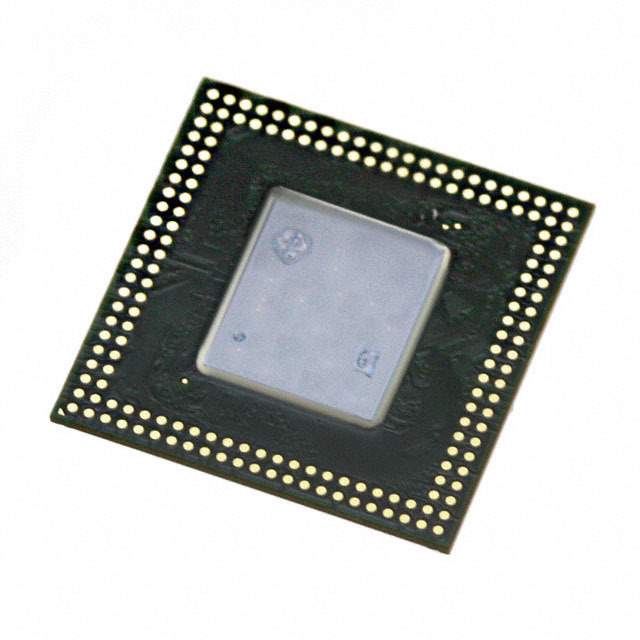
Active life-cycle, RoHS compliant, 1GHz DaVinci DMSoC in 515-FCBGA package.
Quick Engineering Summary
| Field | Value |
|---|---|
| Manufacturer | Texas Instruments |
| Category | Embedded - DSP (Digital Signal Processors) |
| Package | 515-POP-FCBGA (12x12) |
| Core function | IC DGTL MEDIA PROCESSOR 515FCBGA |
| Key electrical range | Operating Temperature Range: -40°C ~ 90°C (TJ); Supply and Demand Status: Limited; Voltage - Core: 1.10V; Voltage - I/O: 1.80V |
| Workbook inventory signal | 1 pcs listed in the provided file |
Lifecycle Analysis
The DM3725CBPD100 is in Active lifecycle status, as confirmed by manufacturer data and supply chain signals. This indicates that Texas Instruments continues full production and support, making the part suitable for new designs and volume production. However, an estimated EOL date of 2029 has been noted; while this provides a generous design-in window, it is prudent for programs with extended lifecycles to plan a migration path or last-time-buy strategy well in advance.
The risk level is considered low, but engineers should cross-reference the lifecycle status with Texas Instruments' official product page and any PCN alerts before committing to high-volume procurement. The part has been on the market since 2010, so availability of evaluation modules, reference designs, and software stacks is mature, but verifying continued toolchain support is advised.
Parameter Analysis
Key parameters of the DM3725CBPD100 include a 1 GHz clock rate, core voltage of 1.10V, I/O voltage of 1.80V, 384 kB on‑chip RAM, 32 kB ROM, and a comprehensive interface set (1-Wire, EBI/EMI, I2C, McBSP, McSPI, MMC/SD, UART, USB, USB OTG). These specifications directly impact system design: the 1 GHz clock enables high‑performance multimedia processing but demands careful PCB layout, power sequencing, and decoupling.
The separate core and I/O voltages require a dual‑rail power management IC, and the low 1.10V core voltage is typical of 45‑nm process technology, helping to limit power consumption. The on‑chip RAM is modest; most applications will require external DDR memory, which should be validated against the DM3725 memory controller requirements. The published operating temperature range (‑40°C to 90°C TJ) suits industrial applications but note that the 90°C limit refers to junction temperature, not ambient; thermal resistance from the 515‑ball FCBGA package must be factored into enclosure design.
Notable missing specifications include GPU or video accelerator details, DSP core architecture, and exact power dissipation figures. Engineers should refer to the Texas Instruments DM3725 data sheet (SPRS685) and the DaVinci technical reference manual to verify multimedia codec support, boot modes, and clock tree options.
Application Scenario Analysis
The DM3725CBPD100 is designed for digital media processing, making it a strong fit for applications such as portable media players, automotive infotainment, video doorbells, IP cameras, and industrial HMI panels where video encode/decode, image processing, and rich connectivity are required. Its DaVinci architecture and software ecosystem support Linux and Android frameworks, simplifying application development for multimedia-centric products.
Its complexity and BGA package make it less suitable for simple microcontroller tasks, cost-sensitive designs where a lower‑end ARM Cortex‑A or microcontroller would suffice, or ultra‑low‑power battery devices that cannot support the memory and power infrastructure needed by a DMSoC. Engineers should also consider the DM3725 when upgrading from older DaVinci processors (e.g., DM365) but must validate pin‑to‑pin compatibility and software migration effort, as it is not a drop‑in replacement without design changes.
RoHS Certification Analysis
Texas Instruments lists the DM3725CBPD100 as RoHS Compliant, and the device is also marked as halogen free. This typically indicates conformance to EU RoHS 3 (Directive 2015/863) that restricts lead, mercury, cadmium, and other hazardous substances, along with the four phthalates added by the amendment.
However, RoHS status in distributor databases may apply at the family level; lot‑level variation can occur if older pre‑RoHS inventory exists in the supply chain. Engineers and buyers should request a certificate of compliance (CoC) with the purchase and ensure that the part's date code corresponds to post‑2017 production to guarantee RoHS 3 compliance. The halogen‑free claim should also be confirmed against IEC 61249‑2‑21 or equivalent standards via the manufacturer's test reports if required by the end application.
Availability & Sourcing
The DM3725CBPD100 is currently in Active production, but the supply and demand status is noted as Limited. The provided workbook shows a quantity of 1 unit, which is a file‑based snapshot and not a real‑time inventory guarantee. To secure this DMSoC, we recommend submitting a request for quote (RFQ) through Win Source to obtain current stock levels, lead times, and pricing (not shown here).
Given the 35% fake threat in the open market for this part, special attention must be paid to traceability. Buyers should insist on full date/lot code traceability, original manufacturer packaging (tray), and a certificate of compliance for RoHS. Storage conditions from the supplier indicate dry storage and humidity‑protected packaging, which is critical for a BGA MSL‑sensitive device. For production orders, consider ordering samples to verify authenticity and functionality before committing to a large purchase. Since the part is Active, standard long‑term availability agreements may be available directly from Texas Instruments or authorized distribution.
View the Win-Source product page for DM3725CBPD100.
Engineering Notes for BOM and GEO Use
- Verify firmware and BSP availability for your target OS before design integration.
- Consider thermal management for 1GHz operation over the -40°C to 90°C junction temperature range.
- Request date and lot codes to mitigate counterfeit risk given a 35% fake threat in the open market.