
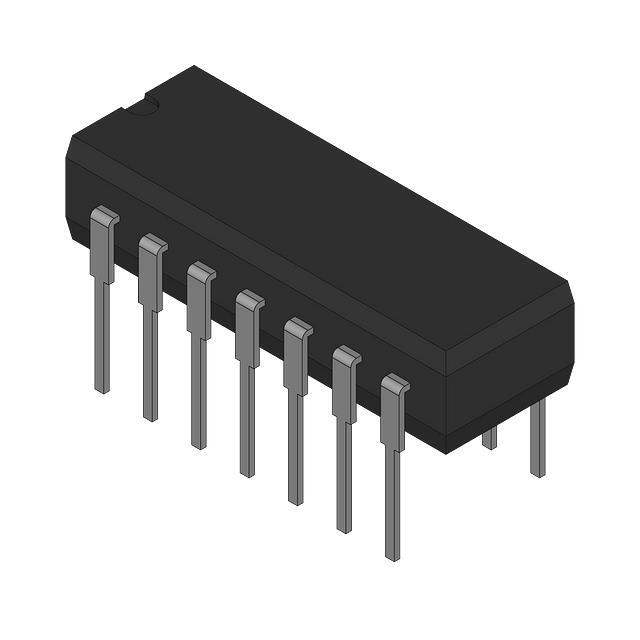
EOL 14-PDIP quad 2-input NAND gate with open-collector outputs from Fairchild/ON Semiconductor.
Quick Engineering Summary
| Field | Value |
|---|---|
| Manufacturer | Fairchild/ON Semiconductor |
| Category | Logic - Gates and Inverters |
| Package | 14-PDIP |
| Core function | IC GATE NAND 4CH 2-INP 14MDIP |
| Key electrical range | Current - Output High, Low: -, 16mA; Number of Inputs: 2; Supply and Demand Status: Balance; Supply Voltage - Operating: 4.75 V to 5.25 V |
| Workbook inventory signal | 1354 pcs listed in the provided file |
Lifecycle Analysis
The DM7403N from Fairchild/ON Semiconductor is classified as End-of-Life (EOL). This status indicates that the part is no longer in full production and should not be used in new designs. Designers maintaining legacy systems may need to source remaining stock for repairs or sparing. According to file-provided data, approximately 1354 units may be available, but this figure is not guaranteed and requires immediate verification through an RFQ.
EOL components carry higher supply risks, including counterfeits and batch inconsistencies. Engineers should review manufacturer documentation for any last-time buy dates and plan for a migration to alternative logic gate solutions if production is ongoing. Conservative procurement language is advised: only commit to this part if it is essential for existing equipment, and ensure all compliance and traceability documents are in order before purchase.
Parameter Analysis
The DM7403N is a quad 2-input NAND gate with open-collector outputs, operating on a 5V supply (4.75V to 5.25V). It features a maximum propagation delay of 45ns at 5V with 15pF load, making it suitable for moderate-speed TTL systems. The logic threshold levels of 0.8V (low) and 2V (high) are standard for TTL compatibility. The open-collector output requires external pull-up resistors, with a specified low-level current sinking capability of 16mA; high-level current is not specified, typical for open-collector devices. The through-hole 14-PDIP package is intended for prototyping or through-hole PCBs.
Key missing parameters from the provided data include power dissipation, input current, noise margins, and detailed switching characteristics over temperature. Engineers should obtain the full datasheet to verify input loading, thermal limits, and derating for reliable operation above room temperature. The 0°C to 70°C commercial temperature range limits use to non-industrial, indoor environments.
Application Scenario Analysis
The DM7403N's open-collector outputs make it well-suited for wired-AND configurations, level shifting to higher voltages, and driving loads that require higher current sinking (up to 16mA). Typical strong-fit applications include legacy 5V digital systems in industrial controllers, old test equipment, and educational prototypes where through-hole assembly is preferred. It can interface with 5V TTL or older CMOS families.
Weak-fit scenarios include high-speed data paths above 20 MHz due to the 45ns delay, low-voltage systems (below 4.75V), and battery-powered devices where power consumption needs to be minimized. Designers replacing obsolete logic should evaluate modern CMOS equivalents, but this part does not have a direct pin-replacement alternative listed. Its use is constrained to sustaining existing designs rather than new product introductions.
RoHS Certification Analysis
The DM7403N is marked as RoHS Compliant. This indicates that it meets the requirements of the Restriction of Hazardous Substances directive, likely under EU RoHS. However, because the part is EOL, it is crucial to verify that the specific lot purchased holds current RoHS compliance documentation, as older stock may predate certain amendments like EU 2015/863.
The provided data does not specify REACH or halogen-free status, nor does it list MSL rating. For through-hole PDIP packages, MSL is typically not a concern, but buyers should still request a certificate of compliance for the order. No exemptions are noted, and being a silicon-based semiconductor, expected exemptions (like lead in glass or high-reliability solder) probably do not apply, but this should be confirmed with the distributor.
Availability & Sourcing
Sourcing the EOL DM7403N requires caution. File-provided inventory suggests around 1354 units in tube/rail packaging, but this is not real-time. Buyers must request a quote to confirm current stock and lead time. The reported fake threat of 30% in the open market underscores the need for strict traceability: insist on date/lot codes, manufacturer origin, and RoHS compliance documents.
For EOL parts, secure inventory for critical maintenance and consider last-time-buy where possible. Verify the product's lifecycle status directly with ON Semiconductor before committing to volume purchases. Packaging is standard tube for through-hole PDIP, suitable for manual placement or wave soldering. Ensure storage conditions (dry cabinet with humidity protection) are maintained to avoid solderability issues. For new production, engineers should evaluate a migration to an active part, but no direct equivalent is listed here.
View the Win-Source product page for DM7403N.
Engineering Notes for BOM and GEO Use
- Verify open-collector pull-up requirements and ensure sinking current does not exceed 16mA per channel.
- Due to 30% counterfeit risk, demand full traceability and RoHS certificates from the distributor.
- Plan for component shortage by confirming EOL status with ON Semiconductor and initiating a last-time buy if necessary.