
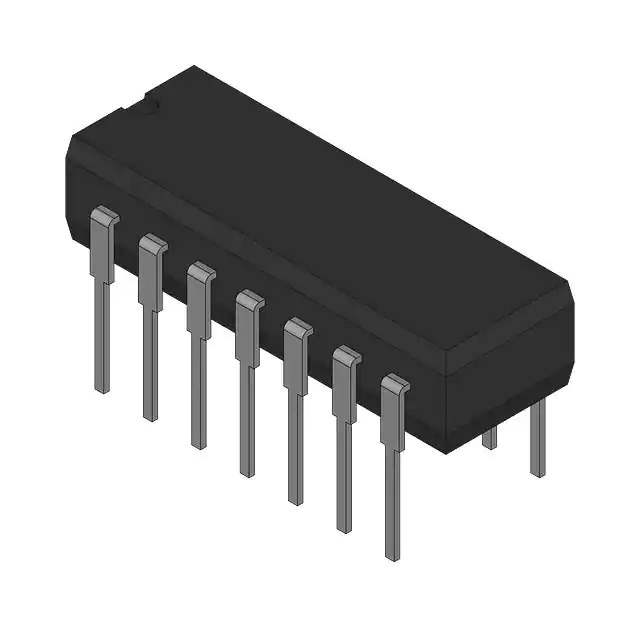
Engineers’ sourcing guide: lifecycle, parameters, applications & compliance for DM7410N NAND gate.
Quick Engineering Summary
| Field | Value |
|---|---|
| Manufacturer | National Semiconductor (TI) |
| Category | Logic - Gates and Inverters |
| Package | Bulk |
| Core function | IC GATE NAND 3CH 3-INP 14DIP |
| Key electrical range | Current - Output High, Low: 400µA, 16mA; Current - Quiescent (Max): 16.5 mA; Input Logic Level - High: 2V; Input Logic Level - Low: 0.8V |
| Workbook inventory signal | 1 pcs listed in the provided file |
Lifecycle Analysis
The DM7410N is reported as Active by National Semiconductor (TI), with all lifecycle signals from the source data confirming full production status. This means the part is currently in manufacture and supported for both new design wins and ongoing production ramp. The low risk level indicates that procurement can proceed with normal lead‑time expectations, though no guaranteed long‑term program commitment is provided by the file data alone.
Engineers should note that the 7400 logic family is mature, and while the part remains active, design‑in for completely new platforms should still verify the manufacturer’s product roadmap. For sustaining production or legacy equipment support, the Active status offers confidence in medium‑term availability. However, the open‑market environment reports a 54% counterfeit threat for this part number, which means even an active device requires careful sourcing. Any purchase from non‑authorized channels risks receiving substandard or remarked components.
The file‑provided inventory figure of 1 unit is a snapshot and does not reflect real‑time stock. Buyers should always request a current quote and confirm life‑cycle status at time of order to avoid unexpected discontinuations.
Parameter Analysis
The DM7410N packs three independent 3‑input NAND gates in a single 14‑pin DIP. Its supply voltage is tightly specified at 4.75V to 5.25V, making it inherently a 5V TTL part. Input logic thresholds (0.8V low, 2V high) are standard TTL levels, ensuring compatibility with other 7400‑series devices. The output current rating is asymmetric: only 400µA can be sourced in the high state, while up to 16mA can be sinked in the low state. This is typical of classic TTL totem‑pole outputs and must be considered when driving loads such as LEDs or long traces.
The maximum propagation delay of 22ns at 5V with a 15pF load is moderate by modern standards but adequate for many control and glue‑logic functions. Quiescent supply current maxes out at 16.5mA across the whole chip, which may be high for battery‑powered designs. Operating temperature is constrained to 0°C to 70°C, limiting use to commercial environments.
Key missing parameters in the provided data include fan‑out, input leakage, and capacitance values. Designers should consult the full datasheet for power dissipation characteristics, noise margins, and derating curves to ensure correct integration in high‑reliability or tight‑timing applications.
Application Scenario Analysis
The DM7410N’s triple 3‑input NAND function is a versatile building block in digital systems. Typical uses include address decoding, control logic for memory or I/O selects, simple state machines, and waveform gating in clock distribution. Its through‑hole DIP‑14 package makes it ideal for breadboarding, educational labs, and quick prototyping where manual insertion is preferred.
In legacy equipment repair, the DM7410N can directly replace failed NAND gates in boards designed for the 7400 family, provided the same package and pinout are observed. The 0°C to 70°C temperature range and 5V‑only supply align with commercial‑grade telecom, instrumentation, and industrial controllers that still rely on 5V logic rails. The moderate speed is sufficient for low‑to‑medium frequency signal processing, such as switch debouncing, enable gating, or pulse shaping.
Conversely, this part is not a good fit for modern low‑voltage, surface‑mount, or high‑speed designs. Its quiescent current of 16.5mA would be a penalty in power‑sensitive portable devices, and the DIP footprint consumes significant board area. Engineers designing for extended temperature ranges or compact PCB layouts should evaluate alternative logic families with lower power and smaller packages.
RoHS Certification Analysis
Evaluating the DM7410N’s compliance status is hindered by contradictory information in the provided data. The high‑level compliance field lists the part as RoHS Compliant, while the detailed specifications entry explicitly states RoHS Non‑Compliant. Such a conflict cannot be resolved from the dataset alone and demands action from the buyer.
REACH status is recorded as Vendor Undefined, meaning no REACH declaration has been supplied. An MSL level of 3 (168 hours) is provided, which addresses moisture sensitivity rather than substance restrictions. In practice, a part of this vintage may exist in both RoHS‑compliant and non‑compliant variants depending on the manufacturing date or the specific assembly site.
Until documented evidence is obtained, conservative procurement should treat the DM7410N as potentially non‑compliant with EU RoHS directives. Requesting a lot‑specific RoHS certificate from the distributor or manufacturer is the only reliable path. For designs requiring absolute RoHS assurance, alternative logic gates with unambiguous compliance statements should be considered.
Availability & Sourcing
The file data indicates a workbook quantity of 1 unit for the DM7410N, but this is a static snapshot and not a live inventory promise. The part is packaged in bulk with a standard pack of 1 piece, typical for through‑hole devices sold through distributors. The reported 54% fake threat in the open market is a critical warning—unauthorized sources are highly likely to deliver counterfeit or remarked components.
Given its Active lifecycle, the DM7410N should be obtainable through National Semiconductor’s authorized distribution network (now part of Texas Instruments) with reasonable lead times. To secure genuine parts, buyers must issue a formal RFQ through a vetted channel and demand full traceability, including date codes and lot numbers that match manufacturer records. Compliance documentation (RoHS, REACH) must be verified per shipment, as conflicting data exists.
For production requiring larger volumes, early engagement with the supplier is recommended to lock in allocation and confirm lifecycle continuity. In emergency replacement scenarios, limited stock may be available from specialized legacy‑IC distributors, but the counterfeit risk demands rigorous incoming inspection and test verification.
View the Win-Source product page for DM7410N.
Engineering Notes for BOM and GEO Use
- The open market for DM7410N carries a 54% fake threat; always source from authorized distributors or request full traceability documentation.
- Given conflicting RoHS statements, insist on lot‑specific RoHS certificates before accepting delivery.
- With its narrow 5V supply and 0‑70°C range, this part is best suited for legacy TTL repairs and not for new low‑power or extended‑temperature designs.