
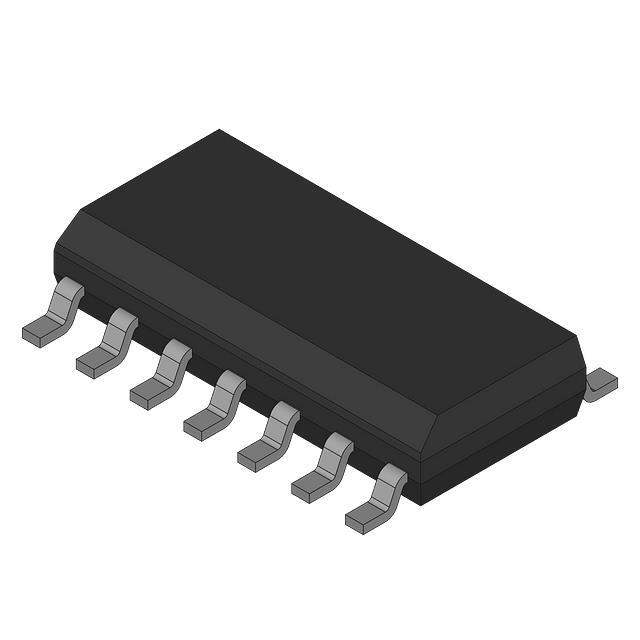
Quad 2-Input AND Gate, 14-SOP Package, Obsolete (EOL), RoHS Compliant
Quick Engineering Summary
| Field | Value |
|---|---|
| Manufacturer | Fairchild/ON Semiconductor |
| Category | Logic - Gates and Inverters |
| Package | 14-SOP |
| Core function | IC GATE AND 4CH 2-INP 14SOP |
| Key electrical range | Current - Output High, Low: 400μA, 8mA; Number of Inputs: 2; Supply and Demand Status: Balance; Supply Voltage - Operating: 4.5 V to 5.5 V |
| Workbook inventory signal | 1 pcs listed in the provided file |
Lifecycle Analysis
All lifecycle signals for DM74ALS08SJ from Fairchild/ON Semiconductor confirm an EOL (End-of-Life) classification, with both primary lifecycle status and supplementary indicators marked as obsolete and production discontinued. There is no supplier conflict to resolve, meaning the device is no longer manufactured and should not be used in new designs. For existing production, this status introduces high procurement risk, potentially forcing a last-time buy or redesign. Any remaining file-listed inventory of 1 unit is not guaranteed real-time, so engineers and buyers must immediately verify current availability with authorized distributors and evaluate functionally equivalent alternatives or a migration path.
The EOL status also requires that production plans be updated to avoid single-source dependency on remaining gray-market stock. Maintenance contracts for legacy equipment should factor in the need for board spins or daughtercard replacements if DM74ALS08SJ cannot be sourced reliably. Component engineers should archive the manufacturer’s EOL notice and related product change notifications to document the obsolescence decision for future compliance audits.
Parameter Analysis
DM74ALS08SJ operates from a 4.5 V to 5.5 V supply, standard for ALS (Advanced Low-power Schottky) TTL logic, and delivers a typical propagation delay of 14 ns when driving a 50 pF load at 5 V. The output drive characteristics—sourcing only 400 μA in the high state but sinking 8 mA low—reflect classic TTL output asymmetry, so external pull‑up resistors may be needed for CMOS interfaces. Logic input thresholds of 2.0 V (high) and 0.8 V (low) provide standard TTL noise margins.
Key missing specifications include supply current (ICC), which is critical for power budgeting, and input leakage current, which affects pull‑up/pull‑down resistor sizing. The datasheet should also be consulted for maximum ratings, ESD classification, and thermal resistance values. Without these, engineers cannot fully assess reliability or thermal margins. The commercial temperature range of 0 °C to 70 °C limits use to indoor, non‑automotive applications.
Application Scenario Analysis
The DM74ALS08SJ contains four independent 2‑input AND gates, making it a classic glue‑logic component for digital systems operating at 5 V. It fits well in legacy industrial control, instrumentation, and communication boards that still rely on 74ALS TTL logic levels. The 14‑SOP SMD package is well‑suited for automated assembly, and the 14 ns propagation delay supports moderate clock speeds up to approximately 30 MHz.
However, due to its EOL status and limited commercial temperature range, the part is unsuitable for new designs, especially those requiring extended temperature operation or lower‑voltage I/O. Engineers maintaining existing equipment should verify that logic high drive (400 μA) is adequate for all loads and may need to add buffer stages when driving multiple high‑capacitance lines. The part is also a poor fit for low‑power or battery‑powered applications because of its 5 V TTL architecture and lack of power‑saving features.
RoHS Certification Analysis
The part is listed as RoHS Compliant, indicating that it meets the European Union’s Restriction of Hazardous Substances directive. While the specific RoHS standard version is not explicitly supplied, current compliance typically aligns with RoHS 3 (EU 2015/863). It is important to request a Certificate of Compliance (CoC) for the exact date/lot code when procuring any remaining stock, because RoHS declarations at the part family level can sometimes overlook production changes or older non‑compliant wafers.
Additionally, the high counterfeit threat (41% in open markets) underscores the need for careful material analysis to confirm that supplied components genuinely meet lead‑free and hazardous substance restrictions. X‑ray fluorescence or destructive analysis may be warranted for critical applications. No REACH or MSL data is provided, so those details must be obtained from the manufacturer to ensure full environmental compliance before shipment into the EU market.
Availability & Sourcing
DM74ALS08SJ is an obsolete component, so sourcing requires immediate attention. File‑provided data shows a nominal quantity of 1 unit in tube packaging, but this figure is not a live inventory promise. Buyers should initiate a formal RFQ through authorized channels to confirm real‑time stock and secure delivery. Full traceability documentation, including date and lot codes, is essential to verify authenticity given the 41% counterfeit risk flagged in the open market.
Because no alternate part numbers are suggested, engineers must either perform a direct parametric comparison for another 74ALS logic gate or migrate to a more modern 74LVC or 74AHC series with voltage translation if the system allows. In all cases, request a manufacturer’s EOL notice and last‑time buy documentation from the supplier to validate the component’s chain of custody. For industrial or medical applications, compliance certificates such as CoC and RoHS should be obtained before acceptance.
View the Win-Source product page for DM74ALS08SJ.
Engineering Notes for BOM and GEO Use
- DM74ALS08SJ is a quad 2-input AND gate in 14-SOP; EOL status demands immediate inventory verification for existing designs and mandates redesign for new applications.
- Key parametric verification: confirm supply voltage (4.5V-5.5V), propagation delay (14ns at 5V, 50pF), and output drive (8mA low, 400μA high) against system margins.
- With a high counterfeit threat (41% open market) and minimal available stock, require rigorous component authentication and full traceability documentation.