
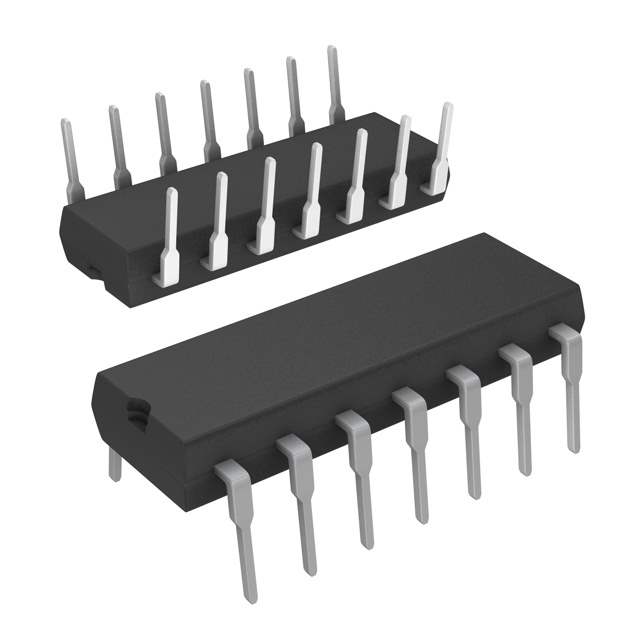
DM74ALS14N: Hex Schmitt-Trigger Inverter (EOL) – Sourcing Guide for Engineers
Quick Engineering Summary
| Field | Value |
|---|---|
| Manufacturer | Fairchild/ON Semiconductor |
| Category | Logic - Gates and Inverters |
| Package | 14-PDIP |
| Core function | IC INVERT SCHMITT 6CH 1IN 14MDIP |
| Key electrical range | Current - Output High, Low: 400μA, 8mA; Number of Inputs: 6; Supply and Demand Status: Limited; Supply Voltage - Operating: 4.5 V to 5.5 V |
| Workbook inventory signal | 464 pcs listed in the provided file |
Lifecycle Analysis
DM74ALS14N is classified as end-of-life (EOL) based on the specification field indicating 'Obsolete(EOL)', although the primary lifecycle status in the data is Unknown. This conflict demands a conservative procurement stance. EOL means the part is no longer recommended for new designs, and sustaining production may require last-time buys or alternative sourcing.
For engineers considering DM74ALS14N in new projects, migration to a newer, active equivalent is strongly advised. If the part is already in existing production, verifying remaining stock and negotiating a last-time purchase with ON Semiconductor is critical. The file-provided quantity of 464 units (not real-time) suggests limited residual stock but should not be relied upon without a current quote.
Supply and demand status is listed as limited, further underscoring the high risk. Always request updated lifecycle confirmation and end-of-life notice directly from the manufacturer before committing to procurement.
Parameter Analysis
DM74ALS14N implements six independent inverters with Schmitt trigger inputs in a through-hole 14-PDIP package. Key parameters include: logic type – inverter with Schmitt trigger, supply voltage 4.5V–5.5V, propagation delay of 12ns maximum at 5V and 50pF load, and output current ratings of 400µA high/8mA low. Schmitt trigger hysteresis improves noise immunity, with typical threshold levels of 1.85V–2V for logic high and 0.75V–0.85V for logic low.
The 4.5V–5.5V supply range pins DM74ALS14N to legacy 5V systems. The 12ns propagation delay is moderate for 74ALS logic, suitable for low- to mid-speed applications. Output drive capacity (8mA low) is sufficient for driving standard TTL loads but may require buffering for heavier loads. The 0°C–70°C operating temperature range limits the device to commercial environments, excluding industrial or extended temperature requirements.
Missing from the supplied data are absolute maximum ratings (e.g., supply voltage limits, input voltage range), power dissipation, ESD classification, and detailed switching characteristics. Verify these in the official datasheet to ensure proper derating and integration into your design.
Application Scenario Analysis
The Schmitt trigger input of DM74ALS14N makes it well-suited for conditioning noisy or slowly transitioning signals, such as switch debouncing, line receivers, and waveform shaping. Its through-hole DIP package supports prototyping, repair, and legacy equipment where SMT components may not be practical. Typical strong-fit scenarios include: signal restoration in older instrumentation, TTL-compatible logic glue, and educational or hobbyist projects.
However, DM74ALS14N is a poor choice for modern, high-density designs due to its through-hole package and 5V-only operation. New designs targeting low power, mixed-voltage, or miniaturized form factors should consider surface-mount CMOS alternatives. The commercial temperature range (0°C–70°C) excludes industrial, automotive, or military applications. Additionally, as an obsolete part, its use in new production carries significant supply chain risk.
Engineers should treat DM74ALS14N as a replacement-only part for existing legacy boards. For all new designs, select an active, pin-compatible or functionally equivalent device after consulting ON Semiconductor’s product portfolio.
RoHS Certification Analysis
DM74ALS14N is identified as RoHS Compliant in the supplied data. This indicates that the part was manufactured to meet EU RoHS restrictions on hazardous substances at the time of production. However, the specific RoHS revision (e.g., 2011/65/EU or 2015/863) is not stated, so verification against current requirements is advisable.
No REACH or halogen-free statements are provided; REACH compliance is not a substitute for RoHS. Because the part is through-hole, moisture sensitivity level is typically not applicable, but storage conditions recommend a dry environment. As with any obsolete component, RoHS compliance should be reconfirmed at the lot level, especially if the stock has been held for an extended period or sourced from non-franchised distributors.
For compliance documentation, request a certificate of conformance from the supplier covering the specific date code and batch of DM74ALS14N before purchase.
Availability & Sourcing
As an end-of-life component, DM74ALS14N availability is limited. The supplied data notes a file-provided quantity of 464 units, which is not a live stock count. The supply and demand status is listed as limited, consistent with an obsolete part. Packaging is tube/rail, typical for DIP devices.
To source DM74ALS14N, submit an RFQ through a trusted distributor or a specialist in obsolete parts. Key verification steps include: confirming the date and lot code to ensure authenticity (the supplied data flags a 30% fake threat in the open market), obtaining a certificate of conformance for RoHS compliance, and verifying that the parts have been stored in the recommended dry storage environment.
Given the EOL status, the primary CTA is to request a quote and verify manufacturer notices. If the quantity is insufficient for ongoing production, consider a last-time buy or evaluate an approved alternate. Do not rely on the file-provided inventory alone; always check live availability and lead time before committing to a build.
View the Win-Source product page for DM74ALS14N.
Engineering Notes for BOM and GEO Use
- DM74ALS14N is obsolete; verify last-time buy options directly with onsemi before committing to production.
- The Schmitt trigger input provides hysteresis, making it suitable for noisy or slow-edge signal conditioning.
- Packaged in 14-PDIP through-hole, it suits legacy designs but may not be suitable for modern high-density boards.