
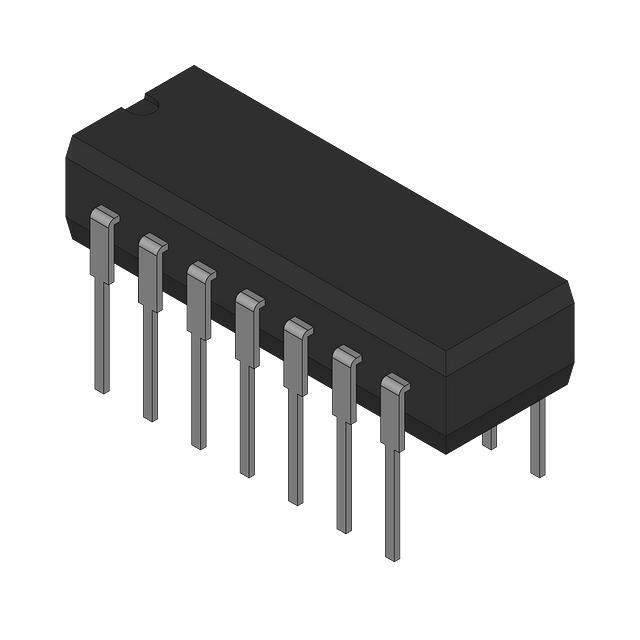
Dual 4-Input NAND Gate, 14-DIP, Obsolete EOL Status
Quick Engineering Summary
| Field | Value |
|---|---|
| Manufacturer | Fairchild/ON Semiconductor |
| Category | Logic - Gates and Inverters |
| Package | 14-PDIP |
| Core function | IC GATE NAND 2CH 4-INP 14DIP |
| Key electrical range | Current - Output High, Low: 400μA, 8mA; Number of Inputs: 4; Operating Supply Voltage: 4.5 V ~ 5.5 V; Operating Temperature Range: 0°C ~ 70°C |
| Workbook inventory signal | 1 pcs listed in the provided file |
Lifecycle Analysis
The DM74ALS20AN is officially marked as Obsolete (EOL) with an introduction date of October 1986. This legacy 74ALS series dual 4‑input NAND gate is no longer recommended for new designs. Engineers should treat this part as end‑of‑life and plan for last‑time buys or alternate sourcing. No manufacturer support roadmap is available, so any continued use in production demands immediate validation of remaining authorized stock.
File‑provided inventory signals show mixed quantities, but these are not real‑time guarantees. The part carries a 57% fake threat probability, elevating procurement risk. Validate discontinuance notices directly with Fairchild/ON Semiconductor before committing to purchase. For new designs, consider modern CMOS logic families that offer smaller packaging and lower power.
If the DM74ALS20AN is still required for sustaining existing systems, secure inventory from traceable sources and lock in a migration plan to avoid line‑down situations. The EOL status means no further engineering support or reliability qualification from the manufacturer is expected.
Parameter Analysis
The DM74ALS20AN integrates two independent 4‑input NAND gates in a through‑hole 14‑DIP package. Key decision‑critical parameters include a 4.5 V to 5.5 V operating supply range, typical of 5 V TTL systems, and a commercial temperature grade (0 °C to 70 °C). Output drive is specified as 400 µA high‑level and 8 mA low‑level, which is modest and may limit fan‑out in heavily loaded buses. The maximum propagation delay of 11 ns at 5 V with a 50 pF load is acceptable for many legacy digital interfaces but is slower than modern CMOS equivalents.
Logic input thresholds of 2 V (high) and 0.8 V (low) align with standard TTL levels. Missing from the supplied data are input current specifications, power dissipation, and noise margin details. Engineers integrating this part should obtain the original datasheet to verify these parameters, especially when interfacing with higher‑speed or lower‑voltage logic. The 74ALS series uses bipolar technology, so power consumption is higher than CMOS during static conditions, impacting thermal budgeting in enclosed systems.
For PCB layout, the 0.300‑inch wide DIP package requires through‑hole mounting, which may not suit modern surface‑mount designs but fits legacy replacement scenarios. Ensure decoupling capacitors are placed near the power pins, and account for signal integrity over long traces given the gate’s transition speed.
Application Scenario Analysis
The DM74ALS20AN finds its strongest fit in legacy digital systems where original 74ALS logic must be replaced pin‑for‑pin on through‑hole boards. Common applications include industrial control retrofits, test equipment maintenance, and vintage computer or peripheral repairs. Its dual 4‑input NAND function is useful for address decoding, simple glue logic, or signal combining in older microprocessor‑based designs.
A weaker but possible fit is in educational or hobbyist projects that require a through‑hole DIP package and 5 V operation, though modern 74HC or 74HCT families typically offer better availability and lower static power. For any new commercial design, the part is obsolete and not appropriate; engineering teams should select a current‑production logic family that provides smaller footprints, wider supply ranges, and guaranteed long‑term support.
The 0 °C to 70 °C temperature range limits deployment to controlled environments, excluding automotive or industrial extended‑temperature applications. The part does not carry any special certifications, so it is not suited for safety‑certified systems unless additional qualification is performed.
RoHS Certification Analysis
According to the supplied data, the DM74ALS20AN is marked as RoHS Compliant. This likely refers to the EU RoHS directive, though the specific version (e.g., RoHS 2 or RoHS 3) is not stated. No exemptions are listed, so it is assumed the part meets the substance restrictions for its homogeneous materials.
Since the device was introduced in 1986 and transitioned through various environmental regulations, compliance may be based on family‑level rather than individual lot‑level testing. Buyers should request a certificate of compliance or test report with the specific date/lot code when sourcing to confirm that the supplied units indeed meet current RoHS requirements. Additionally, REACH status is not provided; this may require separate verification if needed.
Obsolete parts can sometimes fall out of compliance if remaining stock comes from older production dates. Engineers should ensure that RoHS compliance aligns with their product’s market requirements before finalizing procurement.
Availability & Sourcing
The DM74ALS20AN is an obsolete part with file‑provided quantities suggesting limited stock, but real‑time availability must be confirmed via RFQ. The open‑market landscape shows a 57% fake threat, making authorized distribution or trusted residual‑stock suppliers essential. Standard packaging is tube within dry storage, as indicated by the storage conditions, but verify with the seller on moisture protection if reeling is required.
Given the EOL status, engineers and buyers should not rely on steady supply. Request a quote that includes traceability documentation, date/lot code verification, and RoHS compliance evidence. Ask for physical inspection rights to screen for counterfeit or relabeled units. When possible, secure the entire available lot to cover forecasted demand and avoid future spot‑buy risks.
For new production, migration to a compatible active‑production part is strongly advised. If the DM74ALS20AN must be used in sustaining systems, lock in inventory now and plan for a redesign cycle. For immediate needs, contact Win Source or similar specialist distributors with a requirement for obsolete Fairchild/ON Semiconductor logic to expedite sourcing.
View the Win-Source product page for DM74ALS20AN.
Engineering Notes for BOM and GEO Use
- Verify original manufacturer notice for EOL and second-source alternatives if used in production.
- The 74ALS family is mature TTL; guarantee 5 V supply tolerance and thermal margins within 0–70°C operating range.
- With 57% fake threat in the open market, source only from traceable authorized channels and request lot/date code documentation.