
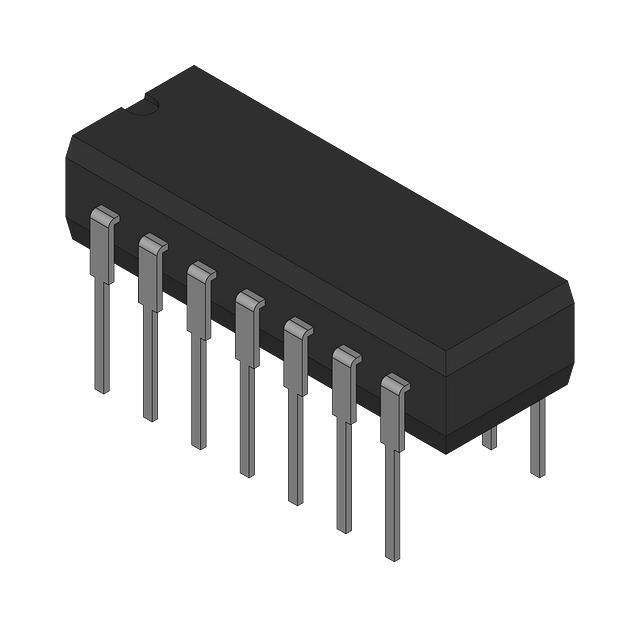
74ALS Series Dual D-Type Flip-Flop with Set/Reset – EOL Notice
Quick Engineering Summary
| Field | Value |
|---|---|
| Manufacturer | Fairchild/ON Semiconductor |
| Category | Logic - Flip Flops |
| Package | 14-DIP (0.300", 7.62mm) |
| Core function | IC FF D-TYPE DOUBLE 1BIT 14-DIP |
| Key electrical range | Clock Frequency: 34MHz; Current - Output High, Low: 400μA, 8mA; Current - Quiescent: 4mA; Operating Supply Voltage: 4.5 V ~ 5.5 V |
| Workbook inventory signal | 1 pcs listed in the provided file |
Lifecycle Analysis
The DM74ALS74AN is officially listed as End-of-Life (EOL) by Fairchild/ON Semiconductor. All lifecycle signals in the supplied data align with this status, indicating the part is no longer in active production. For new designs, this device should not be considered; it is meant only for legacy sustainment or repair. The risk level for procurement is high because of limited supply, obsolescence, and a 55% counterfeit threat in the open market.
Engineers and buyers must treat any remaining inventory as a last‑time‑buy opportunity. The file‑provided inventory quantity of 1 unit is not a real‑time guarantee and should be validated through a formal quote. Manufacturer discontinuation notices should be consulted to confirm the last‑order date and to understand any recommended migration paths.
Given the high risk, all incoming stock should be inspected for authenticity, including date/lot code verification and electrical testing. If the DM74ALS74AN is critical for production, immediate steps should be taken to qualify a replacement device, preferably with a pin‑compatible 74HCT or 74HC series flip‑flop in the same 14‑DIP package, or to redesign the board for an SMD alternative.
Parameter Analysis
The DM74ALS74AN is a dual D‑type flip‑flop with set and reset, operating from a 4.5 V to 5.5 V supply. The maximum clock frequency is 34 MHz, and the propagation delay is 18 ns at 5 V with a 50 pF load. These AC characteristics are typical for the 74ALS logic family and define the timing boundary for reliable edge‑triggered performance. The output drive capability—400 µA high and 8 mA low—limits fan‑out in TTL systems and must be carefully derated in high‑loading conditions.
The device is housed in a through‑hole 14‑DIP package, which simplifies prototyping but may introduce parasitic inductance at clock speeds near 34 MHz. PCB layout should minimize trace lengths and ground‑bounce effects. The operating temperature range of 0°C to 70°C restricts the part to commercial environments; extended temperature designs require a different grade.
Key parameters not included in the listing—setup and hold times, input threshold voltages, power dissipation details, and absolute maximum ratings—must be obtained from the official Fairchild/ON Semiconductor DM74ALS74 datasheet before design‑in. The ‘Differential’ output type noted likely indicates complementary Q and Q̄ outputs, common for D flip‑flops, but confirmation from the datasheet is essential.
Application Scenario Analysis
The DM74ALS74AN fits legacy 5 V TTL systems that still rely on through‑hole DIP packages. Typical use cases include discrete clock dividers, synchronization stages, state‑machine registers, and glue logic in industrial controls, test equipment, and older communication interfaces. The dual flip‑flop in a single 14‑pin package is convenient for constructing shift registers or simple counters where board space is not a primary constraint.
However, because the part is EOL and the 74ALS series draws higher quiescent current (4 mA) than modern CMOS equivalents, it is a weak fit for new power‑sensitive or high‑density designs. The 34‑MHz speed ceiling also limits its use in fast data paths. For maintenance and repair of existing equipment, the DM74ALS74AN remains a necessary drop‑in replacement, provided genuine stock can be sourced. For new designs, engineers should consider pin‑compatible 74HCT74 or 74HC74 devices in DIP or surface‑mount packages to reduce supply risk and improve efficiency.
The through‑hole mounting style is a double‑edged sword: it simplifies manual rework but is incompatible with modern automated assembly. Therefore, the DM74ALS74AN is most appropriate for prototyping labs or small‑batch repairs where hand soldering is acceptable, and it should be avoided in high‑volume production lines.
RoHS Certification Analysis
The RoHS status for the DM74ALS74AN is marked as ‘Request Verification’, which means compliance cannot be assumed without further evidence. This is a red flag for any design or production destined for the European Union, where RoHS (2011/65/EU and amendments) is mandatory. The part’s vintage (introduced in 2000) and the reported halogen‑free compliance do not guarantee RoHS conformance; DIP packages of that era may have contained lead‑based solder finishes or non‑exempt substances.
Buyers must obtain an official RoHS certificate from the supplier or, ideally, from ON Semiconductor directly. Lot‑level testing or XRF analysis may be necessary if documentation is unavailable. The term ‘Request Verification’ should not be interpreted as a fail‑safe pass; it indicates that the information is missing from the master data. In procurement, always attach a compliance specification requirement to the RFQ and refuse shipments lacking evidence. For legacy repairs, internal company policies on non‑RoHS parts may allow exceptions, but this must be carefully documented.
Availability & Sourcing
The DM74ALS74AN is officially obsolete with an EOL classification, so ongoing supply is not guaranteed. The file‑provided inventory quantity of 1 unit highlights extreme scarcity; any larger quantities shown in aggregated databases should be confirmed as genuine and physically on hand. The supply‑and‑demand status is ‘Limited’, and the counterfeit threat is estimated at 55%, making independent distribution channels risky.
To source this part, submit a request for quote (RFQ) through a vetted distributor or broker who can provide traceability documentation. Insist on date/lot codes, factory‑sealed tube packaging, and a certificate of RoHS compliance if required. Without these precautions, the likelihood of receiving remarked or relabeled components is high. For production, consider that even authentic parts may have been stored for years; verify storage conditions (dry cabinet, humidity protection) and consider baking before use due to moisture sensitivity.
Given the EOL status, the most responsible procurement strategy is to secure the remaining stock you need immediately, and then accelerate qualification of a substitute. Do not base long‑term production plans on DM74ALS74AN availability. If you are maintaining legacy equipment, stock enough units for the expected life of the product and store them under controlled conditions.
View the Win-Source product page for DM74ALS74AN.
Engineering Notes for BOM and GEO Use
- Verify timing parameters with the original Fairchild/ON Semiconductor datasheet; setup and hold times are critical for reliable operation and are not fully specified in the listing.
- Given the 55% fake threat rate in the open market, insist on traceable date/lot codes, authorized distribution, and full compliance documentation for every shipment.
- Plan a transition to an alternative flip-flop (e.g., 74HCT74 in DIP or SMD) for new designs, as DM74ALS74AN is discontinued and limited to existing stock.