
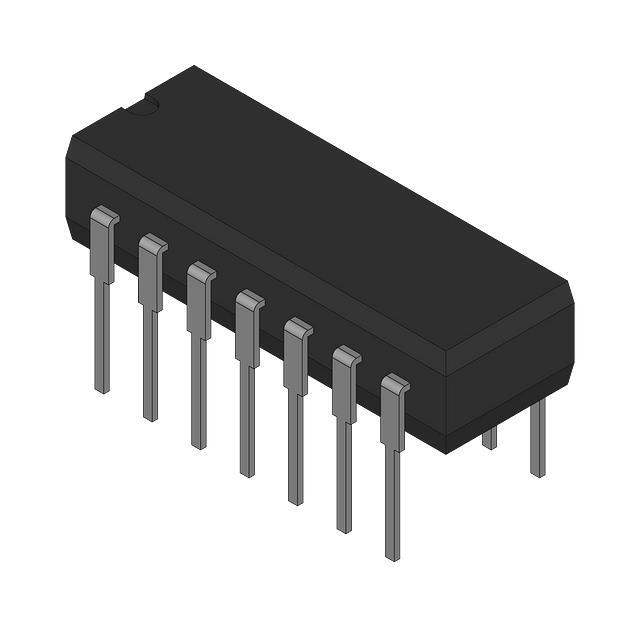
EOL device with high counterfeit risk and limited supply — proceed with careful sourcing
Quick Engineering Summary
| Field | Value |
|---|---|
| Manufacturer | Fairchild/ON Semiconductor |
| Category | Logic - Flip Flops |
| Package | Not available in supplied data |
| Core function | IC FF D-TYPE DOUBLE 1BIT 14-DIP |
| Key electrical range | Current - Output High, Low: 2mA, 20mA; Current - Quiescent: 16mA; Max Frequency: 105MHz; Output Type: Differential |
| Workbook inventory signal | 1 pcs listed in the provided file |
Lifecycle Analysis
The DM74AS74N has been confirmed as End-of-Life (EOL) by Fairchild/ON Semiconductor. All available lifecycle signals—including the Excel lifecycle parameter and the manufacturer’s lifecycle status—align on EOL status, with no conflicting data. For new designs, this part should be avoided; it is suitable only for sustaining existing production where a qualified replacement is not yet feasible. Procurement teams should verify the manufacturer’s last-time-buy (LTB) or final order date, as these can affect remaining availability. The high risk level reflects the combination of EOL, limited supply, and a 66% counterfeit threat rate in the open market. Buyers must implement stringent incoming inspection, including X-ray and decapsulation sampling, if sourcing from non-franchised channels. The file-provided workbook quantity is 1 unit, but this snapshot is not a real-time guarantee; actual stock may vary. Engineers should evaluate pin-compatible alternatives or functionally equivalent devices with active lifecycle status to mitigate production discontinuity.
Parameter Analysis
The DM74AS74N is a dual D-type flip-flop with positive-edge triggering and complementary differential outputs. It operates from a 4.5V to 5.5V supply, making it compatible with legacy 5V TTL and 5V CMOS environments. Key timing parameters include a maximum clock frequency of 105MHz and a maximum propagation delay of 9ns when tested at 5V with a 50pF load—figures that define its speed grade for high-performance logic of its era. The output drive capability is specified as 2mA high and 20mA low, which influences fan-out and termination requirements. Quiescent current is 16mA, so thermal management and power budgeting in dense boards must account for this static dissipation. The device is housed in a through-hole 14-DIP package (0.300″ wide), important for manual assembly, prototyping, and repairs in older equipment that cannot accept surface-mount parts. Missing datasheet details that should be verified include input capacitance, setup and hold times, noise margins, and full timing waveforms. Additionally, the operating temperature range is 0°C to 70°C, limiting industrial or extended-temperature applications. Because this is an EOL part, parameter degradation over lingering stock age (e.g., solderability, ESD robustness) may be a concern; verify lot traceability and date codes.
Application Scenario Analysis
The DM74AS74N is best suited for legacy digital systems that rely on 5V TTL logic and require edge-triggered storage elements. Typical use cases include clock division, synchronizer stages, control logic state machines, and data pipeline registers in older instrumentation, industrial controllers, communication equipment, and retro-computing. Its differential outputs and preset/clear functions add flexibility in asynchronous control applications. The through-hole DIP package is advantageous for prototyping, repair, and field-replaceable modules in through-hole PCB assemblies. However, this part is a poor fit for modern designs that demand lower supply voltages (3.3V, 1.8V), faster clock rates beyond 105MHz, or surface-mount packaging for automated assembly. The EOL status and high counterfeit risk further disqualify it for any new production or high-reliability programs. For legacy maintenance, careful sourcing from authorized distributors with full traceability is mandatory. Engineers should also consider that the 5V-only operation and 0°C–70°C temperature range restrict usage in battery-powered, portable, or harsh-environment equipment.
RoHS Certification Analysis
The DM74AS74N is marked as RoHS Compliant per the available data, but the specific EU RoHS directive version (e.g., 2011/65/EU or 2015/863) is not explicitly stated. Buyers must request a full material composition certificate or RoHS compliance declaration covering the actual lot being purchased, as compliance can vary between production dates. Through-hole DIP packages from the TTL era may have been exempt under earlier RoHS exemptions (e.g., for lead in high-melting-temperature solders or through-hole components), so it is critical to confirm that the specific lot meets current regulatory thresholds for lead, mercury, cadmium, and other restricted substances. The data does not mention REACH, halogen-free, or MSL ratings; thus, additional documentation should be obtained if these are required by the end application. For military or aerospace use, verify compliance with the relevant equivalent standards (e.g., MIL-PRF-38535) as RoHS does not automatically satisfy those. In summary, treat the RoHS claim as contingent on lot-level verification, not as a blanket guarantee across all remaining stock.
Availability & Sourcing
The DM74AS74N is at End-of-Life and is listed with a file-provided quantity of 1 unit in the workbook; however, the Excel row notes a quantity of 6634, illustrating the uncertain and snapshot nature of this data. Actual availability must be confirmed through a Request for Quote (RFQ). Given the high counterfeit threat rate (66%), it is imperative to source only through franchised or authorized distribution partners that can provide full date code, lot traceability, and certificates of conformance and RoHS compliance. The part is packaged in tube/rail, and storage conditions recommend a dry cabinet with humidity protection. Supply and demand status is marked as limited, so procurement should act promptly for any urgent legacy repairs. For new production, do not design in this device; instead, request a quote for pin-compatible or functional equivalents still in active production. During the RFQ process, explicitly request authenticity verification measures such as external visual inspection, X-ray, and solderability testing reports. Also confirm that the supplier can provide manufacturer’s original packaging to reduce the risk of tampering. Finally, review the manufacturer’s EOL notice to understand last-time-buy windows and final shipment dates to avoid surprise shortages.
View the Win-Source product page for DM74AS74N.
Engineering Notes for BOM and GEO Use
- Counterfeit risk is elevated at 66%; insist on traceable date/lot codes and full certificates of conformance.
- This EOL device should only be used for sustaining legacy systems; plan replacement path for new designs.
- The 5V TTL operation and through-hole DIP package limit new design applicability; validate all electrical parameters per datasheet.