
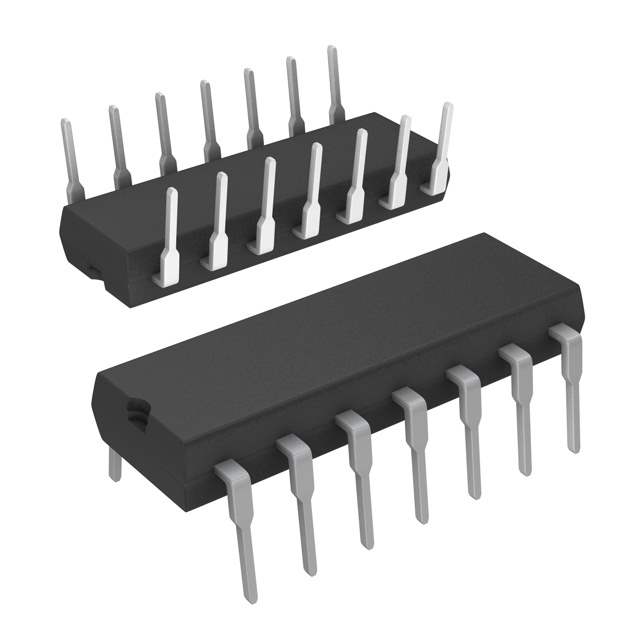
Obsolete 74LS hex inverter with six channels, through‑hole DIP package. High‑risk for new designs – limited to legacy sustainment.
Quick Engineering Summary
| Field | Value |
|---|---|
| Manufacturer | Fairchild/ON Semiconductor |
| Category | Logic - Gates and Inverters |
| Package | 14-PDIP |
| Core function | IC INVERTER 6CH 1-INP 14MDIP |
| Key electrical range | Current - Output High, Low: 400μA, 8mA; Number of Inputs: 6; Supply and Demand Status: Limited; Supply Voltage - Operating: 4.75 V to 5.25 V |
| Workbook inventory signal | 1 pcs listed in the provided file |
Lifecycle Analysis
The DM74LS04N is officially end‑of‑life (EOL) according to all available lifecycle signals. This means the manufacturer has discontinued production, and no new orders are being accepted for ongoing manufacturing. For new designs, this part carries a high risk and must not be selected. Engineers must instead identify an active, drop‑in or functional equivalent inverter.
For existing production that still requires the DM74LS04N, immediate action is needed: verify the exact last‑time‑buy and last‑ship dates with ON Semiconductor, then place a final purchase order to cover your sustaining needs. The file‑provided quantity of only 1 unit underscores the extreme scarcity of this part. Even if more stock appears on the open market, traceability and authenticity should be assumed suspect given the part’s age and the 33% counterfeit threat. Plan a migration to a modern alternative, such as a 74HCT04 in DIP, to avoid future supply disruptions.
Parameter Analysis
The DM74LS04N contains six independent inverters, each accepting a single TTL‑level input. Key electrical parameters include a supply voltage range of 4.75 V to 5.25 V, a high‑level input threshold of 2 V, and a low‑level threshold of 0.8 V. Output drive is rated at 8 mA low and 400 µA high – typical of 74LS family buffers. The maximum propagation delay is 15 ns with a 50 pF load at 5 V, which adequately covers the transition times needed in older control and timing circuits. The commercial‑grade temperature range of 0 °C to 70 °C restricts the part to indoor, non‑industrial environments.
These parameters must be verified against the original ON Semiconductor datasheet because several important values are missing from the source data: static supply current, input clamping diode characteristics, and noise margin data are not provided. For procurement, the through‑hole 14‑DIP package (300‑mil width) and tube/rail packaging are confirmed, but the exact lead finish (matte tin vs. tin‑lead) remains ambiguous due to the RoHS conflict. When qualifying the part, especially for high‑reliability systems, measure or simulate the actual propagation delay under your specific load conditions and compare it with the 15 ns typical value.
Application Scenario Analysis
The DM74LS04N hex inverter is a general‑purpose logic function frequently found in legacy consumer electronics, embedded controllers, clock generation, and multimedia interface circuits. The application field notes from the source data list ‘Clock & Timing, Consumer Electronics, Embedded Design & Development, Multimedia’. In these domains, the part is typically used for signal inversion, buffering, simple RC oscillators, and level translation within a 5 V TTL system. Because of its through‑hole DIP package, it is particularly suited for prototyping, repair, and low‑volume production where hand soldering is preferred.
However, the DM74LS04N is a poor fit for modern designs. Its TTL input currents are relatively high, and the 74LS speed grade is far slower than contemporary CMOS solutions. Low‑power, battery‑operated devices are not appropriate for this part, nor are high‑speed clock trees that demand sub‑5 ns delays. Moreover, surface‑mount assembly and lead‑free soldering processes are not compatible with the DIP package and potential tin‑lead finish. New designs should consider alternatives such as the 74HCT04 (CMOS, TTL‑compatible inputs) or the 74LVC04 (low‑voltage CMOS) in surface‑mount packages.
RoHS Certification Analysis
The RoHS compliance picture for the DM74LS04N is contradictory. The high‑level compliance field in the source data states ‘RoHS Compliant’, but the detailed part specification declares ‘RoHS Non‑Compliant’. This conflict often occurs with legacy parts: the manufacturer may have produced compliant and non‑compliant variants, or the compliance summary may reflect a family‑level status rather than the specific device identifier. The non‑compliant designation is the safer assumption for procurement, especially given that many 14‑DIP parts historically used tin‑lead plating and fall under the EU RoHS 7(a) exemption only under strict conditions.
If the part is intended for the European market, the buyer must obtain a written Compliance Certificate from the distributor or ON Semiconductor for the exact date/lot code being shipped. REACH status and Material Safety Data Sheet are available but do not substitute for a RoHS statement. For civil aerospace, medical, or automotive applications, additional substance‑of‑concern reporting (e.g., full material declaration per IPC‑1752) is strongly recommended. Without confirmation, the part should be treated as non‑compliant, and any equipment sold in the EU must rely on the proper exemption documentation.
Availability & Sourcing
The DM74LS04N is an obsolete part with extremely limited availability. The source data shows a file‑provided quantity of 1 unit, supplied in tube/rail packaging, stored in a dry cabinet with humidity protection. Given the EOL status, no additional production is forthcoming, so any stock on the market is either distributor remnant inventory or new‑old‑stock from the gray market. The 33% counterfeit threat rating is a serious warning: this part number is widely counterfeited, and unverified purchases carry a high probability of receiving non‑functional or relabeled devices.
To source the DM74LS04N responsibly, request a quote through Win Source or another authorized distributor to check real‑time stock levels. Insist on full traceability documentation, including date/lot code, manufacturer certificate of conformance, and evidence of original packaging. Perform incoming inspection with X‑ray or decapsulation if volume is significant. Because the part is EOL, no new design should depend on its procurement; for production repairs, secure whatever remaining inventory is immediately available and store it under controlled conditions to extend shelf life. Once stock is exhausted, transition to a verified replacement such as the 74HCT04N.
View the Win-Source product page for DM74LS04N.
Engineering Notes for BOM and GEO Use
- Confirm RoHS status before purchase; the detailed part record indicates non‑compliance while the summary suggests compliance.
- EOL status means no new designs; secure remaining stock for legacy repairs and plan migration to a 74HCT04 or similar CMOS inverter.
- Counterfeit risk is 33 % on the open market; source only from authorized channels and perform rigorous incoming inspection.