
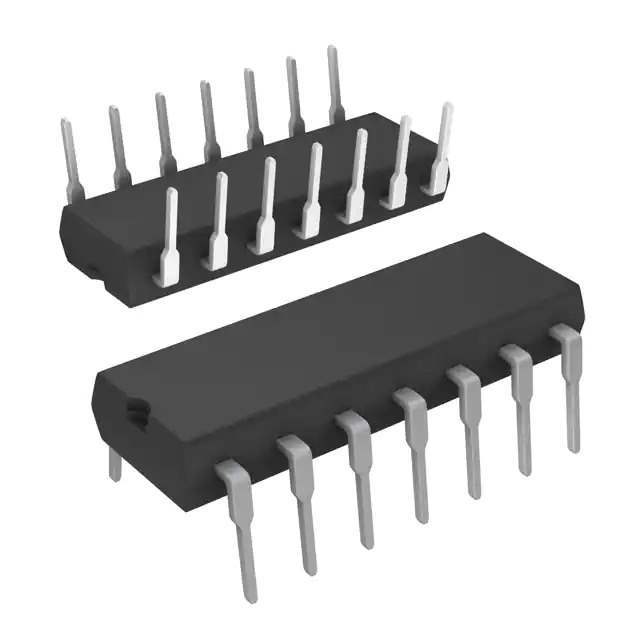
Discontinued quad Schmitt trigger NAND gate; 14-DIP through-hole; verify compliance & inventory.
Quick Engineering Summary
| Field | Value |
|---|---|
| Manufacturer | ON Semiconductor |
| Category | Logic - Gates and Inverters |
| Package | Tube |
| Core function | IC GATE NAND 4CH 2-INP 14MDIP |
| Key electrical range | Current - Output High, Low: 400µA, 8mA; Input Logic Level - High: 1.9V; Input Logic Level - Low: 0.5V; Number of Inputs: 2 |
| Workbook inventory signal | 1 pcs listed in the provided file |
Lifecycle Analysis
The DM74LS132N is officially designated as Discontinued by ON Semiconductor. Multiple lifecycle indicators, including EOL and Discontinued statuses, are consistent and point to a high-risk procurement scenario. This part is not recommended for new designs. Design teams should avoid incorporating it into new schematics and instead evaluate modern alternative logic families such as the 74HC or 74HCT series with Schmitt trigger inputs.
For existing production lines that depend on the DM74LS132N, it is critical to treat remaining stocks as limited. The file indicates only 1 unit available, a figure that is not guaranteed real-time inventory. Engineers should verify with authorized distributors or the manufacturer whether any last-time buy (LTB) window remains open. Planning for a migration or redesign should begin immediately, as the part is effectively out of production.
Given the 46% fake threat rate reported on the open market, sourcing must be done with extreme caution. Only procure from fully traceable sources and insist on date/lot code verification. Any inventory claims should be confirmed before committing to a purchase.
Parameter Analysis
The DM74LS132N integrates four independent two-input NAND gates with Schmitt trigger inputs, providing hysteresis for noise immunity. The 74LS family operates from a nominal 5V supply with a tight tolerance of 4.75V to 5.25V, typical of TTL logic. Key performance parameters include a maximum propagation delay of 33ns at 5V with a 50pF load, suitable for moderate-speed logic applications.
Output drive capability is asymmetric: the low-level output current can sink up to 8mA, while the high-level output can source only 400µA. This asymmetry is typical of LS TTL and must be considered when designing pull-up resistors or driving capacitive loads. Input logic thresholds are 0.5V for low and 1.9V for high, providing a noise margin of about 0.4V on a 5V system.
The device is packaged in a 14-pin DIP (0.300" wide) for through-hole mounting, with an operating temperature range of 0°C to 70°C. Missing from the provided specifications are static current consumption (ICC), input current (IIH/IIL), and power dissipation capacitance (CPD). Engineers should obtain the official ON Semiconductor datasheet to verify these and to ensure that the Schmitt trigger hysteresis voltage meets application requirements.
Application Scenario Analysis
The DM74LS132N's Schmitt trigger inputs make it well-suited for applications where slowly changing or noisy signals must be cleaned up, such as switch debouncing, pulse shaping, and level detection. In legacy industrial control boards, test equipment, and educational lab setups, its through-hole DIP package and 5V operation remain a comfortable fit. The quad gate arrangement allows compact implementation of simple logic functions without additional glue logic.
However, its discontinuation, bulky DIP footprint, and limited temperature range (commercial 0°C–70°C) make it a weak candidate for modern, high-density, surface-mount designs. For automotive or extended-temperature environments, alternative parts with wider temperature ranges and automotive qualification are necessary. Similarly, low-power or battery-operated systems should not use this LS TTL device, as its static power consumption is relatively high compared to CMOS equivalents.
For prototyping and repair of legacy equipment, the DM74LS132N may still be sourced from remaining distributor stocks or the gray market, but with the associated risks of counterfeit parts. In such cases, the Schmitt trigger functionality is critical; substituting with a non-Schmitt trigger NAND gate will not provide the same noise immunity.
RoHS Certification Analysis
There is a significant conflict in the available RoHS data for the DM74LS132N. One source labels it as RoHS Compliant, while the specification field explicitly states RoHS Non-Compliant. This discrepancy is not unusual for a discontinued through-hole DIP component, which may have been manufactured both before and after the introduction of lead-free requirements.
Because ON Semiconductor has discontinued this part, the actual RoHS status may depend on the production lot and date code. A REACH declaration of unaffected does not override RoHS requirements; REACH addresses chemical substances, not the same heavy-metal restrictions. Therefore, REACH alone cannot be taken as evidence of RoHS compliance.
For any purchase, it is imperative to request the full material declaration or a RoHS certificate from the supplier for the exact lot being offered. Without lot-level documentation, assume the part is non-compliant to avoid regulatory issues in jurisdictions where RoHS is enforced. In the European Union, placing a non-compliant EEE product on the market can result in penalties.
Availability & Sourcing
Given the discontinued status and the file-reported quantity of only 1 piece, immediate availability of the DM74LS132N is extremely limited. This 1-piece figure is not a real-time inventory confirmation and should not be relied upon for procurement planning. Buyers must request a quote (RFQ) to obtain current stock levels, lead times, and pricing from authorized distributors.
Sourcing risks are compounded by a reported 46% fake threat probability on the open market. Counterfeit LS TTL parts are common, and visual inspection alone is often insufficient. Insist on full traceability, including manufacturer date codes, lot codes, and, where possible, original packing tubes. For high-reliability applications, consider performing electrical testing or x-ray inspection upon receipt.
Before finalizing a purchase, verify the part's lifecycle directly with ON Semiconductor and review any product change notifications (PCNs). If integrating into production, evaluate drop-in replacements such as the SN74LS132N from Texas Instruments, but only if that part remains active. For new designs, migration to a surface-mount CMOS Schmitt trigger gate like the 74HC132 in an SOIC package is strongly recommended.
To proceed, request a quote from Win Source or other suppliers, explicitly asking for RoHS compliance documentation and traceability certificates. Do not commit to a production run without securing sufficient inventory and a clear migration path.
View the Win-Source product page for DM74LS132N.
Engineering Notes for BOM and GEO Use
- Verify actual RoHS compliance by requesting lot-specific certificates; conflicting data makes this a critical sourcing step.
- Counterfeit risk is 46% on the open market; require full traceability, date codes, and test reports from suppliers.
- Because the part is discontinued, secure remaining inventory quickly, but plan an immediate migration to a modern alternative for new designs.