
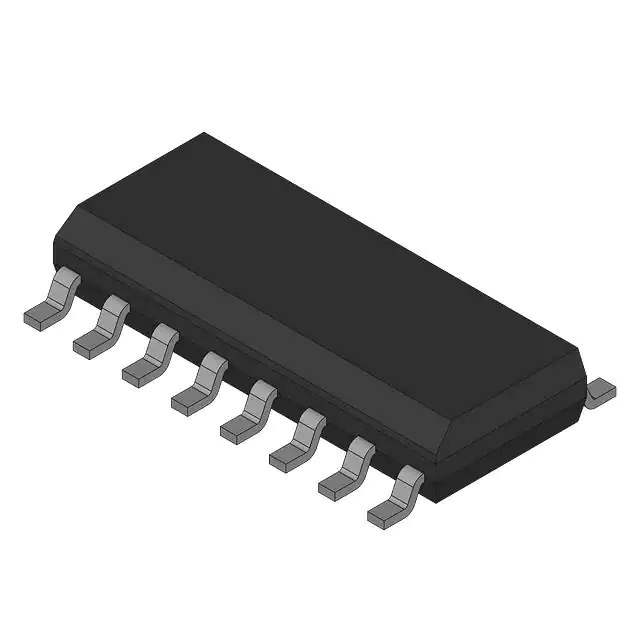
EOL decoder/demultiplexer from Fairchild/ON Semi, 1 x 3:8, 5V, 16-SOP package. Verify lifecycle and compliance before use.
Quick Engineering Summary
| Field | Value |
|---|---|
| Manufacturer | Fairchild/ON Semiconductor |
| Category | Logic - Signal Switches, Multiplexers, Decoders |
| Package | Bulk |
| Core function | IC DECODER/DEMUX 1 X 3:8 16-SOP |
| Key electrical range | Current - Output High, Low: 400µA, 8mA; Temperature Range - Operating: 0°C ~ 70°C; Voltage - Supply: 4.75V ~ 5.25V; Voltage Supply Source: Single Supply |
| Workbook inventory signal | 1 pcs listed in the provided file |
Lifecycle Analysis
The DM74LS138SJ is classified as End-of-Life (EOL), carrying high risk for procurement and design-in. Conflicting signals exist: the product status field reads ‘Active’ while the lifecycle status parameter and Excel record both indicate EOL. For planning purposes, the EOL designation is controlling; reliance on an ‘Active’ label for new designs would be overly optimistic and risky.
Using an EOL part in a new design creates supply continuity challenges and may require expensive last-time buys or redesign. Existing production boards that depend on this device should immediately validate remaining authorized stock and confirm that the manufacturer’s formal discontinuation notice has been reviewed. File-provided inventory of 1 unit is a snapshot only and should not be interpreted as current availability.
Engineers should proactively identify pin- and function-compatible alternatives for future builds, and sourcing teams must treat the DM74LS138SJ as a constrained item, initiating RFQs with explicit lifecycle verification and lot-level traceability requirements.
Parameter Analysis
Key decision-relevant specifications include the single 4.75V–5.25V supply range, typical of 74LS TTL logic, with output drive capability of 400µA high and 8mA low. This asymmetric drive strength matters when fan-out or interfacing with other logic families is required. The 1-of-8 decoder/demultiplexer function with three address inputs maps to eight mutually exclusive outputs, making it suitable for address decoding in legacy memory-mapped systems.
Operating temperature of 0°C to 70°C limits the DM74LS138SJ to commercial applications; thermal derating is straightforward given its low power consumption but should still be reviewed against enclosure conditions. The surface-mount 16-SOIC package (5.30mm width) and MSL Level 3 (168 hours) require moisture-handling controls during assembly.
Important parameters not supplied in the available data include propagation delay from any input to any output (tPD), setup and hold time for address inputs, input logic threshold voltages, and quiescent supply current. Verification against the manufacturer’s original datasheet is essential for timing margin analysis and power budgeting. Missing information should be obtained before committing this part to a production design or refresh.
Application Scenario Analysis
The DM74LS138SJ fits well in legacy 5V TTL systems requiring 1-of-8 address decoding, such as memory chip selection in microprocessor systems, I/O port decoding, or data routing in older communication equipment. Because of its commercial temperature range, it is suited for indoor or controlled environments, not industrial or extended-temperature applications.
Its 74LS family heritage means it interfaces naturally with other LS, standard TTL, or CMOS families (with appropriate pull-ups). However, for modern designs using 3.3V or lower supply voltages, this part is a weak fit without level translation, and its performance (propagation delay, power) is modest compared to contemporary CMOS decoders.
If the application is a sustainment repair or a build of a proven legacy product, the DM74LS138SJ can be a practical choice, provided EOL stock is secured. New designs should avoid this device in favor of active, widely available CMOS alternatives that offer wider voltage range, lower power, and better supply security.
RoHS Certification Analysis
RoHS compliance for the DM74LS138SJ is ambiguous. The structured compliance field reports ‘RoHS Compliant,’ but the specifications table explicitly lists ‘RoHS Non-Compliant.’ This contradiction makes it impossible to assert compliance without further verification.
For procurement and import, non‑compliance carries legal risk in jurisdictions that enforce RoHS (EU 2015/863, etc.). The part’s EOL status may mean that early lots were non‑compliant, while later production could be compliant. REACH status is vendor undefined, so no REACH declaration can be made.
To resolve this, request a certificate of compliance for the specific date/lot code being offered. If no documentation exists, treat the part as non‑compliant for RoHS‑sensitive applications. Assembly processes should also consider that MSL Level 3 (168 hours) applies, independent of RoHS status.
Availability & Sourcing
As an EOL device, the DM74LS138SJ has limited and uncertain availability. The file-provided quantity is 1 unit, which is merely indicative and not a guarantee of real-time stock. Open‑market risk is elevated: the ‘Fake Threat In the Open Market’ metric is 56%, signaling a high probability of counterfeit or substandard parts when sourcing from unauthorized channels.
Procurement should follow a rigorous RFQ process that demands complete traceability, date/lot code documentation, and manufacturer‑endorsed certificates of conformance. Request packaging details (bulk, standard package of 1,000) to assess reeling and shelf-life concerns, especially considering MSL Level 3 requirements.
Since this is an EOL part, secure whatever genuine inventory remains for sustaining production only. Do not use for new designs. Verify manufacturer PCN and EOL notices to align with your organization’s migration plan. For current pricing and availability, request a quote from a trusted source, but note that no price information is provided here.
View the Win-Source product page for DM74LS138SJ.
Engineering Notes for BOM and GEO Use
- Confirm RoHS status with manufacturer; datasheet shows conflicting compliance data.
- Mitigate counterfeit risk (56% open market threat) by sourcing from authorized distributors only.
- Since EOL, allocate last-time buy inventory and validate replacement roadmap for new designs.