
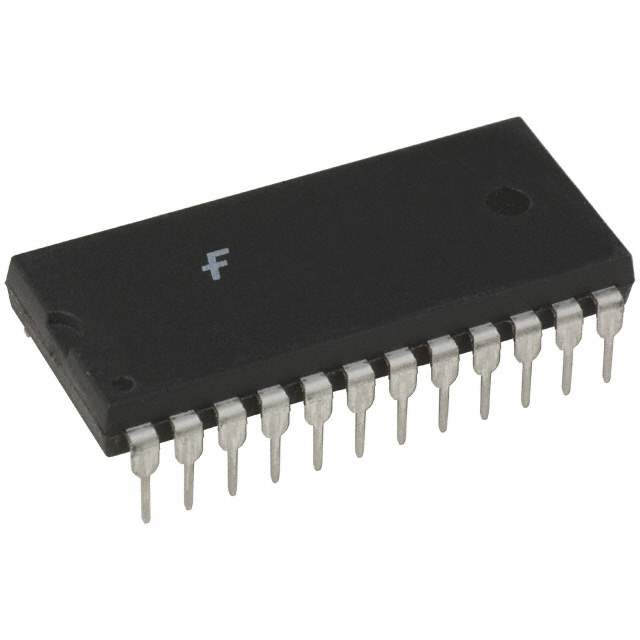
End-of-life logic decoder with single supply and through-hole mounting. Verify lifecycle and inventory before procurement.
Quick Engineering Summary
| Field | Value |
|---|---|
| Manufacturer | Fairchild/ON Semiconductor |
| Category | Logic - Signal Switches, Multiplexers, Decoders |
| Package | 24-PDIP |
| Core function | IC DECODER/DEMUX 1 X 2:4 24-PDIP |
| Key electrical range | Current - Output High, Low: 400μA, 8mA; Supply and Demand Status: Limited; Supply Voltage - Operating: 4.75 V to 5.25 V; Temperature Range - Operating: 0°C to 70°C |
| Workbook inventory signal | 1 pcs listed in the provided file |
Lifecycle Analysis
The DM74LS155N from Fairchild/ON Semiconductor is officially classified as End-of-Life (EOL), meaning the manufacturer has discontinued production and long-term supply cannot be guaranteed. For engineering teams, this status requires immediate attention: avoid using this decoder/demultiplexer in new designs, and evaluate migration paths for existing products that depend on it. Sustaining production may still be possible through last-time purchases or aftermarket inventory, but supply continuity is uncertain.
All available lifecycle indicators confirm the EOL designation, with no conflicting signals. A workbook inventory file shows a single unit at the time of data collection, but this snapshot is not real-time and should not be considered a reliable stock level. Engineers should directly contact ON Semiconductor or authorized distributors to obtain the official discontinuance notice and understand the last-order timeline.
Because the DM74LS155N is a specialized logic device, identifying pin-compatible replacements requires careful comparison of timing, drive strength, and package dimensions. Any substitution must be validated against the original datasheet. We recommend securing sufficient stock for maintenance needs while simultaneously qualifying a modern alternative for future production.
Parameter Analysis
The DM74LS155N is a dual 1-to-4 decoder/demultiplexer operating from a single 4.75 V to 5.25 V supply, typical of legacy TTL logic. It provides two independent circuits, each capable of driving 400 µA high-level and 8 mA low-level outputs. The low high-level drive current demands careful fan-out analysis; it may struggle to drive multiple standard TTL loads or long board traces. This parameter is critical when interfacing with CMOS or other logic families that expect higher drive.
The device is housed in a 24-pin PDIP through-hole package, which simplifies manual assembly and rework but increases board footprint and limits high-speed performance compared to surface-mount alternatives. Its commercial temperature range of 0°C to 70°C restricts usage to indoor, climate-controlled environments. The tube/rail packaging is standard for through-hole parts and suitable for low-volume distribution.
Several important parameters are missing from our dataset: propagation delay, maximum clock frequency, power dissipation, and input current levels. These values directly influence timing closure and thermal design. Engineers must consult the original manufacturer datasheet to obtain complete specifications and verify that the DM74LS155N meets system-level timing requirements before committing to a design.
Application Scenario Analysis
Based on its functional category and available parameters, the DM74LS155N is suited for 5V address decoding in microprocessor or memory-mapped I/O systems, bank selection in memory board designs, and basic demultiplexing of low-rate control signals. Its through-hole construction also makes it a practical choice for prototyping, educational labs, or repairing legacy industrial equipment where surface-mount rework is infeasible. In niche military or aerospace maintenance of older systems, the PDIP package may be preferred for reliability and hand-solderability.
However, the part is a poor fit for new, high-density designs. Its 24-pin DIP form factor consumes significant PCB area, and the commercial-only temperature range excludes outdoor or rugged applications. Additionally, the limited output drive and unknown switching characteristics make it unsuitable for high-speed data paths or bus multiplexing where timing is tight. For modern designs, consider surface-mount decoder ICs with wider voltage ranges or higher drive capability.
Given the EOL status, any use of the DM74LS155N should be restricted to maintenance or last-time-buy scenarios. Attempting a new design with this part carries significant supply risk. Engineers should evaluate alternative decoder solutions that offer improved performance and long-term availability.
RoHS Certification Analysis
The DM74LS155N is listed as RoHS Compliant, indicating that it meets the European Union's Restriction of Hazardous Substances directive. The specific RoHS revision is not stated in our source data, but parts from Fairchild/ON Semiconductor in this era typically conform to EU RoHS (2011/65/EU) or the later RoHS 3 (2015/863) amendment. Buyers should request a certificate of compliance for the exact production lot to confirm freedom from restricted substances such as lead, mercury, and cadmium.
No information is available on REACH compliance, MSL rating, or halogen-free content. While RoHS compliance reduces environmental impact and eases import into EU markets, it does not guarantee compliance with other global regulations like China RoHS. For applications requiring REACH, additional documentation must be obtained from the supplier.
It is important to note that RoHS compliance applies at the component level, but the final assembly's certification depends on the complete bill of materials. The use of a RoHS-compliant DM74LS155N does not automatically make the end product RoHS compliant. Verify that all materials and processes, including soldering, align with RoHS requirements.
Availability & Sourcing
With an EOL lifecycle and workbook inventory showing only one unit, sourcing the DM74LS155N requires immediate and careful action. The supply-and-demand status is listed as Limited, and the open market has a fake threat level of 44 percent, indicating a significant risk of counterfeit parts. Buyers should only procure through verified, authorized channels and insist on full traceability documentation, including date codes and lot numbers.
We recommend initiating a request for quote (RFQ) to confirm current stock availability and to check for any remaining authorized distribution inventory. The original packaging is tube/rail, which is typical for PDIP devices; verify that the parts have been stored in dry, humidity-controlled conditions per the manufacturer's guidelines.
Given the EOL status, secure enough inventory to cover all foreseeable maintenance and production needs. Simultaneously, begin evaluating a migration path to an active decoder alternative. When purchasing, request a RoHS certificate and, if necessary, test samples to guarantee authenticity. The DM74LS155N remains a serviceable part for legacy systems, but it demands disciplined sourcing practices and a clear end-of-life plan.
View the Win-Source product page for DM74LS155N.
Engineering Notes for BOM and GEO Use
- DM74LS155N is EOL with high risk; plan for last-time buys and long-term storage if production depends on it.
- Verify 400µA high-level output current capability against downstream TTL input requirements, as weak pull-up may limit fan-out.
- Through-hole 24-PDIP simplifies soldering but limits board density; consider layout for signal integrity in legacy 5V systems.