
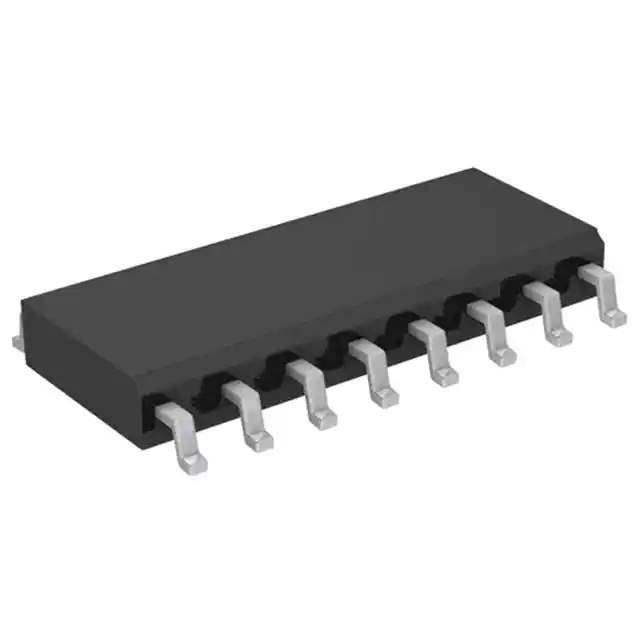
Discontinued 6-bit positive-edge-triggered flip-flop with master reset in 16-SOIC package.
Quick Engineering Summary
| Field | Value |
|---|---|
| Manufacturer | Fairchild/ON Semiconductor |
| Category | Logic - Flip Flops |
| Package | Tube |
| Core function | IC FF D-TYPE SINGLE 6BIT 16SOIC |
| Key electrical range | Clock Frequency: 30 MHz; Current - Output High, Low: 400µA, 8mA; Output Type: Non-Inverted; Temperature Range - Operating: 0°C ~ 70°C (TA) |
| Workbook inventory signal | 8000 pcs listed in the provided file |
Lifecycle Analysis
The DM74LS174M is formally listed as Discontinued by Fairchild/ON Semiconductor, with multiple data fields confirming end-of-life status. This classification means the component is no longer being manufactured, and no further production or engineering support is available from the manufacturer. For new designs, this part should not be considered; engineers must select an active alternative. In sustaining or maintenance applications, the remaining market stock must be secured promptly, as availability will only diminish over time.
The conflicting signals—some fields stating EOL and others Discontinued—do not change the practical outcome: the part is obsolete. The recommended approach is conservative procurement planning, including verifying any manufacturer-issued product change notifications (PCNs) or discontinuation notices. The data file indicates a stock quantity of 8000 units, but this figure is not guaranteed in real time; buyers should always request a current quote and confirm on-hand inventory.
Part number DM74LS174M carries a high risk for long-term availability. Engineering teams managing legacy systems should assess whether a drop-in replacement exists or if a board redesign is warranted. In parallel, procurement should vet sources carefully due to the elevated counterfeit risk associated with obsolete LS logic parts.
Parameter Analysis
Key parameters for the DM74LS174M include its D-type logic family, 6-bit width, and single-element configuration, making it suitable for parallel data capture applications. The positive-edge trigger and master reset function enable synchronous operation and easy initialization. Clock frequency is rated up to 30 MHz, which is typical for the 74LS series and adequate for many legacy digital systems operating at moderate speeds.
Power supply requirements are standard TTL (4.75V to 5.25V), and the commercial temperature range (0°C to 70°C) restricts it to non-industrial environments. Output drive capability is asymmetric: 400µA high-level current and 8mA low-level, which is sufficient for driving standard LS loads but may be marginal in heavily loaded buses. The 16-SOIC surface-mount package provides a compact footprint, but thermal considerations are minor given the low power dissipation of LS logic.
Missing from the available data are critical timing parameters such as propagation delay, setup and hold times, and input capacitance. These values are essential for ensuring reliable data transfer and must be extracted from the original manufacturer datasheet. Additionally, quiescent current (Iq) and input leakage are not provided, which could impact power budgeting in dense designs. Engineers should verify these before integrating the DM74LS174M into a qualified design, even for legacy support.
Application Scenario Analysis
The DM74LS174M is well-suited for legacy 5V TTL digital systems that require a simple 6-bit storage element with master reset. Typical applications include synchronous counters, shift registers, control logic state machines, and data latching in microprocessor peripherals from the 1980s and 1990s. Its positive-edge triggering and non-inverted outputs simplify integration into existing designs that rely on low-power Schottky logic levels.
Conversely, this part is a poor fit for modern low-voltage designs (e.g., 3.3V or lower) without level-shifting circuitry, as its minimum supply voltage of 4.75V is incompatible with newer logic standards. The limited temperature range (0–70°C) excludes it from industrial or automotive environments that require extended or AEC-Q100 qualification. Its 30 MHz clock ceiling also makes it unsuitable for high-speed data paths where sub-10 ns timing is needed.
Engineers considering the DM74LS174M for repair or refurbishment must confirm that its performance margin is adequate for the target system, especially if the original design pushed clock or loading limits. For any new development, a functionally similar but active component (e.g., 74HCT174) should be evaluated to ensure long-term supply and modern performance characteristics.
RoHS Certification Analysis
The RoHS compliance status of the DM74LS174M is ambiguous based on the provided data. One source indicates that the part is RoHS Compliant, while the detailed specification table explicitly states RoHS Non-Compliant. This conflict is significant and must be resolved before the component can be confidently used in products destined for the European Union or other regions with similar environmental regulations.
If the part is indeed non-compliant, it may contain restricted substances such as lead, which could disqualify it from many commercial applications. Buyers should request a Certificate of Compliance or lab test report from the supplier, and ideally cross-reference the lot or date code with ON Semiconductor’s official environmental documentation. The absence of REACH, halogen-free, and MSL (moisture sensitivity level) data further complicates a full environmental assessment.
Given the part’s discontinued status, it is possible that earlier production lots were non-compliant while later ones were converted, or vice versa. However, without clear documentation, the conservative procurement stance is to treat the DM74LS174M as potentially non-compliant. For design teams, this reinforces the need to migrate to a modern, fully RoHS-compliant alternative like the 74HCT174 in SOIC, which carries clear environmental certifications.
Availability & Sourcing
As a discontinued component, the DM74LS174M is no longer in active production, and all market availability comes from residual distributor stock or aftermarket sources. The provided data file indicates an inventory of 8000 units, but this quantity should be treated as unverified until a formal quote is received. Standard packaging is a tube of 48 pieces, which is typical for SOIC logic devices.
Given the high counterfeit threat level (65% reported), rigorous sourcing practices are essential. Buyers should prioritize authorized distributors, insist on full traceability documentation including date/lot codes, and consider third-party testing for suspect lots. Verification of RoHS compliance and manufacturer lifecycle status must be performed before committing to purchase.
Procurement teams are advised to request a quote for the DM74LS174M to confirm current availability and lead time. Simultaneously, engineering should evaluate alternative active parts, such as the 74HCT174 or 74HC174, which may offer equivalent function in the same package with guaranteed long-term supply. For maintenance-only requirements, securing sufficient stock for the expected product lifespan is critical, as prices and lead times are likely to increase as stock depletes.
View the Win-Source product page for DM74LS174M.
Engineering Notes for BOM and GEO Use
- Verify RoHS compliance status before use; conflicting data sources report both compliant and non-compliant.
- This part is discontinued; evaluate the 65% fake threat risk and ensure sourcing from authorized channels.
- The 30 MHz clock frequency and 4.75-5.25V supply range define its limits for legacy 5V TTL systems.