
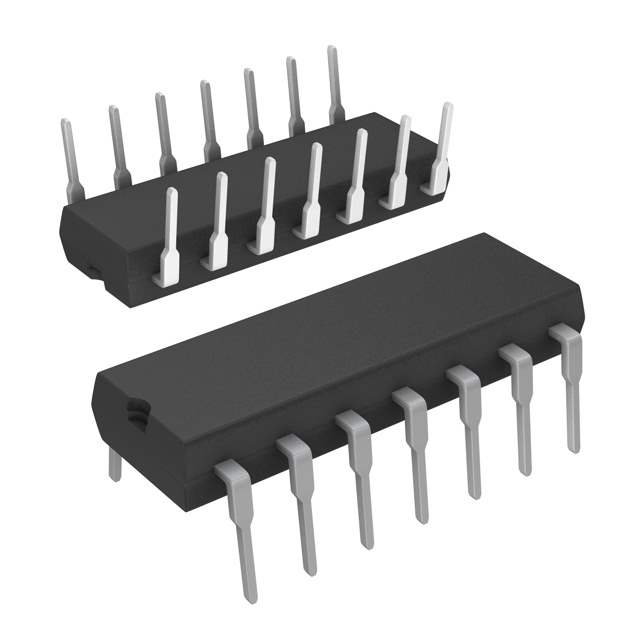
Dual 4-Input NAND Gate, 14-DIP, EOL Status - Compliance Verification Required
Quick Engineering Summary
| Field | Value |
|---|---|
| Manufacturer | ON Semiconductor |
| Category | HOT - SALES and EOL Components |
| Package | 14-DIP |
| Core function | IC GATE NAND 2CH 4-INP 14MDIP |
| Key electrical range | Current - Output High, Low: 400μA, 8mA; Number of Inputs: 4; Supply and Demand Status: Limited; Supply Voltage (V): 4.75V ~ 5.25V |
| Workbook inventory signal | 10600 pcs listed in the provided file |
Lifecycle Analysis
The DM74LS20N is classified as End-of-Life (EOL) by ON Semiconductor. This status means the part is no longer recommended for new designs and is typically targeted for sustaining production, repair, or aftermarket needs. All lifecycle signals in the source data align, indicating a clear EOL designation with no conflicting information.
For engineers, an EOL component introduces significant supply chain risk. New designs should avoid the DM74LS20N entirely, and existing products should plan a migration path to a replacement if production volumes are expected to continue. The provided inventory quantity of 10,600 units is file-based and does not reflect real‑time availability; actual stock and last‑time‑buy options must be confirmed with authorized distributors.
It is advisable to obtain manufacturer product discontinuance notices (PDNs) and lifecycle commitments directly from ON Semiconductor to understand the exact timeline for final shipments and any recommended substitutes.
Parameter Analysis
The DM74LS20N is a dual 4‑input NAND gate housed in a 14‑pin DIP package. Key electrical parameters include a supply voltage range of 4.75 V to 5.25 V, standard for 5‑V TTL logic families. Output drive capability is specified at 400 µA high and 8 mA low, suitable for driving standard TTL loads. Logic input levels are defined at 2 V for a high and 0.8 V for a low, ensuring compatibility with 5‑V systems.
Propagation delay is a critical timing parameter, with a maximum of 15 ns at 5 V and a 50 pF load capacitance. This value sets the speed ceiling for signal processing in a design and must be accounted for in synchronous or high‑speed paths. The operating temperature range of 0 °C to 70 °C limits the part to commercial environments; it is not rated for industrial‑extended or automotive temperature ranges.
Several parameters are absent from the provided data and must be verified against the original datasheet before design‑in: quiescent supply current, input leakage current, fan‑out, and noise margins. These metrics influence power budgeting, loading, and signal integrity, especially in older LS‑TTL systems where device‑to‑device variations can be significant.
Application Scenario Analysis
Based on its specification as a dual 4‑input NAND gate with TTL‑level signaling, the DM74LS20N fits into combinational logic designs requiring multiple‑input NAND functions. Typical applications include address decoding, glue logic, and control signal generation in digital systems. The source data lists Industrial, Communications & Networking as application fields, which aligns with legacy equipment still relying on through‑hole DIP components.
This part is a strong fit for maintaining older industrial controllers, communication modules, or educational test beds where physical form factor and 5‑V logic are mandatory. However, it is a weak fit for any new design due to its EOL status, high counterfeit threat, and limited compliance assurance. Modern designs benefit from surface‑mount, low‑voltage, and high‑speed logic families that surpass the capabilities of the LS‑TTL series.
Designers should limit the use of the DM74LS20N strictly to repair and sustainment. For any forward‑looking project, a pin‑compatible or functionally equivalent device in a newer logic technology should be evaluated. The 74LS20 family is widely documented, and many compatible CMOS or lower‑power replacements exist, but this guide does not assume direct substitutes.
RoHS Certification Analysis
RoHS compliance for the DM74LS20N is ambiguous in the source data. One explicitly labeled field states “RoHS Non-Compliant,” while a separate compliance object indicates “RoHS Compliant.” This discrepancy likely arises from different assembly lots, manufacturing sites, or data entry errors. Without a clear, lot‑by‑lot certification, the part cannot be assumed to meet RoHS 3 (EU 2015/863) or earlier directives.
Engineers must request a Certificate of Conformance (CoC) from the supplier that correlates to the specific date/lot code being purchased. The MSL level is reported as 1 (Unlimited), which relates to moisture sensitivity but does not substitute for RoHS documentation. REACH status is not provided, so if compliance with REACH SVHC lists is required, separate verification is necessary.
Given that many legacy DIP parts were manufactured before or during the transition to lead‑free processes, it is prudent to treat the DM74LS20N as non‑compliant until evidence proves otherwise. This is especially critical for shipments into the EU market or for companies maintaining RoHS‑compliant supply chains.
Availability & Sourcing
The DM74LS20N is available in limited quantities through inventory channels. The file‑provided stock of 10,600 units offers a snapshot, but real‑time availability must be confirmed through a request for quote. The part is packaged in tubes with a manufacturer pack quantity of 25, typical for through‑hole DIP devices.
Sourcing this EOL component carries elevated risk. The open‑market fake threat is rated at 61%, meaning counterfeit analogues are likely in the gray market. Buyers should only procure from authorized ON Semiconductor distributors or reputable sources that provide traceability documentation, including date codes and lot numbers. Visual inspection and electrical testing of samples are recommended for any non‑authorized source.
To secure inventory for legacy production, submit an RFQ that specifies required quantity, target pricing (not published here), and compliance needs. Include a request for full traceability and the manufacturer’s EOL notice. For new requirements, actively evaluate migration to an active‑lifecycle alternative; the DM74LS20N is not a sustainable long‑term solution.
View the Win-Source product page for DM74LS20N.
Engineering Notes for BOM and GEO Use
- Verify RoHS compliance on a lot-by-lot basis due to conflicting datasheet indications.
- The high counterfeit risk (61%) mandates procurement through authorized ON Semiconductor distributors with traceability.
- As an EOL component, the DM74LS20N should only be used for legacy system maintenance; evaluate migration to newer logic families.