
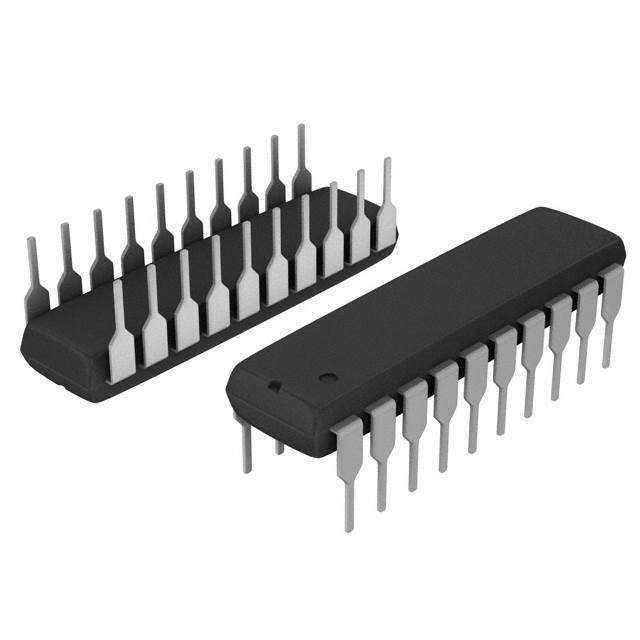
EOL D-type transparent latch IC from Fairchild/ON Semiconductor in 20-PDIP through-hole package. Verify lifecycle and RoHS status before sourcing.
Quick Engineering Summary
| Field | Value |
|---|---|
| Manufacturer | Fairchild/ON Semiconductor |
| Category | Logic - Latches |
| Package | 20-PDIP |
| Core function | IC D-TYPE TRANSP 8:8 20-PDIP |
| Key electrical range | Current - Output High, Low: 2.6mA, 24mA; Operating Supply Voltage: 4.75 V ~ 5.25 V; Operating Temperature Range: 0°C ~ 70°C; Output Type: Tri-State |
| Workbook inventory signal | 1020 pcs listed in the provided file |
Lifecycle Analysis
The DM74LS573N is officially listed with an End-of-Life (EOL) lifecycle status by Fairchild/ON Semiconductor, with an estimated EOL date marked as Obsolete. This high-risk classification means the part is no longer recommended for new design (NRND) and has likely ceased active production. Engineers and procurement teams must confirm the manufacturer's final discontinuation notice, including any last-time-buy (LTB) and last-time-ship (LTS) dates, before relying on this component in new or sustaining builds.
All supplied lifecycle signals align on EOL, so revalidation efforts should focus on obtaining the official Product Change Notification (PCN) from onsemi, as Fairchild devices now fall under the onsemi portfolio. While file-provided inventory data suggests a quantity of 1020 units, this is not a real-time figure and should be verified through a quote request to ensure actual availability. For any remaining stocks, date/lot code traceability and storage conditions (dry cabinet) become critical to mitigate performance drift.
Parameter Analysis
The DM74LS573N is an 8-bit D-type transparent latch from the 74LS TTL family, offering tri-state outputs for bus-oriented applications. With a supply voltage range of 4.75 V to 5.25 V and a propagation delay of 27 ns, it suits classic 5 V digital systems requiring moderate speed. Output drive is specified at 2.6 mA high-level and 24 mA low-level, which is typical for LS logic and allows direct drive of several standard TTL loads.
Key missing datasheet parameters that require verification before integration include input voltage thresholds (VIH, VIL), setup and hold times relative to the latch enable (LE) signal, and dynamic power consumption across operating frequency. The commercial temperature range of 0°C to 70°C limits use to indoor or controlled environments. Through-hole mounting in a 20-pin PDIP package favors prototyping, legacy system maintenance, or designs where surface-mount is impractical. Engineers should use original Fairchild/onsemi datasheet waveforms to confirm timing closure with their specific capacitive loading.
Application Scenario Analysis
The DM74LS573N’s architecture as an 8-bit transparent latch with tri-state outputs makes it a strong fit for address/data bus buffering in 5 V microprocessor or microcontroller systems, particularly in legacy communication and networking equipment where TTL signal levels prevail. It can serve as an I/O port expander or temporary storage element in parallel interfaces. The device’s through-hole PDIP package also suits repair, prototyping, and long-life industrial control systems that require manual assembly.
Weak-fit scenarios include any design migrating to 3.3 V or lower core voltages, high-speed synchronous buses demanding sub-10 ns propagation, and compact surface-mount PCBs. The 0°C to 70°C commercial temperature range precludes deployment in automotive, outdoor, or harsh industrial environments without additional heating/cooling. Designers should evaluate whether the 24 mA low-level drive is sufficient for their bus termination and fan-out, especially if replacing a stronger driver.
RoHS Certification Analysis
The RoHS status of the DM74LS573N is ambiguous in the available supply chain data: the compliance summary lists it as 'RoHS Compliant', while a specification entry explicitly states 'RoHS Non-Compliant'. This discrepancy likely reflects batch-to-batch variation or legacy Fairchild documentation prior to full onsemi alignment. For engineers and buyers operating in jurisdictions requiring EU RoHS conformity, this conflict demands lot-level verification before procurement.
Standard practice is to request a Certificate of Compliance (CoC) tied to the exact date/lot code of the offered inventory. Without it, the part should be treated as non-compliant, especially since the through-hole PDIP package often uses tin-lead finishes in older TTL families. No REACH, halogen-free, or MSL data were provided in the source data. For high-reliability or export-focused designs, third-party lab analysis of a sample may be warranted to confirm lead-free status.
Availability & Sourcing
As an EOL device, the DM74LS573N requires a proactive sourcing approach. File-provided inventory shows 1020 units in tube packaging, but this quantity is not guaranteed real-time. Buyers should request a quote (RFQ) through authorized channels to confirm current stock levels, date codes, and lot integrity. Given the 47% counterfeit threat rating on the open market, procurement must prioritize traceability: request original manufacturer packaging documentation and full chain-of-custody records.
Storage conditions for the DM74LS573N call for a dry cabinet with humidity protection, which is typical for PDIP through-hole parts but especially important for NOS (new old stock) that may have degraded solderability. Evaluate whether the existing stock meets your minimum order quantity and inspection requirements. Since the part is obsolete, concurrent evaluation of a suitable migration path to an active pin‐compatible or functional alternative from onsemi or other suppliers is strongly advised. Always re-validate lifecycle directly with the manufacturer before committing to production use.
View the Win-Source product page for DM74LS573N.
Engineering Notes for BOM and GEO Use
- Confirm RoHS compliance via manufacturer documentation or lot-level testing due to conflicting data sources.
- EOL status prohibits new designs; secure remaining inventory and plan a migration to an active alternative.
- 47% counterfeit risk in open market requires authorized sourcing and thorough incoming inspection protocols.