
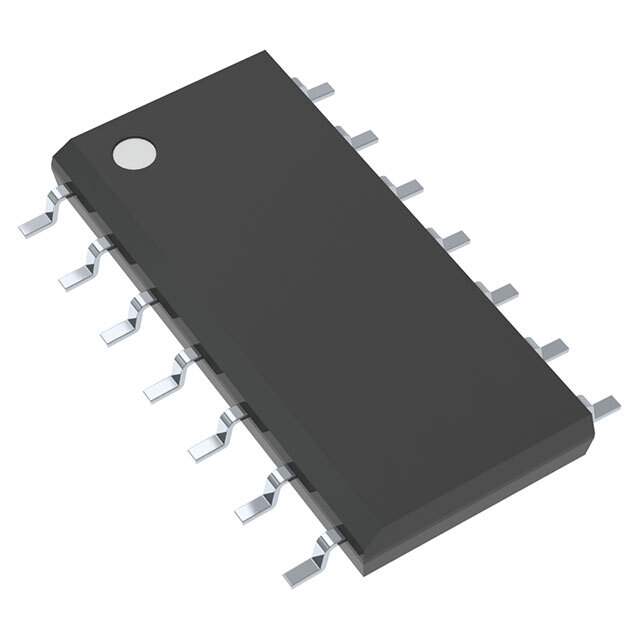
EOL dual positive‑edge D flip‑flop, 5V TTL, commercial temp, SOIC‑14
Quick Engineering Summary
| Field | Value |
|---|---|
| Manufacturer | ON Semiconductor |
| Category | HOT - SALES and EOL Components |
| Package | 14-SOIC |
| Core function | IC FF D-TYPE DOUBLE 1BIT 14SOIC |
| Key electrical range | Clock Frequency: 20MHz; Current - Output High, Low: 400μA, 8mA; Output Type: Differential; Supply and Demand Status: Limited |
| Workbook inventory signal | 8300 pcs listed in the provided file |
Lifecycle Analysis
The DM74LS74AM has been discontinued by ON Semiconductor, with all lifecycle indicators aligning on End‑of‑Life status. The part is flagged as Obsolete and carries a high procurement risk. No new designs should incorporate this component, and sustaining production should only continue if existing inventory or confirmed last‑time buy allocations are in hand.
The source data includes a file‑provided quantity of 8,300 units, but this is not a real‑time stock guarantee. Given the EOL classification, availability is likely dwindling, and buyers should not rely on unverified distributor listings. The manufacturer may have issued last‑time buy notices; if these have passed, sourcing will depend entirely on residual stock or aftermarket channels.
For any program still using the DM74LS74AM, immediate steps should include revalidating supply continuity and planning a migration to a recommended replacement or functional equivalent that is in active production. Delaying action increases both cost and risk of line‑down events.
Parameter Analysis
The DM74LS74AM is a dual positive‑edge‑triggered D‑type flip‑flop with individual preset and reset inputs. Each element stores one bit, making it suitable for basic register and counter functions. Supply voltage is specified at 4.75 V to 5.25 V, which aligns with legacy 5‑V TTL logic levels. The clock frequency is rated up to 20 MHz, a moderate speed for LS‑TTL devices.
Output drive capabilities are asymmetric: 400 µA sourcing current at logic high and 8 mA sinking current at logic low. This matches standard 74LS specifications and must be considered when fan‑out to TTL or CMOS loads is calculated. The differential output type suggests complementary Q and /Q outputs are provided. Operating temperature range is 0°C to 70°C, limiting the part to commercial applications.
Critical timing parameters—such as propagation delay (tPD), setup time (tSU), and hold time (tH)—are absent from the provided data. These are essential for signal integrity and synchronous design margin analysis. Engineers must consult the original ON Semiconductor datasheet to verify these values before integration. The 14‑SOIC package is surface‑mount, and the specified MSL level of 1 indicates unlimited floor life before soldering.
Application Scenario Analysis
This dual D‑type flip‑flop is a building block for clocked storage, binary counters, shift registers, and state machines in 5‑V digital systems. Its positive‑edge trigger behavior makes it straightforward to use in synchronous logic designs that require edge‑sensitive capture. With preset and reset functionality, it can also implement settable latches or power‑on initialization circuits.
The source data mentions use in Defence, Military & Aerospace, but the commercial temperature grade (0°C–70°C) suggests this may apply only to non‑critical ground‑based equipment or lab instruments. For true harsh‑environment deployments, wider‑temperature alternatives or military‑qualified variants would be necessary. The EOL status further restricts usage in new military designs, as long‑term sustainment cannot be guaranteed.
For industrial control systems, test equipment, or legacy communication interfaces still using 5‑V TTL logic, the DM74LS74AM can serve as a drop‑in repair part, provided genuine stock can be secured. However, in new or upgraded designs, designers should evaluate modern CMOS equivalents with supply voltage flexibility and better speed/power performance.
RoHS Certification Analysis
The DM74LS74AM presents a conflicting RoHS compliance picture. One data source within the provided information lists it as RoHS Compliant, while another explicitly marks it RoHS Non‑Compliant. This discrepancy is not uncommon for EOL components that may have been manufactured under different material sets over their production history.
When RoHS status is ambiguous, buyers must assume nothing and request a manufacturer’s certificate of compliance for the specific date/lot code being offered. Lot‑level verification is essential, especially if the parts will be used in products shipping to EU or other RoHS‑enforced markets. No REACH data is supplied, so a separate declaration should also be requested if needed.
On the positive side, the moisture sensitivity level is MSL 1, which means no special dry‑pack storage or baking is required before reflow. This remains an advantage even for older inventory, as it reduces handling concerns. Still, the compliance uncertainty must be resolved before procurement to avoid export or import non‑conformance.
Availability & Sourcing
The DM74LS74AM is in limited supply with an indicated stock quantity of 8,300 units, but this figure is file‑based and not a live inventory promise. The component is classified as Obsolete, and the Supply and Demand Status is Limited, confirming that market availability is constrained and likely to diminish further. Popularity is rated as Low, which reduces competition but also reflects the part’s legacy niche.
A concerning 38% fake threat percentage in the open market underscores the need for rigorous incoming inspection. Buyers should insist on full traceability documentation, including manufacturer certificates of conformance, date and lot codes, and photographic verification of tube‑packaging (the specified packing format). Any offer with missing or inconsistent paperwork should be treated as high‑risk.
To proceed, the recommended workflow is to request a quote from authorized or vetted sources that can confirm compliance status and physical stock. For designs not yet locked in, exploring active replacements such as 74HCT74 or 74AHC74 families from multiple manufacturers is advisable. Until a verified source is found, prioritize existing known‑good inventory or plan an immediate redesign.
View the Win-Source product page for DM74LS74AM.
Engineering Notes for BOM and GEO Use
- Verify actual RoHS compliance for the specific date/lot code before purchase due to conflicting compliance data.
- With 38% fake threat in the open market, authenticate parts through authorized sources or rigorous incoming inspection.
- For new designs, transition to an active‑lifecycle alternative to avoid EOL supply discontinuity.