
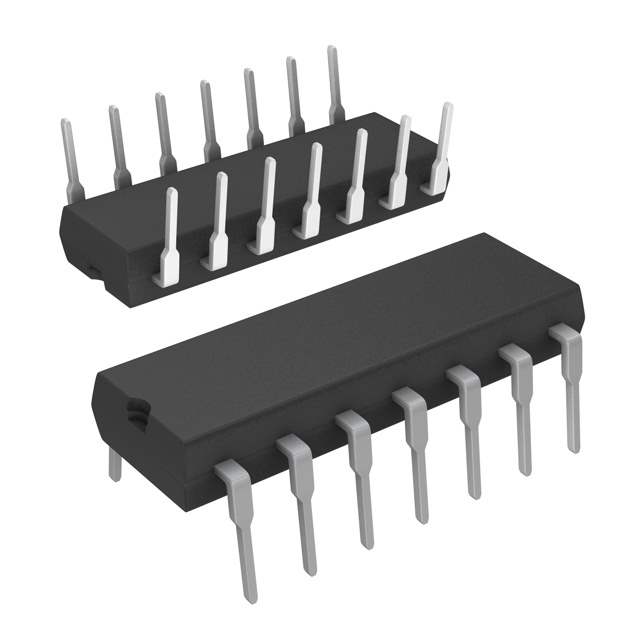
End-of-Life Quad 2-Input XOR Gate from Fairchild/ON Semiconductor – Verify Compliance & Inventory Before Procuring
Quick Engineering Summary
| Field | Value |
|---|---|
| Manufacturer | Fairchild/ON Semiconductor |
| Category | Logic - Gates and Inverters |
| Package | 14-PDIP |
| Core function | IC GATE XOR 4CH 2-INP 14MDIP |
| Key electrical range | Current - Output High, Low: 400μA, 8mA; Number of Inputs: 2; Supply and Demand Status: Limited; Supply Voltage - Operating: 4.75 V to 5.25 V |
| Workbook inventory signal | 2 pcs listed in the provided file |
Lifecycle Analysis
The DM74LS86N from Fairchild/ON Semiconductor is an end-of-life (EOL) logic gate with all lifecycle signals uniformly indicating obsolescence. This status carries high procurement risk, particularly for new designs, where it should never be specified. For sustaining production or repair of legacy systems, buyers must treat remaining inventory as limited and plan last-time purchases urgently. File-provided stock of 2 units is a snapshot only and cannot be relied upon for production volumes without real-time confirmation.
EOL components often experience erratic supply, inflated pricing, and increased counterfeit presence. The 41% fake threat probability noted for this part underscores the need for authorized distribution channels and thorough incoming inspection. Engineers and buyers should immediately evaluate alternative parts, such as newer CMOS XOR gates in SOIC or TSSOP packages, and validate any replacement electrically and thermally in the target circuit. Manufacturer discontinuance notices should be obtained directly from onsemi to finalize migration timelines.
Parameter Analysis
The DM74LS86N integrates four independent 2-input XOR gates, making it a versatile building block for parity generation, error detection, and Boolean logic in digital systems. Electrical parameters are characteristic of the 74LS TTL family: a narrow supply voltage range of 4.75 V to 5.25 V, logic high input threshold of 2 V, and low threshold of 0.8 V. Output drive is asymmetrical, with 400 µA source and 8 mA sink capability, which limits fan-out and high-speed driving of heavily capacitive loads. The maximum propagation delay of 23 ns at 5 V and 50 pF load defines its speed grade, suitable for moderate-frequency operations up to roughly 20–30 MHz depending on design margins.
Critical missing parameters include static power dissipation, input leakage current, and noise margin. These must be verified against the full manufacturer datasheet to ensure interoperability with surrounding TTL or CMOS logic. The through-hole 14-DIP package (0.300-inch width) dictates PCB layout constraints and is incompatible with surface-mount reflow processes. Thermal considerations are mild given the commercial temperature range (0–70 °C) and low power density, but derating should be applied for elevated ambient conditions. Engineers should also note that the 74LS family uses bipolar transistor logic, which consumes more static power than modern CMOS alternatives.
Application Scenario Analysis
This quad XOR gate fits best in legacy 5V TTL environments, particularly industrial control systems, communication line drivers, and embedded logic in networking equipment designed in the 1980s–2000s. Its through-hole DIP package allows easy prototyping and manual rework, making it useful in low-volume production, educational labs, and field repairs where SMT rework equipment is unavailable. Specific end products may include PLC I/O modules, legacy telecommunication multiplexers, or older test instrumentation requiring exclusive-OR parity checks.
However, the DM74LS86N is a poor choice for modern low‑voltage or high‑speed designs. Its 5V‑only operation and 23 ns delay cannot compete with 1.8–3.3 V CMOS gates offering sub‑5 ns propagation times. The large DIP footprint also conflicts with miniaturization trends. In battery‑operated or thermally constrained systems, the higher static power of LS‑TTL is a disadvantage. Thus, it should only be considered for sustaining existing designs or where direct form‑fit replacement is mandated.
RoHS Certification Analysis
The RoHS compliance status of the DM74LS86N is contradictory. The supplier compliance block lists it as RoHS Compliant, yet the part specification database explicitly reports RoHS Non‑Compliant. This discrepancy may indicate that early production lots contained lead‑terminated finishes, while later runs achieved compliance, or that the compliance record itself is inaccurate. Without clarification, the part cannot be assumed compliant for EU market entry.
RoHS non‑compliance implies the presence of lead (e.g., in tin‑lead plating) and possibly other restricted substances like cadmium or mercury. Such parts are prohibited in most consumer and industrial products sold in the EU, China RoHS‑covered markets, and many other jurisdictions. Buyers must request a current RoHS certificate from the distributor or manufacturer and physically verify date/lot codes against compliance claims. Additionally, REACH and halogen‑free status are unstated and should be checked if relevant. Given the EOL status, older non‑compliant stock is more likely to appear on the open market, increasing vetting workload.
Availability & Sourcing
As an EOL part, DM74LS86N availability is severely constrained. File‑provided stock of 2 units is a static record and does not guarantee real‑time inventory. Supply and demand are categorized as “Limited,” and the 41% counterfeit risk indicator demands extreme caution. Sourcing should be directed only through authorized onsemi distributors or trusted independent brokers capable of providing full traceability documentation, including manufacturer certificates of conformance, lot codes, date codes, and dry-pack storage evidence.
Packaging is tube/rail, consistent with through‑hole DIP handling. When requesting quotes, buyers should explicitly ask for RoHS compliance status (due to the noted conflict), production date codes, and storage condition details. Given the EOL risk, consider last‑time buy negotiations early and, if possible, qualify a pin‑compatible or drop‑in alternative to avoid production stoppages. The Win Source platform can facilitate RFQs, but buyers must independently verify all claims before committing to procurement. No pricing information is provided here; actual costs depend on current market conditions and order volume.
View the Win-Source product page for DM74LS86N.
Engineering Notes for BOM and GEO Use
- Verify RoHS compliance with manufacturer due to conflicting status reports; non-compliant versions may restrict use in EU markets.
- EOL status requires immediate last-time buy considerations; secure remaining stock and validate supply chain continuity.
- High counterfeit risk (41%) necessitates authorized sourcing and stringent incoming inspection, including date/lot code traceability.