
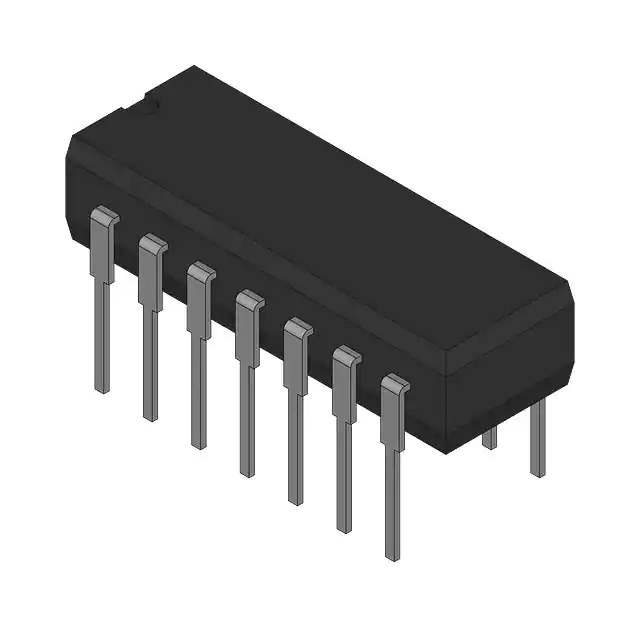
Discontinued quad 2‑input NOR gate, 14‑DIP package, from Fairchild/ON Semiconductor.
Quick Engineering Summary
| Field | Value |
|---|---|
| Manufacturer | Fairchild/ON Semiconductor |
| Category | Logic - Gates and Inverters |
| Package | Tube |
| Core function | IC GATE NOR 4CH 2-INP 14MDIP |
| Key electrical range | Current - Output High, Low: 1mA, 20mA; Input Logic Level - High: 2V; Input Logic Level - Low: 0.8V; Number of Inputs: 2 |
| Workbook inventory signal | 8600 pcs listed in the provided file |
Lifecycle Analysis
The DM74S02N has been discontinued by Fairchild/ON Semiconductor, placing it firmly out of active production. For engineers, this means the part is not recommended for new designs, and any bill of materials depending on it should be reviewed for a migration strategy. The lifecycle status carries high procurement risk: no further factory output is expected, and future demand must be satisfied from remaining stock in the open market.
The available data contains conflicting signals—Excel records show EOL while other fields state Discontinued—but the conservative interpretation is a finalized end‑of‑life. Any quantity appearing in distributor or broker inventories is file‑provided and not guaranteed real‑time. Teams maintaining legacy systems should treat this component as a last‑time‑buy candidate and immediately pursue supplier‑direct verification of remaining inventory levels and lot integrity.
Parameter Analysis
The DM74S02N is a quad 2‑input positive‑NOR gate, meaning it contains four independent NOR functions in a single 14‑pin DIP package. The logic type and input count are the most fundamental design‑fit parameters. The supply voltage is tightly specified at 4.75V to 5.25V, which aligns with classic 5‑V TTL rails, and maximum propagation delay is 7.5 ns at 5 V with a 50 pF load. These timing figures are critical for ensuring proper logic hold times and clock synchronization in digital systems.
Output drive currents are rated at 1 mA for high‑level sourcing and 20 mA for low‑level sinking, which defines fan‑out capability when interfacing with other TTL or LSTTL devices. Input thresholds (0.8 V low, 2 V high) are standard for the 74S TTL family. The operating temperature range of 0°C to 70°C limits deployment to commercial environments; industrial or extended‑range applications require careful thermal evaluation. Missing from the provided data are typical power dissipation, input clamp currents, and noise margins—items that should be verified in the original Fairchild/ON Semiconductor datasheet before finalizing a design.
Application Scenario Analysis
As a discrete logic element, the DM74S02N fits wherever basic Boolean NOR functions are required, such as in address decoding, reset generation, or combinatorial gating. The 14‑DIP through‑hole package and 5‑V supply make it suited for breadboarding, legacy equipment repair, and sustaining older industrial controllers where surface‑mount replacements are not practical.
Its discontinued status, however, limits its suitability for new commercial products. It may still be viable in military or aerospace maintenance scenarios where existing qualification records require an identical part number, but any such use demands rigorous lot‑level authenticity checks and lifetime‑buy commitments. For modern designs, an active CMOS or low‑power logic family (e.g., 74HC, 74LVC) would be a more appropriate starting point, while the DM74S02N should only be considered for exact pin‑for‑pin replacements when no redesign is feasible.
RoHS Certification Analysis
The RoHS status of the DM74S02N presents a serious verification challenge. The source data contains a direct contradiction: the component‑level RoHS Status is listed as ‘RoHS Non‑Compliant’, yet the overarching compliance field reports ‘RoHS Compliant’. This inconsistency likely arises from different evaluation scopes—one may reflect the original device, while the other might pertain to a specific production lot or a different package finish. Without clarification, no blanket RoHS statement should be relied upon.
For procurement, this means that RoHS compliance must be confirmed on a per‑lot basis. Request the full material declaration and a valid RoHS certificate from the supplier before accepting stock. If the part is truly non‑compliant and your product must meet EU or similar regulations, it may be necessary to seek an alternative part or apply for an exemption. Do not assume that the mere presence of ‘RoHS Compliant’ in an aggregated database suffices for regulatory purposes.
Availability & Sourcing
The DM74S02N is discontinued, so availability is entirely dependent on residual distributor stock or surplus channel inventory. File‑provided quantity shows 8,600 units, but this is a static snapshot and not a real‑time guarantee. Packaging is tube, with a nominal standard package of 2,664 pieces, though actual lots may vary. Sourcing teams should treat every advertised quantity as unvalidated until a formal quote is received.
When procuring this part, emphasize the need for documented date/lot codes, physical inspection for counterfeits (the open‑market fake threat is estimated at 59%), and compliance certificates. Use an RFQ process that explicitly asks for RoHS status, traceability, and lead inspection reports. Because this is an EOL component, negotiate return terms and consider purchasing the entire available lot to avoid future shortages. For active production lines, immediately escalate the lifecycle status to engineering and initiate a migration plan to an alternative logic device.
View the Win-Source product page for DM74S02N.
Engineering Notes for BOM and GEO Use
- Verify RoHS compliance on a per‑lot basis; conflicting data makes blanket certification unreliable.
- Confirm pinout and electrical compatibility with existing designs by reviewing the original manufacturer’s datasheet before substituting.
- Since the DM74S02N is discontinued, secure inventory early and evaluate migration paths to active logic families for new production.