
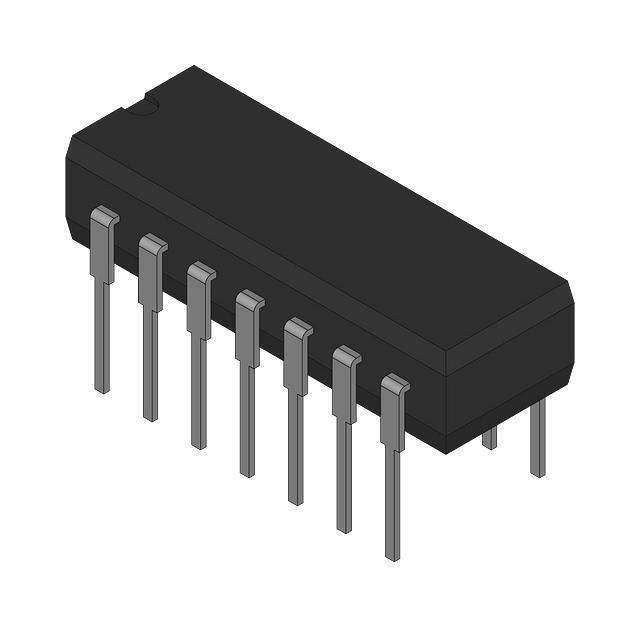
EOL dual 4-input NAND gate in 14-DIP package; RoHS compliant, limited stock available.
Quick Engineering Summary
| Field | Value |
|---|---|
| Manufacturer | ON Semiconductor |
| Category | HOT - SALES and EOL Components |
| Package | 14-DIP |
| Core function | IC GATE NAND 2CH 4-INP 14MDIP |
| Key electrical range | Current - Output High, Low: 1mA, 20mA; Number of Inputs: 4; Supply and Demand Status: Limited; Supply Voltage (V): 4.75V ~ 5.25V |
| Workbook inventory signal | 2350 pcs listed in the provided file |
Lifecycle Analysis
The DM74S20N is classified as End-of-Life (EOL) by ON Semiconductor, indicating that the manufacturer has discontinued production and is no longer recommending this part for new designs. Procurement for ongoing production requires immediate action to secure existing inventory or qualify a replacement. According to supplied data, lifecycle signals are consistent, showing no conflicts: both status fields and category tagging confirm the EOL status. This is a high-risk component for any project that has not yet completed the product lifecycle transition.
The file-provided inventory quantity for DM74S20N shows 2,350 units, but this number is not guaranteed real-time and may deplete rapidly given the limited supply status. Engineers and buyers should treat this figure as a snapshot and plan for a last-time buy immediately to cover production needs. Additionally, the open market poses a high counterfeit threat (49 percent) for this obsolete part, necessitating rigorous supplier verification and traceability.
For new designs, a migration to an active alternative is strongly advised. For sustaining production, secure DM74S20N inventory while simultaneously validating pin-compatible substitutes or redesigning the logic function using active, widely available logic families. Request official EOL notices and PCN documentation from ON Semiconductor to confirm timelines and last-ship dates.
Parameter Analysis
The DM74S20N contains two independent 4-input NAND gates in a single 14-pin DIP through-hole package. It operates from a supply voltage of 4.75V to 5.25V, appropriate for standard TTL-compatible logic systems. The logic input thresholds are 2V for a high level and 0.8V for a low level, ensuring compatibility with legacy 5V TTL families. Output drive capability is asymmetric: the high-level output can source 1mA, while the low-level output can sink up to 20mA. This makes the device better suited for driving TTL loads or active-low indicators where the low state requires stronger current sinking.
The maximum propagation delay is specified as 8ns at 5V with a 50pF capacitive load, which is typical of Schottky-clamped TTL. For many moderate-speed digital applications, this delay is acceptable, though not competitive with modern CMOS families. Operating junction temperature range is 0°C to 70°C, limiting the DM74S20N to commercial environments only. No thermal resistance or power dissipation data is supplied in the source, so thermal analysis for high-reliability designs would require the full datasheet from ON Semiconductor.
Important missing parameters include quiescent supply current (ICC), input leakage current (IIH/IIL), and ESD protection levels. These would be necessary for power budgeting and handling precautions. Also, no timing diagrams or setup/hold specifications are provided, which are irrelevant for combinational gates but might be needed if using in asynchronous designs. Engineers should refer to the original ON Semiconductor datasheet to close these gaps before committing to use.
Application Scenario Analysis
The DM74S20N serves well as a basic combinational logic element in through-hole designs. Its dual 4-input NAND configuration is useful for implementing Boolean functions requiring wide AND-OR-INVERT structures, such as address decoding, glue logic in microcontroller interfaces, or generating complex chip-select signals. The 14-DIP package and through-hole mounting style are advantageous for hand-soldered prototypes, breadboarding, or repairing legacy equipment where mechanical robustness and ease of replacement are priorities.
The device is a strong fit for sustaining older industrial or commercial equipment originally designed with 74S series logic, where a drop-in form-and-function replacement is needed. Hobbyists and educational labs may also find it useful for teaching digital logic fundamentals, as the DIP format is easy to handle. However, the EOL status means that new production runs of commercial products should not adopt this part unless no alternative exists.
Weak-fit scenarios include modern high-speed digital systems where nanosecond-level timing margins are critical, as 8ns delay may be excessive. Also, the 5V-only supply and commercial temperature range exclude it from portable, low-voltage, or automotive/industrial extended-temperature applications. The low output-high current (1mA) makes it unsuitable for driving high-brightness LEDs or heavy loads directly. For new designs, consider 74HC20 or 74HCT20 families in active, surface-mount variants to overcome these limitations.
RoHS Certification Analysis
According to supplied data, the DM74S20N is marked as RoHS Compliant. This indicates that the part meets the requirements of the EU Restriction of Hazardous Substances Directive, typically RoHS 2 (2011/65/EU) or RoHS 3 (2015/863). However, the exact directive version is not specified, and no exemption documentation is provided. Consequently, for high-compliance projects, it is advisable to request a certificate of compliance (CoC) or full material declaration from the supplier for the specific batch.
The part also carries an MSL (Moisture Sensitivity Level) rating of 1, which means it has unlimited floor life under standard conditions. This is a considerable advantage for inventory management, as no baking is required before soldering, even after prolonged storage. However, MSL is independent of RoHS, so it should not be mistaken for a substitute for hazardous substance compliance verification.
No REACH statement or halogen-free information is available in the provided data. Procurement teams should clarify REACH SVHC status directly with the distributor or manufacturer if required by company policy, especially for shipments into EU markets. Lot-level traceability can be used to ensure that the RoHS compliance is maintained.
Availability & Sourcing
Sourcing the DM74S20N requires a careful approach due to its EOL and high counterfeit risk. The component is packaged in tubes, with a manufacturer pack quantity of 25 units per tube. Distributors may still hold limited stocks, as evidenced by the file-provided quantity of 2,350 units, but this figure is static and real-time availability must be confirmed via RFQ. Buyers should request a quote for current pricing and lead time, noting that no price information is provided here.
Given the 49 percent fake threat in the open market, purchasing only from authorized or reputable distributors with strong anti-counterfeit policies is essential. Insist on full traceability documentation, including date/lot codes and certificates of conformance (CoC). Visual inspection and, if possible, decapsulation testing may be warranted for mission-critical applications. The packaging in tubes facilitates partial reel retrieval, but ensure that handling and ESD precautions are observed.
For ongoing production, secure as many DM74S20N units as needed to cover the product lifecycle, as EOL parts can become unobtainable quickly. Simultaneously, engage with engineering teams to qualify a suitable replacement, such as a 74HC20 or 74ACT20 in a compatible DIP package, to mitigate supply chain risk. Request an official latest-time buy notice from ON Semiconductor to align procurement with contractual obligations. For immediate needs, use the provided Win Source part number 252452-DM74S20N for reference when contacting suppliers.
View the Win-Source product page for DM74S20N.
Engineering Notes for BOM and GEO Use
- Verify actual output drive strength (1mA high / 20mA low) for interfacing with modern low-power logic families.
- Given EOL status and 49% open-market counterfeit risk, source only from authorized distributors with traceability.
- Operating voltage of 5V ±5% requires stable supply; consider LDO regulation if using in battery-powered designs.