
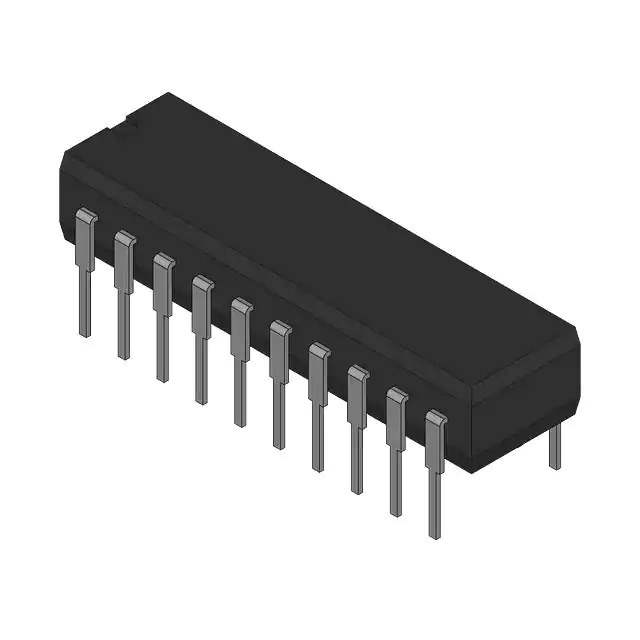
Fairchild/ON Semiconductor 8-bit universal shift register with tri-state outputs in 20-PDIP package, active lifecycle.
Quick Engineering Summary
| Field | Value |
|---|---|
| Manufacturer | Fairchild/ON Semiconductor |
| Category | Logic - Shift Registers |
| Package | Bulk |
| Core function | IC TRI-STATE 8BIT 20-PDIP |
| Key electrical range | Output Type: Tri-State; Temperature Range - Operating: 0°C ~ 70°C; Voltage - Supply: 4.75V ~ 5.25V |
| Workbook inventory signal | 1 pcs listed in the provided file |
Lifecycle Analysis
DM74S299N is currently listed as Active with all lifecycle signals aligned, indicating continued production and support from Fairchild/ON Semiconductor. For new designs, this status supports integration without immediate obsolescence concerns. However, engineers should periodically verify with the manufacturer for any updates, especially since ON Semiconductor maintains legacy Fairchild product lines.
Given the file-provided inventory of 1 unit, procurement teams should not rely on this as guaranteed stock. The active lifecycle suggests that additional supply can be obtained through normal distribution channels upon request for quote. No end-of-life notice has been issued, so this part remains suitable for both new production and sustaining builds.
To manage long-term availability risk, sourcing teams should confirm lifecycle status directly with ON Semiconductor and evaluate if the part’s 74S TTL logic family may face future NRND transitions as the industry shifts toward newer technologies.
Parameter Analysis
DM74S299N is an 8-bit universal shift register featuring tri-state outputs, allowing bus-oriented applications. The device operates from a single 5V supply (4.75–5.25V) and supports commercial temperature range (0°C to 70°C), making it suitable for standard digital logic systems. The through-hole 20-DIP package (0.300" width) provides ease of prototyping and robust mechanical retention in socketed boards.
The tri-state output type enables multiple devices to share a common bus without contention, critical for memory and I/O expansion in legacy microprocessor systems. The 'universal' function indicates capability for shift-left, shift-right, parallel load, and hold operations, but the specific control pins and timing must be verified from the datasheet. Missing key parameters include maximum clock frequency, propagation delay, setup and hold times, and I/O voltage thresholds—all essential for timing closure and signal integrity analysis. The MSL level 3 requires baking before reflow if moisture exposure occurs, a notable consideration for through-hole components that may undergo wave soldering.
Engineers should confirm the exact logic family speed grade (74S series implies Schottky TTL, typically faster than standard TTL) and power dissipation for thermal management, as these devices may draw significant current.
Application Scenario Analysis
DM74S299N is well-suited for classic 5V TTL digital systems requiring parallel I/O expansion, serial-to-parallel conversion, or data buffering. Its through-hole package is ideal for prototyping, test fixtures, and low-volume industrial equipment where hand-soldering or socketing is preferred. Common applications include legacy communication interfaces, address/data bus multiplexing, and control signal generation in microcontroller-based designs.
In new designs, the 74S series offers moderate speed but is less efficient than modern CMOS logic (e.g., 74HC or 74LVC families) in terms of power consumption and voltage flexibility. Therefore, DM74S299N fits best in systems that must maintain compatibility with existing 5V TTL logic levels and do not require battery-friendly operation. It is less appropriate for portable, low-power, or mixed-voltage applications where 3.3V or lower logic is standard.
Potential weak-fit scenarios include high-reliability environments with extended temperature requirements beyond 0–70°C, or designs where the 20-pin DIP footprint consumes excessive board space. For such cases, surface-mount equivalents or CMOS alternatives should be evaluated.
RoHS Certification Analysis
The RoHS status for DM74S299N presents a conflict: the top-level compliance data indicates RoHS Compliant, while the detailed specifications list RoHS Non-Compliant. This discrepancy may stem from different data sources or part revisions. Engineers and buyers must treat this with caution. Before finalizing a bill of materials, obtain a current certificate of compliance or full material declaration from the manufacturer or authorized distributor to confirm exemption status and compliance level.
Additionally, REACH status is undefined, so it is unknown whether the part contains any Substances of Very High Concern (SVHC). The MSL rating of 3 confirms moisture sensitivity, but does not directly impact RoHS status. Since through-hole components are often exempt from lead-free requirements in certain exemptions, the part may still be sold as RoHS compliant if it meets the exemption criteria. However, this exemption logic must be verified. Without explicit lead-free or halogen-free markings, reliance on the stated RoHS status alone is insufficient.
Given the high counterfeiting risk (54%), verifying RoHS compliance at the lot level becomes even more critical, as counterfeit parts are unlikely to meet environmental regulations.
Availability & Sourcing
DM74S299N is listed as Active from Fairchild/ON Semiconductor, yet the file-provided inventory shows only one piece, which is not a real-time guarantee. Therefore, immediate availability cannot be assumed, and a request for quote (RFQ) is necessary to secure up-to-date stock. With a 54% counterfeit threat in the open market, procurement must strictly use authorized channels or verified distributors to mitigate risk.
Sourcing teams should request date and lot code traceability, along with factory-sealed packaging (bulk standard package of 1 unit) to ensure authenticity. The MSL 3 classification demands proper moisture-barrier bag packaging and handling to prevent damage during soldering. For volume orders, lead times may vary, so early engagement with suppliers is advised.
Because the lifecycle is active, users can confidently quote for production, but should simultaneously verify the manufacturer’s latest production status and consider inventory of the 74S299 base number from multiple sources. For NRND concerns down the line, long-term procurement agreements may be warranted. Always request compliance documentation (RoHS, REACH) alongside the quote to avoid later qualification issues.
View the Win-Source product page for DM74S299N.
Engineering Notes for BOM and GEO Use
- Verify RoHS compliance with manufacturer documentation, as conflicting data exists; request a CoC.
- For new designs, confirm timing parameters and power dissipation from the datasheet before integration.
- Source only through authorized distributors to mitigate 54% counterfeit risk, and inspect lot codes.