
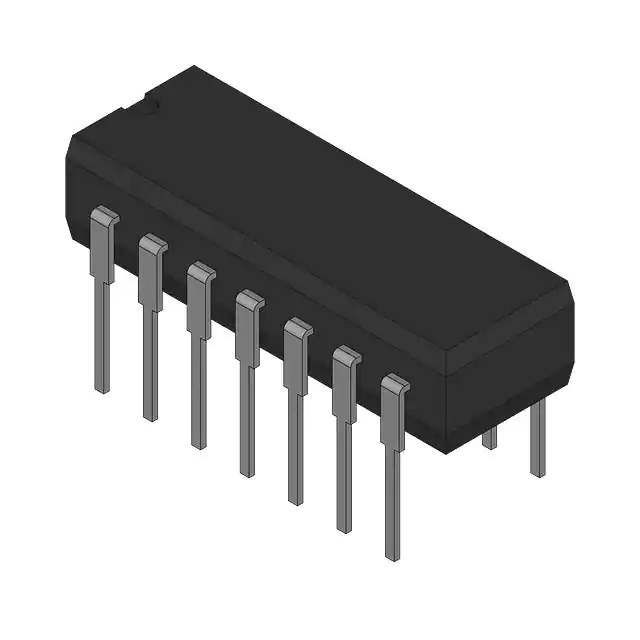
Discontinued dual 4-input NAND gate in 14-DIP package from Fairchild/ON Semiconductor. Verify RoHS and lifecycle before procurement.
Quick Engineering Summary
| Field | Value |
|---|---|
| Manufacturer | Fairchild/ON Semiconductor |
| Category | Logic - Gates and Inverters |
| Package | Tube |
| Core function | IC GATE NAND 2CH 4-INP 14MDIP |
| Key electrical range | Current - Output High, Low: 3mA, 60mA; Input Logic Level - High: 2V; Input Logic Level - Low: 0.8V; Number of Inputs: 4 |
| Workbook inventory signal | 2920 pcs listed in the provided file |
Lifecycle Analysis
The DM74S40N from Fairchild/ON Semiconductor is a discontinued logic device. Conflicting signals from the data include an EOL designation in one field and a Discontinued status in another; however, all indications confirm the part is no longer in active production. For new designs, this part should not be considered. For existing designs, procurement options are limited to residual stock or the gray market. Engineers must verify the manufacturer’s official discontinuation notice to determine last-time-buy dates or any available supply. The file-provided inventory quantity of 2920 units is not guaranteed real-time and requires confirmation with a distributor.
As a Discontinued part, the risk level is high. Sustaining production with this device depends on locating verifiable stock with proper date codes and traceability. Any stock found should be secured quickly, but migration to an alternative active part is recommended for long-term support. The 74S series is an older high-speed TTL logic family, and replacement parts may require redesign due to voltage and timing differences.
Parameter Analysis
The DM74S40N is a dual 4-input NAND gate from the 74S Schottky TTL family. Key parameters include a maximum propagation delay of 9ns at 5V with a 150pF load, which is fast for TTL logic but surpassed by modern CMOS equivalents. The supply voltage range is tight at 4.75V to 5.25V, typical of 5V TTL systems, and output drive currents are 3mA high and 60mA low, suitable for driving standard TTL loads. The operating temperature range is 0°C to 70°C, indicating a commercial grade device.
Engineers should note that through-hole 14-DIP packaging limits board density and may not be compatible with modern surface-mount assembly processes. Critical missing datasheet information includes input current requirements, power dissipation, and noise immunity specifics. Before using this part in a design or replacement, verify these parameters against the original datasheet, as the 74S family can consume significant power compared to LS or CMOS substitutes. The base product number 74S40 provides the generic part reference for further research.
Application Scenario Analysis
The DM74S40N is best suited for legacy digital systems that require exact form, fit, and function replacements, such as industrial controllers, test equipment, or vintage computer boards originally designed with 74S TTL logic. Its through-hole DIP package makes it easy to replace in hand-soldered assemblies or for prototyping repairs. The 2-channel, 4-input NAND configuration is common in glue logic for address decoding or signal gating.
Conversely, the DM74S40N is a poor choice for new designs due to its obsolete status, high power consumption relative to modern CMOS logic, and limited availability. For applications requiring high-speed logic, modern families like 74HCT or advanced Low-Voltage CMOS offer better speed, lower power, and surface-mount packages. Additionally, the commercial temperature range may not suit industrial extended temperature environments, so designers should cross-check operational requirements before relying on this part.
RoHS Certification Analysis
Conflicting RoHS data exists for the DM74S40N: the top-level compliance field reports RoHS Compliant, while a specification entry states RoHS Non-Compliant. In practice, through-hole DIP packages from the 74S era often contain lead (Pb) in the terminal finish, making them non-compliant with EU RoHS directives unless a specific exemption applies. The exemption for lead in solders for through-hole devices (e.g., Annex III or IV) may no longer be valid, so verification is critical.
For procurement, engineers should request a full material declaration or RoHS test report from the distributor to confirm compliance status. If the part is non-compliant, it may not be suitable for shipments into the EU or other regulated markets without proper exemptions. As the DM74S40N is discontinued, finding a compliant stock may be even more challenging. This conflict underscores the importance of verifying environmental compliance documentation before finalizing a purchase.
Availability & Sourcing
The DM74S40N is a discontinued part, meaning availability depends entirely on existing stock held by distributors or aftermarket suppliers. The file indicates a quantity of 2920 units, but this figure is not a real-time inventory count and must be confirmed via a request for quote. A high counterfeit threat level of 56% is noted, so purchasers must insist on date/lot code traceability, manufacturer packaging authenticity (tube), and visual inspection to mitigate risk.
Given the Discontinued status, sourcing this part requires conservative procurement strategies: secure inventory immediately from trusted sources, verify the part’s origin and conformity, and evaluate whether an alternative active part can serve as a longer-term solution. For any quotes, explicitly request RoHS compliance certificates and discontinuation notices. The standard package of 951 units suggests that full tubes may be available. Since the DM74S40N is no longer supported, always cross-check with ON Semiconductor for any remaining authorized distribution channels.
View the Win-Source product page for DM74S40N.
Engineering Notes for BOM and GEO Use
- Obtain manufacturer’s discontinuation notice and confirm the last-time-buy date before committing to a production run.
- Verify RoHS compliance status with a full material declaration, as conflicting data exists between supplier fields for the DM74S40N.
- Functional testing is recommended for parts sourced from the open market due to a 56% counterfeit risk and the part’s discontinued status.