
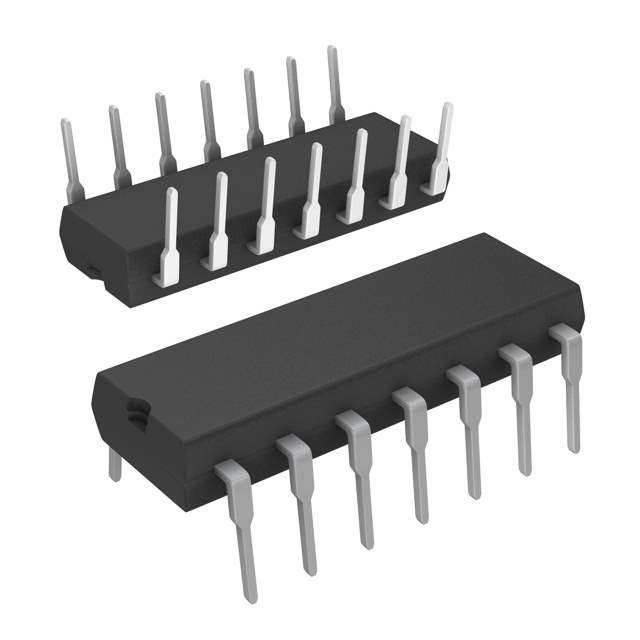
Fairchild/ON Semiconductor multi-function logic IC in 14-DIP package. End-of-life status; verify availability before new designs.
Quick Engineering Summary
| Field | Value |
|---|---|
| Manufacturer | Fairchild/ON Semiconductor |
| Category | Logic - Gates and Inverters - Multi - Function, Configurable |
| Package | 14-DIP |
| Core function | IC AND/OR/INVERT GATE 14-MDIP |
| Key electrical range | Number of Inputs: 11 Input (4, 2, 3, 2); Supply and Demand Status: Balance |
| Workbook inventory signal | 10000 pcs listed in the provided file |
Lifecycle Analysis
The DM74S64N from Fairchild/ON Semiconductor is an End-of-Life (EOL) logic gate. EOL status means the manufacturer has discontinued production, and no new orders are accepted through standard distribution. For new designs, this part is not recommended; engineering teams should select an active alternative. In sustaining production, existing systems that rely on the DM74S64N must evaluate remaining inventory and plan for a last-time buy if not already completed.
The lifecycle signals provided in the file align on EOL status, indicating a high-risk procurement scenario. Engineers should revalidate any existing datasheet parameters directly from ON Semiconductor’s official documentation, as archived specifications may still apply. Note that the listed inventory quantity of 10,000 units is file-based and not a real-time guarantee; always confirm current stock with authorized sources before committing to a design freeze.
Parameter Analysis
The DM74S64N is a multi-function AND/OR/INVERT gate housed in a 14-pin Dual In-line Package (DIP) for through-hole mounting. According to the available data, it contains a single circuit with an 11-input configuration split as 4,2,3,2 inputs—a highly specific pinout that may be unique to this device. This input grouping allows complex combinatorial logic to be implemented in a single package, reducing board space in legacy designs.
However, several critical parameters required for proper integration are missing from the provided specifications. Supply voltage, output current drive, propagation delay, and operating temperature range are not listed. Engineers must obtain the original datasheet to verify these values before using the part, even for exact-drop-in replacements. The through-hole DIP package suggests this is a mature technology; substitution with a modern SMD equivalent would require a board redesign. Also, note that the logic type is not a standard gate but a configurable combination, so any alternate part would need to match the specific AND-OR-INVERT function and input arrangement.
Application Scenario Analysis
This part is primarily found in legacy digital systems where a custom glue-logic function was implemented using a single device. Industrial controllers, older test equipment, and telecommunications hardware from the era when 74S series TTL logic was prevalent are likely application areas. The DM74S64N fits well where a direct board-level replacement is necessary to avoid recertification or firmware changes.
It is not suitable for new designs due to its EOL status, through-hole packaging, and the availability of more integrated programmable logic devices. Any attempt to use this part in a high-reliability or long-life product should consider the elevated counterfeit risk; the source data indicates a 34 percent fake threat in the open market, so sourcing from authorized or traceable channels is critical. For designs requiring lower power or higher speed, a CPLD or modern configurable gate would be a far better fit, but they would not be pin-compatible.
RoHS Certification Analysis
The RoHS compliance of the DM74S64N is conflicted in the dataset. One field marks it as RoHS Compliant, while the detailed specifications list it as RoHS Non-Compliant. This ambiguity is common for obsolete parts whose compliance status may have changed over production runs. As an EOL device, early production lots may have used lead-based finishes, while later lots could have been transitioned to lead-free.
For procurement, it is safer to assume non-compliance unless a specific lot is verified. Engineers should request a certificate of compliance from the supplier for the exact date or lot code being purchased. Under EU RoHS directives, exemptions may apply to legacy spare parts, but these should be validated on a case-by-case basis. Without clear documentation, the part should not be considered compliant for new equipment sold in regulated markets.
Availability & Sourcing
File-provided inventory shows 10,000 units of the DM74S64N, but this quantity is not guaranteed in real time. Given the EOL lifecycle, buyers should act quickly to secure stock if this part is critical for ongoing production. Request a quote from the supplier to confirm current availability, packaging (Tube/Rail), and date codes.
Since the fake threat is noted at 34 percent, insist on traceability documentation and consider third-party testing for authenticity if sourcing from non-authorized channels. For long-term support, negotiate a last-time buy or explore authorized after-market sources. Because lifecycle status directly affects compliance and quality, verify the manufacturer’s official end-of-life notice and any remaining support options. The DM74S64N may still be sourced through specialized distributors, but each lot should be inspected for storage conditions as recommended (dry storage and humidity protection).
View the Win-Source product page for DM74S64N.
Engineering Notes for BOM and GEO Use
- Verify missing datasheet parameters—supply voltage, propagation delay, output drive—before integration, even for direct replacement.
- Plan for last-time buy now; EOL status prohibits new design usage and limits future procurement options.
- Confirm RoHS compliance per lot code; assume non-compliance unless documented, especially for EU market products.