
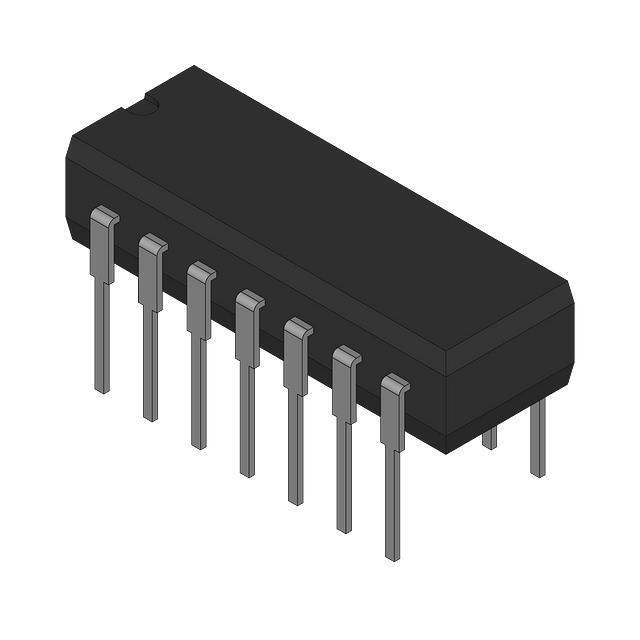
Dual D-type positive-edge-triggered flip-flop with set and reset; 14-pin DIP package, EOL lifecycle, RoHS compliant.
Quick Engineering Summary
| Field | Value |
|---|---|
| Manufacturer | ON Semiconductor |
| Category | HOT - SALES and EOL Components |
| Package | 14-DIP |
| Core function | IC FF D-TYPE DOUBLE 1BIT 14-DIP |
| Key electrical range | Clock Frequency: 65MHz; Current - Output High, Low: 1mA, 20mA; Output Type: Differential; Supply and Demand Status: Balance |
| Workbook inventory signal | 3365 pcs listed in the provided file |
Lifecycle Analysis
The DM74S74N is officially classified as End‑of‑Life (EOL) by ON Semiconductor, with all available lifecycle signals – including an Obsolete status and EOL parameter – aligned and showing no conflict. For new designs, this part is unsuitable; procurement teams should immediately halt any new design‑ins and instead evaluate active‑production alternatives like the 74LS74 or 74HCT74, which offer similar functionality in continued manufacture.
Sustaining production programs that rely on the DM74S74N face high risk. While a file‑provided workbook indicates a quantity of 3365 units, this figure is not a live inventory promise and may reflect old or aggregated data. Any remaining stock should be purchased only after confirming the manufacturer’s last‑time‑buy window and verifying authentic, traceable units. Failure to secure a transition plan now could lead to production line stops or exposure to counterfeit parts in the open market.
Parameter Analysis
Key decision‑relevant parameters from the supplied data include the 65MHz maximum clock frequency, the 4.75V–5.25V supply voltage range, and the complementary differential output stage. The positive‑edge trigger type and the inclusion of asynchronous set and reset inputs make this dual D‑type flip‑flop suitable for register, counter, and synchronization tasks in 5V legacy systems. Output drive capability – 1mA high and 20mA low – must be carefully checked against the loading of downstream logic, especially when driving TTL inputs.
Critical electrical and timing parameters are absent from the provided specification list. Engineers must consult the original ON Semiconductor 74S74 datasheet to verify propagation delay, maximum setup and hold times, power dissipation characteristics, and absolute maximum ratings before finalizing any sustaining design. Without these, a complete worst‑case timing analysis or thermal margin assessment cannot be performed. The through‑hole 14‑DIP package and MSL Level 1 simplify handling but limit layout density compared to surface‑mount alternatives.
Application Scenario Analysis
The DM74S74N fits best in legacy 5V digital systems where through‑hole assembly is required or preferred, such as industrial control boards, older test equipment, and academic/hobbyist projects. Its dual independent flip‑flops with set/reset are well‑suited for simple control logic, manual debounce circuits, divide‑by‑two frequency stages, and synchronous state machine building blocks operating up to 65MHz. The commercial temperature range (0°C–70°C) confines its use to benign indoor environments.
Conversely, the part is a poor choice for any new high‑density, high‑speed, or low‑power design due to its EOL status, 5V‑only operation, and large 14‑DIP footprint. Modern applications demanding surface‑mount packaging, wide voltage range, or sub‑zero industrial temperatures will find little value here. Even in legacy systems, the high open‑market counterfeit threat and vanishing supply make continued dependence risky without a validated substitute ready.
RoHS Certification Analysis
According to the supplier data, the DM74S74N is RoHS Compliant. This declaration typically covers EU Directive 2011/65/EU and its amendments, limiting hazardous substances such as lead, mercury, and cadmium. The through‑hole 14‑DIP package is usually tin‑plated or solder‑dipped, and the MSL Level 1 rating indicates no moisture‑sensitivity concerns for wave soldering processes.
However, because the part is EOL and may be sourced from aged or broker stock, compliance should not be assumed at the lot level without verification. Request a valid certificate of compliance or full material declaration from the distributor for each shipment. If REACH compliance is also required, ask explicitly, as this data was not included in the provided specification set. For high‑reliability or export‑controlled end products, third‑party testing of random samples may add an extra assurance layer.
Availability & Sourcing
The DM74S74N is a high‑risk EOL component with a reported open‑market counterfeit threat of 36%. Procurement teams must approach sourcing with extreme caution. Always request a quote (RFQ) from authorized or verified independent distributors and demand full traceability documentation, including original manufacturer date codes and lot codes. The file‑provided workbook mentions a quantity of 3365 units, but this is not a guarantee of immediate availability; treat it as a historical indicator only.
Due to the EOL lifecycle, every purchase should be preceded by a manufacturer‑issued discontinuation notice review and an in‑house incoming inspection protocol. For sustaining production, consider evaluating functional replacements like the 74LS74 (lower speed, lower power) or the 74HCT74 (TTL‑compatible CMOS) while remaining stock is still reachable. To secure what may be the last available inventory, raise an RFQ now and specify that compliance certificates and date/lot traceability are mandatory.
View the Win-Source product page for DM74S74N.
Engineering Notes for BOM and GEO Use
- Verify EOL status with ON Semiconductor before committing to production; the 74LS74 or 74HCT74 may serve as functional replacements for new designs.
- Operates at a single 5V ±5% supply; ensure TTL input thresholds and output drive (I_OH = 1mA, I_OL = 20mA) meet interface requirements.
- With a 36% counterfeit threat in the open market, mandate full traceability, date/lot codes, and authentic distributor sourcing for every shipment.