
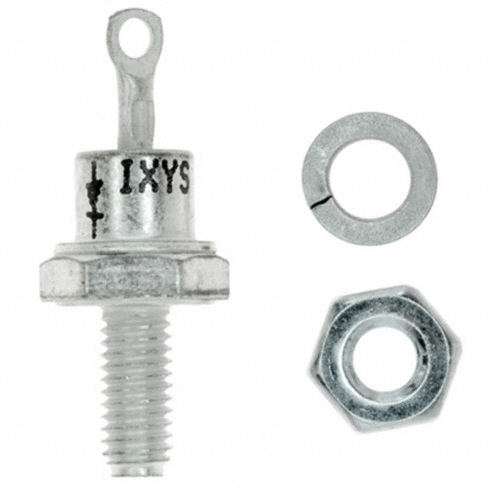
Key specifications, lifecycle, and availability insights for engineers sourcing the DMA30E1800HA power diode.
Quick Engineering Summary
| Field | Value |
|---|---|
| Manufacturer | IXYS |
| Category | Diodes, Rectifiers - Single |
| Package | TO-247-2 |
| Core function | DIODE STANDARD 1800V 30A TO247 |
| Key electrical range | Capacitance @ Vr, F: 10pF @ 400V, 1MHz; Current - Average Rectified (Io): 30A; Current - Reverse Leakage @ Vr: 40 µA @ 1800 V; Operating Temperature - Junction: -55°C ~ 175°C |
| Workbook inventory signal | 363 pcs listed in the provided file |
Lifecycle Analysis
The IXYS DMA30E1800HA is currently listed as Active with all available lifecycle signals aligning. This status indicates the part is in full production and available for new designs. Engineers can proceed with confidence, but should verify directly with IXYS or authorized distributors for any planned obsolescence or Product Change Notifications (PCNs). The supplied data shows no conflicts, and the lifecycle status is supported by manufacturer documentation. For long-lifecycle applications, monitoring IXYS's product roadmap is advisable to avoid unexpected end-of-life declarations.
A file-provided inventory quantity of 363 units was noted, but real-time availability may vary and should be confirmed through a request for quote. As an active component, the DMA30E1800HA is typically stocked by multiple distributors, but the observed shortage tag suggests that lead times could be extended; early procurement planning is recommended.
Parameter Analysis
The DMA30E1800HA offers a high reverse blocking capability of 1800V, suitable for elevated voltage rail applications. Its 30A average rectified current and 1.25V forward voltage drop at rated current indicate moderate conduction losses; designers should calculate power dissipation and ensure adequate heatsinking in continuous operation. The junction capacitance of 10pF at 400V and 1MHz is low, but the standard recovery speed (>500ns) suggests that this diode is optimized for line-frequency rectification rather than high-frequency switching.
Reverse leakage is specified at 40µA at the full 1800V rating, which is typical for a high-voltage standard diode and should be accounted for in leakage-sensitive circuits. The operating junction temperature range of -55°C to 175°C allows use in harsh environments, but derating may be necessary near the upper limit. Key missing datasheet parameters include the reverse recovery time (trr), which is essential for estimating switching losses; engineers should obtain the full IXYS datasheet for that value and consider it in any switching application.
Application Scenario Analysis
The DMA30E1800HA's 1800V 30A rating and standard recovery profile make it well-suited for 50/60Hz rectification in high-voltage industrial power supplies, welding equipment, or UPS systems. Its through-hole TO-247 package enables effective heat dissipation when mounted on a heatsink, supporting operation up to 175°C junction temperature. This diode is a strong candidate for designs that require high voltage blocking with moderate current levels and do not involve high-speed switching.
For applications such as switch-mode power supplies operating above a few kilohertz, the diode's slow recovery may lead to excessive switching losses; engineers should consider fast or ultrafast alternatives if switching frequency exceeds 1kHz. The part is also appropriate for snubber or clamping circuits where a robust, high-voltage diode is needed but switching speed is not critical. In all cases, verify thermal resistance and mounting requirements against the full datasheet to ensure safe operation.
RoHS Certification Analysis
The DMA30E1800HA is marked as RoHS Compliant, indicating compliance with EU Directive 2015/863 (RoHS 3) requirements for hazardous substance restrictions. No specific exemptions are noted in the provided data. This compliance status supports use in European and other regulated markets, but it is based on a supply-chain declaration; actual material content can vary by production lot.
Engineers and buyers should request a Certificate of Conformance (CoC) or full material declaration from the distributor or manufacturer for each batch to confirm ongoing RoHS compliance. The data also does not include REACH or halogen-free information; if these are critical to a design, they must be verified directly with IXYS. In high-reliability or commercial product certifications, relying solely on a catalog RoHS status is not sufficient.
Availability & Sourcing
The DMA30E1800HA is supplied in Tube packaging for the TO-247 package, suitable for automated handling. File-provided inventory shows 363 units, but actual availability may fluctuate; a request for quote (RFQ) is recommended to obtain real-time stock levels, lead times, and pricing. The part is Active, so standard procurement channels should support both prototype and production quantities.
Given the 'Shortage' supply and demand status indicated in the source data, early ordering and buffer stock consideration may be prudent to avoid supply gaps. Buyers should verify date/lot codes, manufacturer traceability, and request RoHS compliance certificates with each shipment. For prototype builds, a small quantity may be available from stock, but for production runs, negotiating lead times with authorized distributors is advised. Always confirm lifecycle status through official IXYS channels before finalizing a bill of materials reliant on this component.
View the Win-Source product page for DMA30E1800HA.
Engineering Notes for BOM and GEO Use
- Verify forward voltage and reverse recovery time in application circuit; the datasheet's 1.25V Vf @ 30A may shift with junction temperature.
- Confirm TO-247 thermal management and heatsink compatibility; the junction temperature range of -55°C to 175°C demands proper derating for high ambient environments.
- For high-frequency applications, note the 10pF junction capacitance @ 400V, 1MHz, but standard recovery speed (>500ns) limits use above line frequencies.