
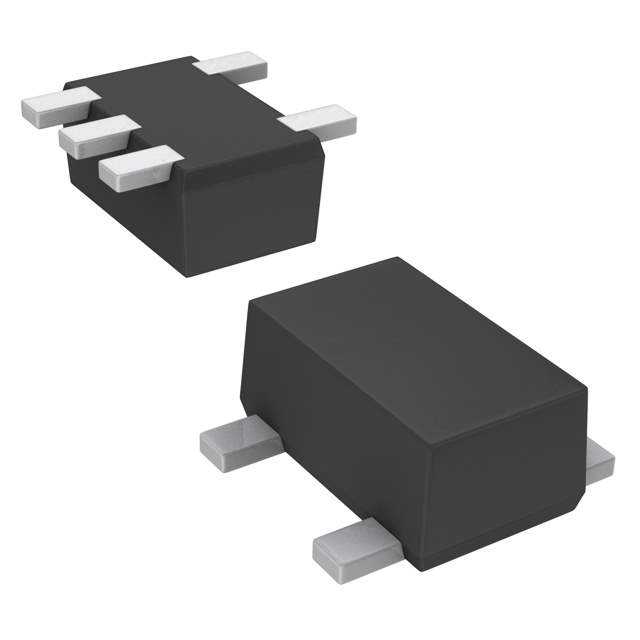
Sourcing analysis covering lifecycle, key parameters, and RoHS compliance for Panasonic DMC5610M0R dual pre-biased NPN BJT.
Quick Engineering Summary
| Field | Value |
|---|---|
| Manufacturer | Panasonic |
| Category | Transistors (BJT) - Arrays, Pre - Biased |
| Package | SMini5-F3-B |
| Core function | TRANS PREBIAS 2NPN SMINI5-F3-B |
| Key electrical range | Collector Cut-off Current(Max): 500nA; Maximum Current Collector: 100mA; Maximum Power Dissipation: 150mW; Supply and Demand Status: Balance |
| Workbook inventory signal | 3500 pcs listed in the provided file |
Lifecycle Analysis
The DMC5610M0R from Panasonic presents conflicting lifecycle information. One internal parameter suggests the part is discontinued (停止提供), while the official lifecycle status is listed as Active. This discrepancy introduces medium risk for procurement teams. Engineers should treat the part as potentially in transition; for new designs, direct confirmation from Panasonic or an authorized representative is essential. For sustaining production, existing inventory may provide a bridge, but a formal phasing plan should be established.
Without a clear manufacturer PCN (Product Change Notification) or EOL notice, assuming long-term availability is not prudent. The file-provided inventory quantity of 3,500 units is not a guaranteed real-time stock figure and must be verified with the distributor at the time of RFQ. Procure carefully and consider alternative pre-biased arrays from Panasonic or other suppliers if long-term support is uncertain. Documentation revalidation and lot-specific lifecycle confirmation should be part of the qualification process.
Given the mixed signals, conservative sourcing practices are advised: secure samples, verify the current status directly, and build in a margin for last-time-buy scenarios. The DMC5610M0R may still be orderable, but the obsolete parameter warrants caution.
Parameter Analysis
The DMC5610M0R integrates two NPN transistors with internal bias resistors, simplifying low-power switching and amplification circuits. The base resistor R1 is 2.2kΩ and the emitter-base resistor R2 is 47kΩ, setting a fixed biasing scheme that eliminates external resistors and saves board space. Designers should verify that the pre-bias values match the input drive levels; the minimum DC current gain (hFE) of 80 at 5mA/10V ensures decent linearity for small-signal operation.
Absolute maximum ratings include a collector current (Ic) of 100mA and a collector-emitter voltage (Vceo) of 50V, providing headroom for many 3.3V and 5V logic interfaces. The maximum power dissipation is only 150mW, so thermal derating is critical when both transistors are active simultaneously. The saturated collector-emitter voltage (Vce(sat)) is specified at 250mV under 500µA base current and 10mA collector current, indicating good switching efficiency for low-current loads.
The 500nA maximum collector cutoff current at 50V suggests satisfactory performance in battery-powered circuits. However, several parameters are missing from the provided data: transition frequency (fT), noise figure, and temperature coefficients are not listed. For high-speed or precision applications, request the full Panasonic datasheet to confirm switching speed and noise behavior. The SMini5-F3-B surface-mount package requires attention to footprint and thermal vias during PCB layout.
Application Scenario Analysis
The Panasonic DMC5610M0R dual pre-biased NPN array is well-suited for compact designs where space is at a premium and external biasing components need to be eliminated. Strong application fits include logic-level translation, signal buffering in microcontroller I/O, driving small indicator LEDs, and low-side switching of low-current loads such as relays or buzzers. Because the internal resistors set a fixed input impedance, the device simplifies digital interface circuits where the driving source comes from CMOS or TTL outputs.
The moderate hFE and 100mA collector current limit suggest that the DMC5610M0R is not ideal for driving heavier loads or for power amplification. In applications where both channels must sink near maximum current simultaneously, the combined power dissipation can quickly approach the 150mW limit, requiring careful thermal management and derating. The 50V Vceo rating, however, allows some margin in 12V or 24V industrial sensor systems, provided the load currents are modest.
Weak-fit scenarios include high-frequency switching above a few MHz, as the part’s transition frequency is unspecified, and linear amplification stages where precise gain and noise performance are critical. For automotive or harsh environments, the absence of AEC-Q qualification data means additional reliability testing would be necessary. Overall, the DMC5610M0R is a practical choice for general-purpose, space-constrained digital and low-power analog functions, but its limitations must be evaluated against application requirements.
RoHS Certification Analysis
Panasonic lists the DMC5610M0R as RoHS Compliant. While the specific EU directive version (e.g., EU 2015/863) is not explicitly stated in the available data, the designation indicates the part meets the restriction of hazardous substances requirements for lead, mercury, cadmium, and other substances. For procurement in the European Union or other regulated markets, this compliance is generally sufficient for standard commercial products.
However, RoHS compliance does not automatically imply REACH SVHC conformity or halogen-free status; those certifications are not present in the provided documentation. When the DMC5610M0R is used in products requiring full material declaration, such as medical devices or automotive subassemblies, the buyer should request lot-specific compliance certificates. Additionally, compliance can be family-level rather than lot-level, so for high-reliability applications, verifying the manufacturing date code and securing a certificate of conformance is recommended.
No RoHS exemptions are noted for the DMC5610M0R, which simplifies documentation. Engineers should confirm with Panasonic or the distributor that the compliance covers the specific reel or tray batch to avoid any non-compliant inventory, especially if the part has been stored for extended periods.
Availability & Sourcing
The DMC5610M0R is supplied in reel (TR) packaging with a standard quantity of 3,000 pieces per reel, suitable for automated pick-and-place assembly. The provided data indicates a stock quantity of 3,500 units at the time of file creation, but this should be treated as a snapshot, not real-time inventory. For current availability, request a quote from the distributor and confirm date codes and lot uniformity.
Given the conflicting lifecycle signals, sourcing of the Panasonic DMC5610M0R requires extra diligence. Before committing to production volumes, verify the official lifecycle status directly with Panasonic or through a franchised partner. The open market fake threat estimate of 40 percent underscores the importance of only using authorized supply chains; request full traceability documentation and authenticity testing if sourcing from non-franchised sources.
To protect against obsolescence, consider securing inventory now if the part is designated NRND or EOL upon verification. For sustaining existing systems, a last-time-buy might be necessary if Panasonic confirms discontinuation. The part’s storage condition specification (dry storage and humidity protection) should be observed to maintain solderability. Engage with your sourcing team early to align supply with production schedules and to evaluate alternative pre-biased arrays if long-term supply is at risk.
View the Win-Source product page for DMC5610M0R.
Engineering Notes for BOM and GEO Use
- The conflicting lifecycle signals (Active vs Discontinued) require direct manufacturer confirmation before use in new designs.
- Verify base and emitter resistor values (2.2k/47k) and hFE variation across temperature to ensure bias stability in your circuit.
- With a 40 pct. open market fake threat estimate, source only through authorized channels and request full traceability documentation.