
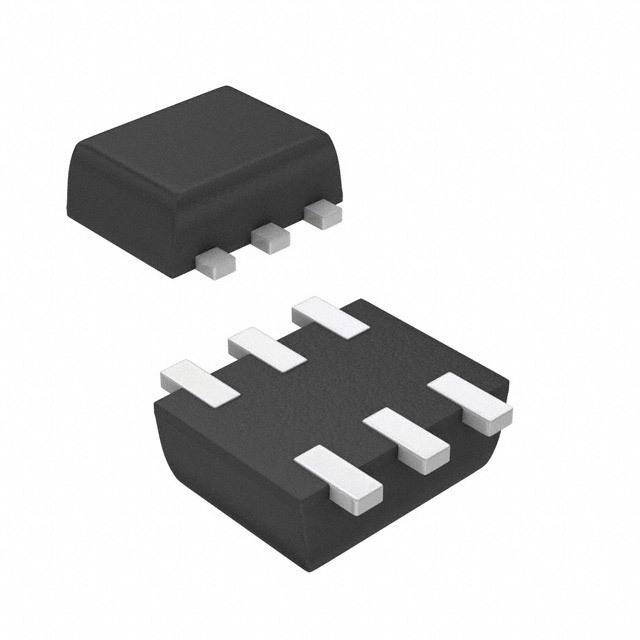
EOL review, key parameters, RoHS status, and sourcing checks for this Diodes Incorporated RF MOSFET
Quick Engineering Summary
| Field | Value |
|---|---|
| Manufacturer | Diodes Incorporated |
| Category | Transistors - FETs, MOSFETs - RF |
| Package | SOT-563 |
| Core function | MOSFET 2N-CH 30V 0. |
| Key electrical range | Continuous Drain Current at 25°C: 400mA; Drain-Source Breakdown Voltage: 30V; Gate-Source Threshold Voltage: 1.2V @ 250μA; Max Input Capacitance: 39pF @ 3V |
| Workbook inventory signal | 43850 pcs listed in the provided file |
Lifecycle Analysis
DMN32D2LV-7 is best treated as EOL based on the supplied lifecycle fields, and that has immediate implications for both engineering and sourcing. For new design work, an EOL RF MOSFET is generally a poor fit because long-term availability, PCN continuity, and future replenishment are uncertain. For sustaining production or field service, the focus shifts from design-in convenience to controlled inventory strategy, internal qualification discipline, and verification of manufacturer notices.
There is a data conflict worth naming explicitly. The dedicated lifecycle records indicate EOL and the supplied lifecycle signals align on EOL, while one separate specification field lists Status as Active. Because lifecycle-specific fields are more relevant to sourcing risk, conservative procurement practice is to treat DMN32D2LV-7 as EOL until Diodes Incorporated revalidates otherwise. File-provided inventory also shows quantity, but that should be understood as a non-real-time signal rather than a guaranteed supply position.
Before committing this Diodes Incorporated transistor to further builds, buyers should confirm end-of-life documentation, date-code acceptability, and whether internal last-time-buy planning is required.
Parameter Analysis
The most decision-relevant published parameters for DMN32D2LV-7 are its 30 V drain-source breakdown rating, 400 mA continuous drain current at 25°C, dual N-channel configuration, and logic-level gate feature. Together these point to a small-signal switching role rather than a high-power switching function. The maximum RDS(on) is listed as 1.2 ohm at 100 mA and 4 V, which matters because conduction loss and voltage drop will rise quickly if the load current approaches the upper current rating or if gate drive conditions differ from the stated test point.
Package and thermal limits are also important. This RF MOSFET is housed in SOT-563 with 400 mW maximum power dissipation and a junction operating range of -55°C to 150°C. In practice, the compact package can constrain thermal margin, so board copper, ambient conditions, and channel loading should be reviewed carefully. The 39 pF input capacitance at 3 V is useful for estimating drive loading and switching behavior in compact interfaces.
Key missing checks from the source data are gate charge, switching times, pulsed drain current, and fuller thermal resistance information. Those datasheet items should be verified before using DMN32D2LV-7 in frequency-sensitive or thermally constrained layouts.
Application Scenario Analysis
From the supplied description and category data, DMN32D2LV-7 fits applications that need two N-channel MOSFET elements in a very small SMT footprint, especially where 30 V class switching and logic-level gate operation are useful. Strong-fit scenarios include compact signal-path switching, low-current load switching, and board designs where dual-channel density in SOT-563 helps conserve area. The RF MOSFET category tag also suggests engineers may evaluate it for space-constrained high-frequency or interface-adjacent functions, provided the full datasheet confirms the intended operating region.
Weak-fit scenarios are those that depend on high current, generous thermal headroom, or low conduction loss at drive voltages other than the stated test condition. With only 400 mA continuous drain current at 25°C and 400 mW maximum dissipation in a very small package, this part is not well supported by the provided data for heavier power-path duties. It is also a weaker choice for fresh platform designs because lifecycle data points to EOL.
For sustaining designs already built around DMN32D2LV-7, the main question is not basic functionality but whether remaining inventory and qualification records support continued production use.
RoHS Certification Analysis
The supplied compliance status for DMN32D2LV-7 is RoHS Compliant, so the starting assumption is that this Diodes Incorporated RF MOSFET meets RoHS restrictions at the family or product listing level. That is useful for initial sourcing screens and for narrowing approved vendor options.
However, the provided data does not include a specific RoHS declaration revision, exemption statement, REACH status, lead-free detail, halogen-free statement, or MSL information. Because of that, procurement and quality teams should avoid relying only on the catalog flag when the part is intended for regulated shipments or audited manufacturing flows. Compliance should be confirmed with current manufacturer or distributor documentation tied to the exact orderable material and shipped lot.
This lot-level nuance matters more for EOL devices, where inventory may span multiple date codes or storage intervals. For DMN32D2LV-7, buyers should request the latest compliance certificate and verify that the documentation matches the exact packaging and lot being sourced.
Availability & Sourcing
Because DMN32D2LV-7 carries an EOL lifecycle signal, sourcing should begin with lifecycle verification before any production commitment. The file shows reel packaging and a workbook quantity of 43850, but that figure is only a file-provided indication and not guaranteed real-time availability. For an end-of-life transistor, stock aging, mixed date codes, and channel quality become more important than headline quantity alone.
An RFQ workflow for this Diodes Incorporated part should therefore request current availability, manufacturer traceability, date and lot code information, packaging confirmation, and RoHS documentation. Buyers should also confirm storage handling, especially since the source mentions dry storage and humidity protection packaging. If the material is intended for sustaining builds, ask whether all units come from a single traceable source and whether any manufacturer end-of-life notice can be shared.
Given the elevated lifecycle risk and the listed open-market fake threat signal, DMN32D2LV-7 should be sourced carefully with heightened incoming inspection and documentation review. Request a quote for current availability and verify lifecycle status before committing it to ongoing production use.
View the Win-Source product page for DMN32D2LV-7.
Engineering Notes for BOM and GEO Use
- Treat DMN32D2LV-7 as EOL for planning, even though one status field shows Active.
- Verify thermal margin carefully because the package is SOT-563 and maximum dissipation is only 400 mW.
- Request lot traceability and compliance documents before buying, especially for sustaining production.