
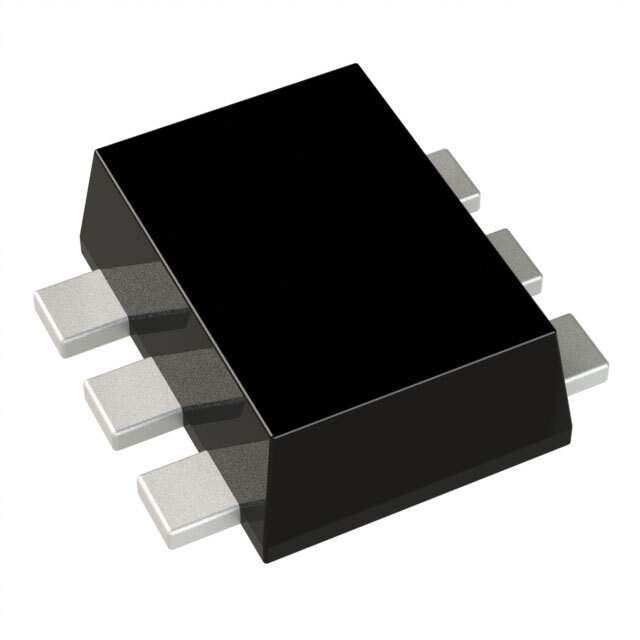
EOL NPN transistor for low-power switching and amplification.
Quick Engineering Summary
| Field | Value |
|---|---|
| Manufacturer | Diodes Incorporated |
| Category | Transistors (BJT) - Single |
| Package | SOT-563 |
| Core function | TRANS NPN 60V 1A SOT-563 |
| Key electrical range | Collector Cut-off Current(Max): 100nA; Frequency - Transition: 270MHz; Maximum Current Collector: 1A; Maximum Power Dissipation: 300mW |
| Workbook inventory signal | 4600 pcs listed in the provided file |
Lifecycle Analysis
The DNLS160V-7 is officially classified as End-of-Life (EOL) by Diodes Incorporated. All supplied lifecycle signals, including the dedicated lifecycle status field and the Excel parametric lifecycle indicator, confirm this designation. One isolated specification field lists "Status: Active," but this likely refers to a product status code or internal classification; the authoritative manufacturer lifecycle status is EOL. For procurement teams, this means the DNLS160V-7 should not be used in new designs (NRND is no longer applicable). Existing production lines relying on this part must immediately initiate a last-time buy (LTB) and evaluate alternative transistors to ensure continuity of supply.
Diodes Incorporated typically provides a product discontinuance notice (PDN) that specifies final order dates and last shipment dates. It is critical to contact Diodes or an authorized distributor to obtain the exact LTB timeline. Although the workbook inventory shows 4,600 units, this is a file-based snapshot and does not guarantee real-time availability. Risk of part obsolescence is high; planning a migration now reduces supply chain disruption.
Parameter Analysis
The DNLS160V-7 is an NPN bipolar junction transistor housed in an ultra-miniature SOT-563 surface-mount package. Key electrical specifications from the supplied data include a maximum collector-emitter breakdown voltage (VCEO) of 60V, a continuous collector current (IC) rating of 1A, and a power dissipation limit of 300mW. DC current gain (hFE) is specified at a minimum of 200 when measured at 500mA and 5V, indicating good amplification capability at moderate collector currents. Collector-emitter saturation voltage (VCE(sat)) is 250mV at 100mA, 1A, suitable for low-voltage switching applications. The operating junction temperature range extends from -55°C to +150°C.
A notable discrepancy exists in the transition frequency (fT) data: one source lists 270MHz while another indicates 150MHz. Engineers must refer to the official Diodes Incorporated datasheet to verify the exact fT before committing to designs that involve high-frequency switching. Several critical parameters are missing from the provided data, including thermal resistance (junction-to-ambient), safe operating area (SOA) curves, and maximum junction temperature (TJ(max)). These are essential for thermal management and reliability predictions; obtain the full datasheet to complete a thorough evaluation.
Application Scenario Analysis
The DNLS160V-7 is best suited for general-purpose low-power switching and small-signal amplification in consumer electronics, portable devices, and industrial control modules. With a 60V breakdown voltage and 1A current capability, it can drive small relays, LEDs, or serve as a level shifter in logic interfaces. The SOT-563 package’s small footprint makes it ideal for space-constrained PCB layouts, typical in handheld instruments and IoT edge nodes. Its 300mW power dissipation limits continuous high-current operation; sustained loads above 0.5A may require careful thermal evaluation.
Applications requiring high-frequency performance above 150MHz should only proceed after confirming the transistor’s fT from the official datasheet. The device is not recommended for new designs in automotive powertrain or high-reliability aerospace systems due to its EOL status and unverified qualification data. When used in existing products, verify that the operating temperature range (-55°C to 150°C) matches the ambient conditions, and consider derating if the enclosure temperature approaches the maximum junction limit. For battery-powered applications, the low collector cut-off current (100nA max) helps minimize standby leakage.
RoHS Certification Analysis
The DNLS160V-7 is marked as RoHS Compliant according to the supplier’s data. This typically indicates compliance with the EU Restriction of Hazardous Substances Directive, likely meeting RoHS 3 (EU 2015/863) requirements that limit lead, mercury, cadmium, and other substances. However, RoHS compliance at the part-number level should be validated with a certificate of compliance (CoC) from the manufacturer or an authorized distributor for each batch. Some OEMs require additional testing for halogen-free or REACH SVHC declarations, which are not provided in the current data.
Given the EOL status and a 63% fake threat rating in the open market, sourcing from non-authorized channels increases the risk of non-compliant or counterfeit parts. To maintain product compliance, always request a full material declaration and RoHS test report with the purchase order. For high-volume production, lot-by-lot verification may be necessary, especially if second-tier suppliers are used. The absence of MSL (moisture sensitivity level) and halogen-free data means that if these are critical, obtain them from the manufacturer before committing to a purchase.
Availability & Sourcing
As an End-of-Life (EOL) device, the DNLS160V-7 requires immediate attention to secure remaining inventory. The provided workbook indicates 4,600 units, but this is a static file count and not real-time stock. Buyers should request a quote from Win Source or authorized distribution partners to confirm current availability, date/lot codes, and packaging integrity. The part is supplied on tape and reel (TR) and requires dry storage and humidity-controlled packaging, which is especially important for long-term storage after last-time buys.
Plan the last-time purchase based on your annual consumption and project lifespan. Diodes Incorporated’s product change notice (PCN) will detail the discontinuation schedule; if not already received, request it immediately. For production continuity, begin evaluating alternative NPN transistors with similar parameters and package. Because of the high counterfeit risk (63% open market threat), insist on full traceability documentation and consider third-party testing for authenticity. RoHS compliance certificates should accompany each shipment to avoid regulatory issues.
View the Win-Source product page for DNLS160V-7.
Engineering Notes for BOM and GEO Use
- Verify transition frequency from official Diodes datasheet (discrepancy between 150MHz and 270MHz in sources).
- Do not design into new products; this part is EOL—secure last-time buys and plan migration.
- Request full RoHS and material certification with each shipment to avoid counterfeit risks (open market fake threat rated 63%).