
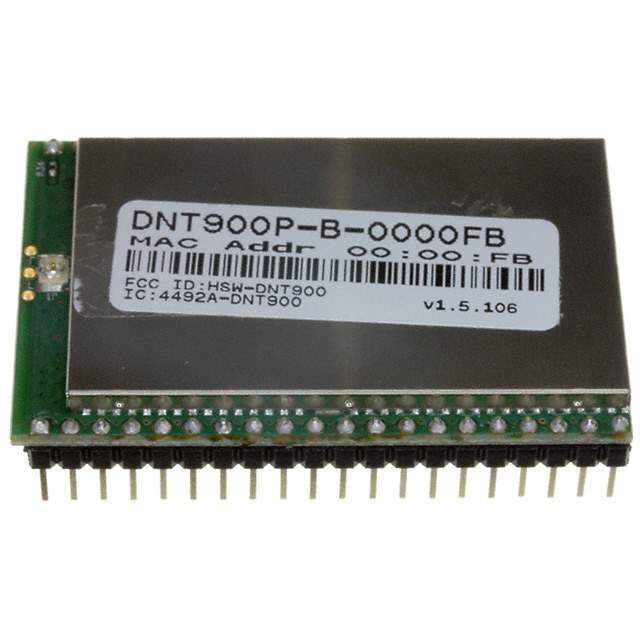
Murata Electronics North America DNT900P RF Receivers procurement and engineering review
Quick Engineering Summary
| Field | Value |
|---|---|
| Manufacturer | Murata Electronics North America |
| Category | RF Receivers |
| Package | Tray |
| Core function | RF TXRX MOD ISM\\u003c1GHZU. |
| Key electrical range | Current - Receiving: 105mA; Current - Transmitting: 1.2A; Frequency: 900MHz; Power - Output: 30dBm |
| Workbook inventory signal | 1 pcs listed in the provided file |
Lifecycle Analysis
DNT900P from Murata Electronics North America should be treated as Discontinued for sourcing decisions in the RF Receivers category. The file contains a lifecycle conflict: one signal lists EOL, while Lifecycle Status and Product Status both list Discontinued. Those labels differ slightly in wording, but neither supports new-design use. The conservative interpretation is that DNT900P carries high supply risk and should be considered only for sustaining builds, repair demand, or controlled last-time procurement activity.
For engineering teams, this lifecycle status means any new design-in should be avoided unless a program is already locked to existing qualified stock. For ongoing production, buyers should request manufacturer notices, PCN or end-of-life documentation where available, and confirmation that the exact ordering code matches the approved BOM entry. The file also shows inventory of 1 unit, but that is only a file-provided signal and not a real-time stock guarantee. Because discontinued RF modules can have revision and documentation drift over time, revalidation of interface, compliance, and assembly assumptions is advisable before committing remaining inventory to production.
Parameter Analysis
The most decision-relevant published parameters for DNT900P are its 900 MHz operating frequency, FHSS modulation, 500 kbps data rate, 30 dBm output power, and -108 dBm sensitivity. Together, those indicate a sub-1 GHz RF transceiver module intended for relatively robust wireless links where range, interference behavior, and link budget matter. The 30 dBm output level is especially important because it drives power budgeting, thermal planning, antenna-path losses, and regulatory review at the product level.
Integration details also matter. DNT900P uses a 3.3 V supply, draws 105 mA in receive and 1.2 A in transmit, and exposes SPI and UART interfaces. That combination should prompt careful review of supply rail transient capability, decoupling, ground return layout, and host interface firmware assumptions. The module is through-hole, packaged as a module, uses a U.FL antenna connection with no antenna included, and is rated for -40°C to 85°C operation. The biggest missing items to verify in the datasheet are channelization or protocol details, receive and transmit timing behavior, regulatory approval scope, and any required layout or keep-out guidance around the RF path and antenna connector.
Application Scenario Analysis
Based on the category hierarchy, description, and published specifications, DNT900P is a realistic fit for embedded sub-1 GHz wireless nodes that need a module-level implementation rather than a discrete RF design. Strong-fit scenarios include industrial or infrastructure-style links where 900 MHz operation, FHSS modulation, UART or SPI host control, and a wide -40°C to 85°C temperature range are relevant. The U.FL antenna interface also suits products where the antenna must be off-board or mechanically separated from the main PCB.
Weak-fit scenarios are designs that need modern lifecycle stability, compact SMT assembly, or a fully integrated antenna solution. Through-hole mounting and the absence of an included antenna can complicate space-constrained or highly automated builds. The 1.2 A transmit current also makes DNT900P less attractive for power-limited systems unless the power architecture was designed specifically for that transmit profile. Because the description identifies a transceiver-style module in general ISM under 1 GHz rather than a narrowly defined end application, designers should confirm protocol behavior, region-specific deployment assumptions, and host-side firmware requirements before treating it as a drop-in subsystem.
RoHS Certification Analysis
RoHS status for DNT900P is not cleanly resolved by the supplied file. One compliance field states RoHS Compliant, but a separate specification line states RoHS Non-Compliant. That conflict means the safest procurement position is to treat compliance as unverified until document-backed evidence is received. For release to production, buyers should request the manufacturer declaration or lot-specific supplier compliance paperwork rather than relying on a single catalog field.
Other compliance-related data in the file is limited, but one handling attribute is useful: MSL Level 1 with unlimited floor life is listed, which can simplify assembly handling if the material is authentic and the package state is controlled. However, MSL is not a substitute for environmental compliance. No REACH, halogen-free, or exemption details are supplied, and no RoHS standard revision is explicitly stated in the source file. Because discontinued parts can also have historical material variations, compliance should be checked at the exact part-number and lot-code level, not assumed from a family-level record.
Availability & Sourcing
Availability for DNT900P should be approached as a controlled RFQ process rather than a routine catalog purchase. The lifecycle is discontinued, the file shows only a minimal stock signal, and open-market risk is elevated by the file entry indicating a fake-threat concern. Request current availability before planning any build, and require full traceability including manufacturer name, part marking, date code, lot code, packaging condition, and chain-of-custody details. The listed package is tray, which should also be confirmed against received goods and handling expectations.
For procurement teams, the correct next step is to request a quote together with lifecycle confirmation and compliance documents. If the requirement is for sustaining production, ask the supplier to confirm whether stock is original excess, brokered material, or direct-franchised inventory, and verify whether the exact DNT900P ordering variant matches your approved BOM. File-provided quantity is 1, but that should not be treated as real-time available stock. Because Murata Electronics North America DNT900P is a discontinued RF Receivers product, buyers should source carefully, verify manufacturer notices, and perform incoming inspection and authenticity checks before committing material to production.
View the Win-Source product page for DNT900P.
Engineering Notes for BOM and GEO Use
- Treat DNT900P as discontinued and unsuitable for new production releases.
- Verify antenna, power supply, and thermal design against 30 dBm output and 1.2 A transmit current.
- Resolve the conflicting RoHS records with manufacturer or supplier compliance documents before ordering.