
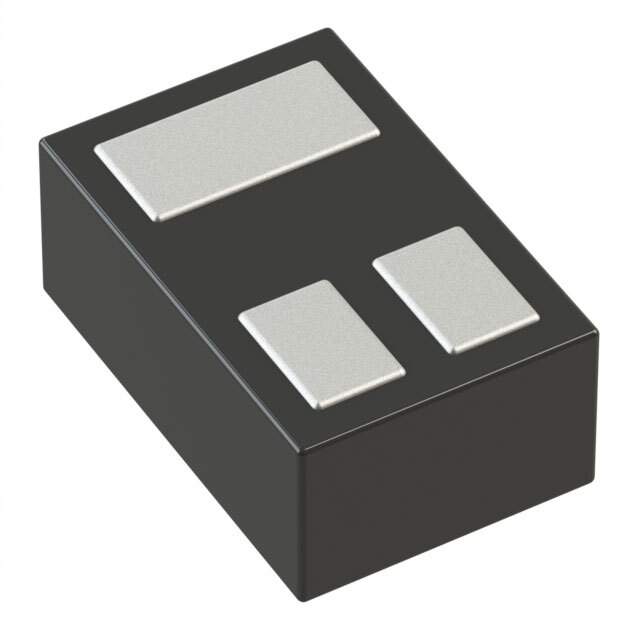
PNP Bipolar Transistor, 50 V, 100 mA, X2-DFN1006-3, Active Lifecycle
Quick Engineering Summary
| Field | Value |
|---|---|
| Manufacturer | Diodes Incorporated |
| Category | Transistors (BJT) - Single |
| Package | X2-DFN1006-3 |
| Core function | TRANS PNP 50V 0. |
| Key electrical range | Collector Cut-off Current(Max): 100nA (ICBO); Frequency - Transition: 80MHz; Maximum Current Collector: 100mA; Maximum Power Dissipation: 450mW |
| Workbook inventory signal | 174000 pcs listed in the provided file |
Lifecycle Analysis
DP0150BLP4-7 is classified as Active across all available lifecycle signals—product status, lifecycle parameter, and manufacturer designation—with no conflicts or obsolescence warnings. An active lifecycle means the part is in full production, supported by Diodes Incorporated, and available for both new designs and ongoing volume requirements. Engineers can proceed with this device in new PCB designs, expecting standard lead times and multi-year availability.
Nevertheless, sustaining production should include periodic revalidation of the manufacturer's product change notification (PCN) and end-of-life (EOL) notices, as discrete semiconductor lifecycles can shift. The supplied inventory figure of 174,000 units is a workbook snapshot and not a real-time stock guarantee; live availability should be confirmed through a formal RFQ. Given the active status, procurement risk is low, but design freeze and second-source planning remain good practice.
Parameter Analysis
The DP0150BLP4-7 transistor offers a 50 V VCEO breakdown, a 100 mA maximum collector current, and a total power dissipation of 450 mW. These ratings make it well-suited for low‑voltage, low‑current switching and small‑signal amplification. The DC current gain (hFE) minimum of 200 at 2 mA collector current and 6 V collector‑emitter voltage ensures reliable saturation for logic level interfaces, while the 80 MHz transition frequency supports moderate‑speed analog applications.
Critical parameters for design‑in include the low collector‑emitter saturation voltage (300 mV max at 10 mA base drive and 100 mA collector current), which minimizes on‑state losses in switching circuits. The X2‑DFN1006‑3 package measures only 1.0 × 0.6 mm, enabling ultra‑compact layouts. Missing from the provided data are the thermal resistance (junction‑to‑ambient and junction‑to‑case) and safe operating area curves; these must be obtained from the full Diodes Incorporated datasheet to calculate junction temperature rises and to verify that pulse‑handling capability meets application requirements.
Application Scenario Analysis
The DP0150BLP4-7 is a strong candidate for general‑purpose low‑power switching and small‑signal amplification in portable and space‑constrained electronics. Typical uses include signal gating, level shifting, sensor interface biasing, and low‑side load switches in battery‑powered devices, IoT endpoints, and consumer gadgets. Its 50 V rating provides a healthy margin for 3.3 V to 24 V rails, while the miniscule DFN1006‑3 footprint supports high‑density SMD assembly.
Applications requiring continuous collector currents above 50 mA or ambient temperatures above 85 °C should incorporate derating based on the missing thermal resistance data. The part is not suitable for high‑power loads, motor drives, or circuits demanding greater than 100 mA steady‑state current. In RF applications, the 80 MHz fT limits its use to lower‑frequency amplification stages; designers should simulate or bench‑test gain‑bandwidth performance if the transition frequency is a critical parameter.
RoHS Certification Analysis
DP0150BLP4-7 is declared RoHS Compliant in the source data, which typically indicates conformity with the European Union’s Restriction of Hazardous Substances directive (generally EU 2015/863 for current production). No explicit REACH statement or halogen‑free claim is included, so those certifications should be confirmed separately if required by end‑market regulations.
The recommended storage condition—dry storage cabinet with humidity protection packaging—implies that the device is moisture‑sensitive and has an assigned MSL rating. When ordering, request the full material declaration and lot‑specific RoHS certificate from Diodes Incorporated or the authorized distributor. Since REACH compliance is not mentioned, any high‑reliability or medical design should validate the absence of SVHCs through the manufacturer’s REACH statement. The RoHS status alone does not guarantee conformance to additional environmental standards such as China RoHS or WEEE.
Availability & Sourcing
As an Active part from Diodes Incorporated, DP0150BLP4-7 is normally in steady supply with typical factory lead times. The workbook indicates a file‑based inventory quantity of 174,000 units, but this is not a real‑time stock reflection; actual availability and pricing must be obtained through a request‑for‑quote. The part is supplied on tape‑and‑reel packaging (standard for the X2‑DFN1006‑3 footprint), which suits automated pick‑and‑place assembly.
A notable concern is the 37% fake threat rate reported in the open market. To mitigate counterfeit risk, procurement should only be conducted through Diodes Incorporated authorized channels or reputable distributors who provide full traceability, date‑code verification, and compliance documentation. For active lifecycle parts, the standard CTA is to request a quote and verify the latest PCN; buyers should also confirm MSL handling and RoHS/REACH certificates when placing orders. If the design is in the NPI phase, consider obtaining samples first to validate parametric performance against the official datasheet.
View the Win-Source product page for DP0150BLP4-7.
Engineering Notes for BOM and GEO Use
- Verify thermal resistance (RθJA) and safe operating area (SOA) from the manufacturer datasheet before PCB layout, especially when operating near the 450 mW dissipation limit.
- The typical gain of 200 is specified at 2 mA/6 V; characterize hFE at the actual collector current and temperature extremes of your design.
- Despite an active lifecycle, a 37% fake threat rate in the open market underscores the need to procure only through authorized channels.