
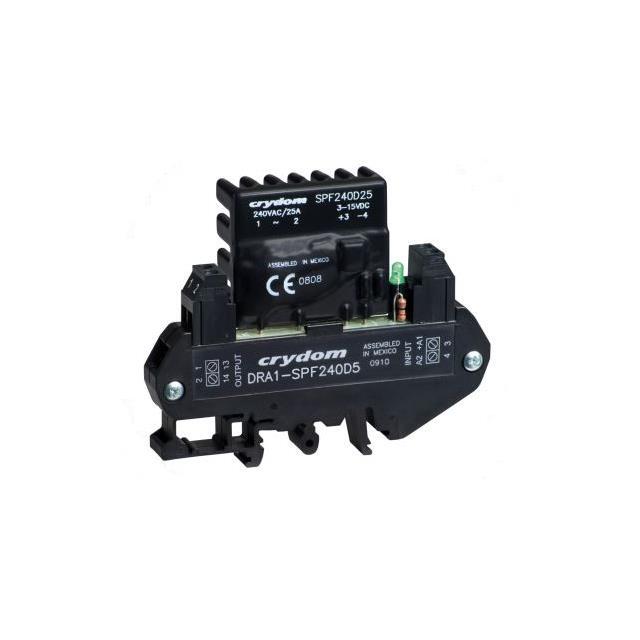
Solid State Relay: Key specs, lifecycle analysis, and procurement guidance for the Sensata-Crydom DRA1-SPFE240D25R.
Quick Engineering Summary
| Field | Value |
|---|---|
| Manufacturer | Sensata-Crydom |
| Category | Solid State Relays |
| Package | Module |
| Core function | SSR RELAY SPST-NO 8A 12-280V |
| Key electrical range | Load Current: 8 A; Output Type: AC; Supply and Demand Status: Shortage; Temperature Range - Operating: -20°C ~ 80°C |
| Workbook inventory signal | 5 pcs listed in the provided file |
Lifecycle Analysis
The DRA1-SPFE240D25R from Sensata-Crydom presents conflicting lifecycle indicators. While the Lifecycle Status field is listed as Active, the Product Status is Not For New Designs, and an internal Excel parameter explicitly flags the part as not suitable for new designs. This contradiction suggests the device is in a phase-down or limited-support state, typical of NRND (Not Recommended for New Designs) components.
For engineers evaluating this solid state relay for new projects, the conservative interpretation recommends against its use. New designs should target alternatives with confirmed Active, full-production status. For sustaining existing designs, immediate verification with Sensata-Crydom is essential to understand the rationale behind the Not For New Designs classification and to obtain a last-time-buy notice if one exists.
The file-provided inventory shows only 5 units, which is insufficient for production builds and aligns with a product approaching discontinuation. Procurement teams should treat the DRA1-SPFE240D25R as a high-risk item for long-term availability and plan migration strategies accordingly. Without manufacturer clarification, assuming continued supply beyond current stock is not advisable.
Parameter Analysis
The DRA1-SPFE240D25R is a DIN rail-mounted solid state relay with a SPST-NO (1 Form A) configuration, AC output, and screw terminal connections. The load current is rated at 8 A, with a load voltage range of 12–280 VAC, making it suitable for moderate AC switching in industrial control panels. Input control voltage accepts 15–32 VDC, aligning with standard 24 VDC logic systems.
Key operational parameters include an operating temperature range of -20°C to 80°C, which covers most commercial and light industrial environments but may require derating at elevated temperatures. The module package and DIN rail mounting facilitate easy installation in equipment racks, while the screw terminals simplify field wiring. Approvals from CE and cURus provide a baseline for regulatory acceptance, though the scope of these certifications should be verified for specific end applications.
Important datasheet parameters not supplied in our source include on-state voltage drop, off-state leakage current, optical isolation voltage, and zero-crossing or random-turn-on behavior. These missing specifications are critical for assessing relay power dissipation, signal integrity, and compatibility with inductive or capacitive loads. Engineers must retrieve the full Sensata-Crydom datasheet to evaluate these aspects, especially for designs where EMI or inrush current is a concern. Without this data, using the DRA1-SPFE240D25R in high-reliability or energy-sensitive applications carries additional design risk.
Application Scenario Analysis
The DRA1-SPFE240D25R is well-suited for industrial automation tasks that require silent, wear-free switching of AC loads up to 8 A. Typical strong-fit applications include resistive heaters, solenoid valves, small AC motors, and incandescent or halogen lighting in HVAC systems, packaging machinery, and process control cabinets. Its DIN rail form factor integrates easily into control panels powered by 24 VDC supplies, and screw terminals allow straightforward connection to load circuits.
Weak-fit scenarios involve highly inductive or capacitive loads with high inrush currents, such as large transformers, contactor coils, or high-starting-torque motors. Without a specified peak surge current rating or dV/dt immunity, the DRA1-SPFE240D25R may experience premature failure or false triggering. Similarly, applications requiring fast switching cycles or zero-crossing synchronization may be mismatched if the relay’s turn-on characteristic is not characterized. The limited temperature range of -20°C to 80°C restricts outdoor or extreme environments unless additional thermal management is provided.
In retrofit or replacement scenarios, designers can consider the DRA1-SPFE240D25R for existing systems originally designed around this relay, but only after confirming that the electrical and mechanical interfaces remain unchanged. Its NRND status, however, means that even in sustaining applications, part longevity is uncertain. Engineers should validate all load parameters against the full manufacturer datasheet before committing to a design freeze, particularly for safety-critical loops.
RoHS Certification Analysis
The DRA1-SPFE240D25R is listed as RoHS Compliant in the source data, indicating that Sensata-Crydom has manufactured this solid state relay in accordance with the European Union’s Restriction of Hazardous Substances directive. Typically, this means the device meets the substance limits of EU 2011/65/EU, including the expanded list under Delegated Directive 2015/863 (RoHS 3), though no specific revision is cited.
Despite the RoHS Compliant mark, procurement teams should note that no additional environmental compliance details (e.g., REACH, halogen-free, MSL) are provided in the available records. RoHS status can sometimes be declared at a product family level rather than individual lot, and process changes over the life of a component may affect material composition. For applications requiring full compliance documentation, request a certificate of conformance or a detailed material declaration from the distributor or manufacturer.
As with all NRND parts, verifying the RoHS status is particularly important if the DRA1-SPFE240D25R is sourced from surplus or secondary market channels. The original compliance may not apply to later production runs if the device was manufactured after a regulation update. To avoid compliance gaps, cross-check the date code and request explicit confirmation of RoHS 3 compliance if the assembly will be sold into the EU market.
Availability & Sourcing
The DRA1-SPFE240D25R solid state relay shows limited file-provided inventory of 5 units, with a market condition marked as Shortage. This quantity is not a real-time figure and may change rapidly. Given the part’s Not For New Designs status and conflicting lifecycle signals, availability is likely constrained, and lead times may be extended or unreliable.
When sourcing the DRA1-SPFE240D25R, a formal RFQ process is recommended to obtain current stock levels, factory lead times, and pricing from authorized distributors or Sensata-Crydom directly. Buyers should request date codes and lot traceability to ensure the parts are recent production and not outdated stock that could have compromised solderability or parametric drift. Verify packaging: the part is supplied in bulk, which may require additional handling precautions compared to tape-and-reel.
Because the part is NRND, sourcing should be coupled with an engineering review to either qualify an alternative or secure a sufficient lifetime buy. Compliance documentation—including RoHS certificates and safety approvals (CE, cURus)—should be obtained with the quotation. Do not rely on file-provided quantity for production planning; always confirm real-time availability before quoting lead times to internal stakeholders. For sustaining production, evaluate migration to an Active solid state relay with similar footprint and ratings to avoid supply chain disruptions.
View the Win-Source product page for DRA1-SPFE240D25R.
Engineering Notes for BOM and GEO Use
- Verify official lifecycle status with Sensata-Crydom before committing to new designs; conflicting signals indicate potential limited availability.
- The 8A AC output rating requires careful derating for inductive loads; confirm thermal performance and surge capability from the manufacturer datasheet.
- Request lot-level RoHS compliance documentation and date codes when sourcing, given the file-provided low inventory and NRND classification.