
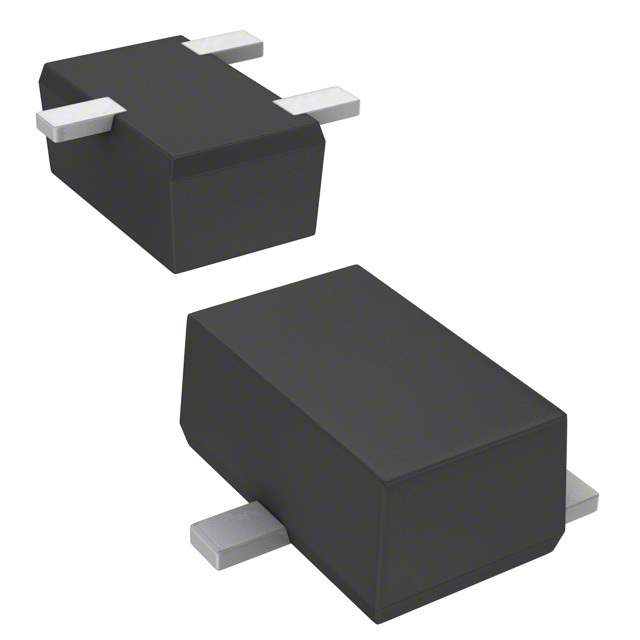
Panasonic Pre-Biased PNP Transistor – Verify Lifecycle and Stock Before Procuring
Quick Engineering Summary
| Field | Value |
|---|---|
| Manufacturer | Panasonic |
| Category | Transistors (BJT) - Single, Pre - Biased |
| Package | SMini3-F2-B |
| Core function | TRANS PREBIAS PNP 50V SMINI3 |
| Key electrical range | Collector Cut-off Current(Max): 500nA; Maximum Current Collector: 100mA; Maximum Power Dissipation: 150mW; Supply and Demand Status: Sufficient |
| Workbook inventory signal | 78800 pcs listed in the provided file |
Lifecycle Analysis
The DRA5114E0L lifecycle status is uncertain. While one data field lists the part as Active, the lifecycle analysis block indicates unknown with no lifecycle signals. This discrepancy means that new designs should not rely on the Active claim without manufacturer confirmation. Treat the part as NRND (Not Recommended for New Design) until Panasonic provides a current lifecycle statement.
For sustaining production, this uncertainty introduces medium risk. If this part is already in an existing design, verify ongoing availability directly with Panasonic or authorized distributors. The file-provided quantity of 78,800 units suggests market availability, but this does not guarantee stable long-term supply.
Engineering teams should request official lifecycle documentation as part of the procurement process. Without it, the part is safest used for prototype or small-scale production where alternative sourcing can be arranged quickly.
Parameter Analysis
The DRA5114E0L is a pre-biased PNP bipolar transistor in a surface-mount SMini3-F2-B package. Its key ratings include a maximum collector-emitter voltage (VCEO) of 50V and a maximum collector current of 100mA. The power dissipation is limited to 150mW, which may restrict use in higher-current or higher-voltage continuous operation. The pre-biased configuration includes integrated base and base-emitter resistors (R1=10kΩ, R2=10kΩ), simplifying circuit design by eliminating external resistors.
The typical gain (hFE) is specified as minimum 35 at 5mA collector current and 10V Vce. This moderate gain makes it suitable for switching and low-level amplification. The saturation voltage (Vce(sat)) is 250mV at Ib=500µA, Ic=10mA, indicating low on-state loss for battery-operated devices.
Missing from the provided data are temperature-dependent characteristics, safe operating area curves, and thermal resistance values. These are critical for high-temperature environments or near power limits. Engineers should consult the official Panasonic datasheet to verify derating curves and junction-to-ambient thermal resistance for accurate reliability analysis.
Application Scenario Analysis
The DRA5114E0L fits applications requiring low-power PNP switching or simple analog buffering. Its 50V rating makes it usable in industrial or consumer electronics with 24V or 48V supply rails, while the 100mA collector current supports driving small relays, LEDs, and low-current logic loads. The pre-biased resistors reduce component count and layout complexity, which is advantageous in dense SMD designs.
However, its 150mW power dissipation limits its use in continuous high-current or high-duty-cycle switching. Strong-fit applications include logic-level translation, load switches in microcontroller circuits, and low-side switching in battery-powered devices. Weak-fit uses include automotive high-temperature environments or high-speed switching due to unspecified transition frequency and temperature ratings.
For circuits requiring higher current or power, consider alternative devices. Always verify that the input drive voltage and current are compatible with the internal resistor divider defined by R1 and R2.
RoHS Certification Analysis
The DRA5114E0L is listed as RoHS Compliant in the supply data, but no specific directive version (e.g., EU 2015/863) is cited. This typically means the part meets lead-free requirements and does not contain restricted substances above threshold limits. However, the absence of a standard version identifier leaves ambiguity regarding exemptions or updates.
Without REACH or halogen-free declarations, full material compliance cannot be assumed. For products destined for the European market, request a formal RoHS certificate from Panasonic or the distributor, covering the specific lot being purchased. This is especially important for contracts requiring CE marking or WEEE compliance.
In practice, most semiconductor components from major manufacturers like Panasonic are RoHS-compliant by default, but lot-level verification ensures the parts are not from older non-compliant stock. Additionally, note that the part is marked as surface mount and shipped on tape and reel, so moisture sensitivity level (MSL) should be confirmed before reflow soldering, though it is not provided here.
Availability & Sourcing
The DRA5114E0L is sourced as a pre-biased PNP transistor with file-indicated stock of 78,800 units, packaged in reels of 3000 pieces. However, this quantity is not real-time and must be confirmed by requesting a quote. The part enjoys medium popularity and the supply-demand status is reported as sufficient, suggesting stable channel availability.
Procurement should begin with an RFQ specifying the part number, preferred reel quantity, and required certifications (RoHS, lot traceability). Given the lifecycle uncertainty, early-stage design teams should secure engineering samples and verify lifecycle status directly with Panasonic or authorized distributors.
The open market fake threat level is 42%, which is moderately high. This underscores the importance of sourcing through authorized channels and requesting date code and manufacturer traceability documentation. For critical builds, consider third-party inspection to verify component authenticity.
View the Win-Source product page for DRA5114E0L.
Engineering Notes for BOM and GEO Use
- Verify lifecycle status with Panasonic before committing to new design; treat as NRND until confirmed.
- Pre-biased resistors simplify circuits, but check bias compatibility with driving voltage and input impedance.
- 150mW power limit constrains use; confirm thermal margins when switching near 100mA.