
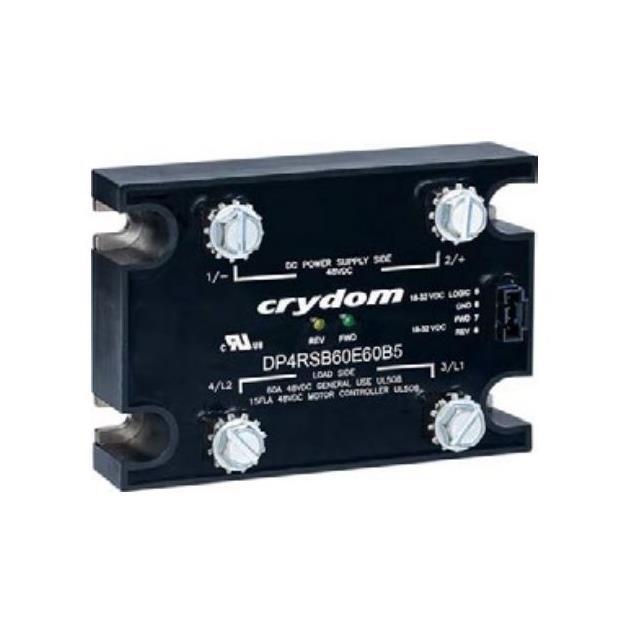
Solid state contactor for AC loads up to 510 V and 7.6 A, 24 V AC/DC control input, chassis/DIN rail mount.
Quick Engineering Summary
| Field | Value |
|---|---|
| Manufacturer | Sensata-Crydom |
| Category | Contactors (Solid State) |
| Package | Module |
| Core function | REV 480V 7. |
| Key electrical range | Load Current: 7.6 A; Output Type: AC; Supply and Demand Status: Shortage; Voltage - Input: 18 ~ 30VAC/DC |
| Workbook inventory signal | 10 pcs listed in the provided file |
Lifecycle Analysis
The DRC3R48D420 solid state contactor is listed with an Active lifecycle status according to supplied manufacturer file signals and online status checks. Active indicates the part is in full production, suitable for new design starts, and supported for ongoing volume procurement. No cross-signal conflicts were found. For critical applications, it is prudent to re-confirm lifecycle directly with Sensata-Crydom, as active status does not guarantee indefinite availability.
The supplied inventory of 10 units is file-provided and not a real-time guarantee; usage in production should be backed by a manufacturer line card or formal PCN monitoring. Buyers should still validate that no transitioning to NRND is imminent by reviewing the latest product change notices.
Parameter Analysis
The primary selection parameters for the DRC3R48D420 are its load current rating of 7.6 A and wide load voltage range from 48 V to 510 V. This makes it suitable for controlling single-phase or three-phase AC loads such as resistive heaters, small motors, or lighting circuits where the load voltage does not exceed 510 V. The control input accepts 18–30 V AC/DC, which aligns with common 24 V industrial control systems. The 3PST-NO (3 Form A) contact configuration means it switches three independent circuits simultaneously, which is typical for three-phase motor control or multi-pole switching applications. The module is designed for chassis or DIN rail mounting, offering flexibility in panel layouts.
However, several critical parameters are missing from the source data and must be verified from the manufacturer’s datasheet before final design-in: surge current withstand (I²t and non-repetitive peak), off-state leakage current, maximum operating temperature, and thermal resistance. These parameters are essential for derating and ensuring reliable operation in enclosures with high ambient temperatures or inrush currents. Without them, engineers must assume worst-case conditions and potentially oversize the contactor or add active cooling.
Application Scenario Analysis
The DRC3R48D420 solid state contactor is well suited for industrial automation applications that require silent, fast, and wear-free switching of moderate AC loads. Typical strong-fit scenarios include heating element control in ovens or plastic processing machines, where the contactor cycles frequently and the load is predominantly resistive. It can also be used for lighting control in commercial or stage environments, as the AC output type handles standard mains voltages. For small three-phase motor loads such as fans or pumps up to about 0.5 HP (assuming 480 V), the 7.6 A rating may be adequate for direct starting, but careful evaluation of motor inrush is required.
Weak-fit scenarios include applications with high inrush currents like transformer primaries, capacitor banks, or incandescent lamp loads, unless the surge rating is verified. Additionally, since the description notes "REV 480V 7.6A 2NO" which might suggest reversing capability, but the spec shows 3PST-NO, the exact function should be confirmed. It is not recommended for safety-critical or emergency stop circuits without additional redundant protection.
RoHS Certification Analysis
According to the supplied data, the DRC3R48D420 is RoHS Compliant. This usually indicates conformance to EU Directive 2011/65/EU and its amendment 2015/863, commonly known as RoHS 3, which restricts lead, mercury, cadmium, hexavalent chromium, and certain phthalates. No specific exemptions are mentioned for this part. However, RoHS compliance is often declared at the product family level; for high-volume production, it is advisable to obtain a lot-specific certificate of compliance from Sensata-Crydom or an authorized distributor to ensure that the actual shipped stock meets current requirements.
The file does not include REACH or halogen-free status, so those certifications cannot be assumed. Additionally, the part is supplied in bulk packaging, so users should verify that packaging materials also comply with environmental regulations if required by their application or region.
Availability & Sourcing
The DRC3R48D420 is currently shown with a file-provided quantity of 10 units, and the supply/demand status indicator reads "Shortage". This flag suggests that market availability may be constrained, so sourcing teams should prioritize obtaining real-time stock confirmation and lead time quotes. As an Active product, standard distribution channels and traceability documentation are expected.
Request a formal quote to verify date codes, lot codes, and RoHS compliance certificates. Bulk packaging requires careful handling to avoid contamination; consider strip or tray packaging for automated assembly. Because the lifecycle is Active, normal procurement processes apply: issue an RFQ to authorized distributors, confirm delivery schedule, and secure a copy of the manufacturer's PCN (Product Change Notification) to stay informed of any upcoming changes. For immediate production needs, the available file-provided quantity can be evaluated in parallel with a sourcing request, bearing in mind that it is not a guaranteed live stock level.
View the Win-Source product page for DRC3R48D420.
Engineering Notes for BOM and GEO Use
- Verify full datasheet for thermal derating curves and surge current withstand to ensure the 7.6 A rating is sufficient for the target load type and duty cycle.
- Confirm that the control voltage range of 18–30 V AC/DC matches the system’s control power supply, especially if AC and DC modes have different input current characteristics.
- For three-phase motor applications, evaluate motor inrush and consider the need for external snubbers or varistors to protect the solid state outputs from voltage transients.