
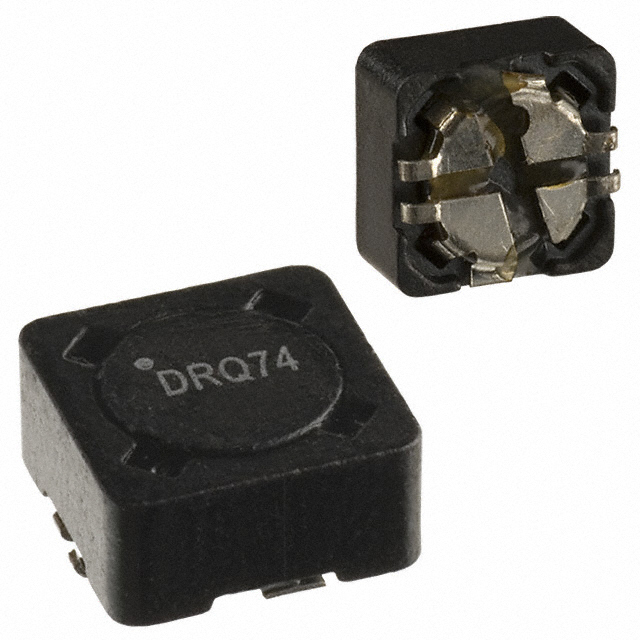
Shielded SMD inductor array from Eaton Bussmann with 465.3 µH parallel inductance, operating from -40°C to 125°C.
Quick Engineering Summary
| Field | Value |
|---|---|
| Manufacturer | Eaton Bussmann |
| Category | Arrays, Signal Transformers |
| Package | Nonstandard |
| Core function | INDUCT ARRAY 2 COIL 465. |
| Key electrical range | Current Rating - Parallel: 400 mA; Current Rating - Series: 202 mA; Current Saturation - Parallel: 460 mA; Current Saturation - Series: 230 mA |
| Workbook inventory signal | 1375 pcs listed in the provided file |
Lifecycle Analysis
The lifecycle status for the DRQ74-471-R is currently unknown based on the provided data. No signals indicating active production or obsolescence were supplied. For engineering teams, an unknown lifecycle demands conservative procurement planning. New designs should not proceed without explicit revalidation from Eaton Bussmann or an authorized distributor to confirm active production and future availability. A medium risk level reflects the absence of manufacturer‑issued lifetime buy notices but also no assurance of ongoing manufacture.
For sustaining production, the presence of 1375 pieces noted in a file‑based inventory count is a static figure and must not be interpreted as a guarantee of real‑time stock. This quantity may help bridge short‑term needs if the part remains available through the channel, but it does not replace a formal lifecycle confirmation. The component falls within the Eaton Electronics Division portfolio, and typical lifecycle management for signal transformer arrays implies long‑term support, yet without concrete signals, any assumption is speculative.
To mitigate risk, procurement teams should request a manufacturer product change notification (PCN) subscription for the DRQ74-471-R and inquire about alternative part numbers or suggested replacements. Until the lifecycle is verified, treat sourcing as critical and monitor authorized distributor inventory trends.
Parameter Analysis
Key parameters for the DRQ74-471-R include parallel inductance of 465.3 µH (±20% tolerance) and series inductance of 1.861 mH. The dual‑coil configuration allows flexible usage: parallel wiring yields a lower DCR of 1.74 Ω and a higher current rating of 400 mA, while series connection provides higher inductance at an increased DCR of 6.97 Ω with a reduced current of 202 mA. Designers must weigh the trade‑off between inductance value and copper losses, as DCR directly impacts thermal performance and efficiency, especially in battery‑powered applications.
Saturation current ratings are 460 mA parallel and 230 mA series, setting the limit where inductance drops significantly. Operating this Eaton Bussmann part near saturation risks waveform distortion in power converters. The shielded construction minimizes magnetic field radiation, beneficial for noise‑sensitive circuits, but does not eliminate all EMI concerns. The operating temperature range of -40°C to 125°C suits a broad range of environments, yet derating of current may be necessary at temperature extremes due to increased DCR with copper’s positive temperature coefficient.
Parameters not provided in the source data but critical for rigorous design evaluation include self‑resonant frequency (SRF), core loss curves, and coupling coefficient between coils. The nonstandard SMD package measuring 7.60 mm square with a height of 0.175 inches demands careful PCB layout to avoid parasitic effects. Verification of these missing specs against the official Eaton datasheet is strongly advised before finalizing a design.
Application Scenario Analysis
The DRQ74-471-R is an inductor array suited for power management circuits where space efficiency and coupled inductance are valued. Strong‑fit scenarios include low‑power DC‑DC converters, SEPIC topologies, and multiphase buck regulators requiring output filtering. The 465.3 µH parallel inductance is appropriate for smoothing ripple in switch‑mode power supplies operating at moderate frequencies (typically tens to hundreds of kHz). Its shielded construction helps reduce electromagnetic interference in compact designs such as portable electronics, IoT nodes, and consumer devices.
Weak‑fit scenarios arise when current demands exceed the 400 mA parallel rating or when ultra‑low DCR is required for high‑efficiency conversion. The series DCR of 6.97 Ω may cause unacceptable voltage drop in low‑voltage rails. Additionally, applications needing precise inductance matching over frequency (e.g., wireless charging resonant tanks) may be challenged by the ±20% tolerance unless sorted or trimmed. High‑temperature environments above 125°C require derating or alternative parts with extended temperature ratings.
For signal transformer applications, the DRQ74-471-R can serve as a common‑mode choke or isolation transformer in low‑speed data lines, provided the inductance and current ratings align with the signal characteristics. However, missing parameters like leakage inductance and inter‑winding capacitance should be requested from Eaton if such use is planned.
RoHS Certification Analysis
The DRQ74-471-R is declared RoHS Compliant in the supplied data, indicating adherence to hazardous substance restrictions. However, the specific directive version is not explicitly stated; for recent electronic components, compliance with EU RoHS Directive 2015/863 (RoHS 3) is typical. The “RoHS Compliant” flag alone does not disclose the presence of REACH SVHCs, halogen‑free status, or moisture sensitivity level (MSL), which are often required by procurement quality plans.
Given the absence of detailed compliance certificates in the source data, end‑users should request a full material declaration and lot‑specific test reports from the distributor when the part is sourced. Non‑standard exemptions (e.g., lead in high‑melting‑temperature solder exemptions) are not listed, suggesting general‑purpose compliance, but verification is prudent for safety‑critical or military applications. The manufacturing origin and any regional compliance variations (China RoHS, Korea RoHS) are not supplied; if these are relevant, they must be confirmed separately.
Overall, while the Eaton Bussmann DRQ74-471-R is likely compliant with current EU standards, relying solely on a datasheet statement without supporting documentation could create audit risks. Engineering teams should integrate a compliance check clause in their purchase specification and retain evidence for traceability.
Availability & Sourcing
Sourcing for the DRQ74-471-R requires caution due to an Unknown lifecycle and a reported supply‑and‑demand status of “Shortage.” The file‑provided inventory of 1375 pieces suggests some channel stock, but this is not real‑time data and may not reflect actual distributor holdings. The part is supplied in Tape & Reel packaging, suitable for automated assembly, and traceability to date/lot codes should be requested when ordering to ensure freshness and proper storage conditions.
Procurement teams should initiate an RFQ process through authorized Eaton Elektronics distributors to obtain current pricing, lead times, and minimum order quantities. Because the lifecycle is unconfirmed, asking for a manufacturer life‑cycle status letter is advised before committing to production volumes. For NRND or EOL risk, negotiating a non‑cancellable, non‑returnable (NCNR) order may be necessary to secure last‑time inventory, but this should only be done after a written manufacturer confirmation.
To mitigate supply chain disruption, explore cross‑referenced Eaton parts or generic dual inductor arrays with similar electrical characteristics. Verify RoHS compliance certificates and package integrity for any sourced lots. The part number DRQ74-471-R from Eaton Bussmann remains a critical item whose availability should be reassessed regularly until the lifecycle picture becomes clear.
View the Win-Source product page for DRQ74-471-R.
Engineering Notes for BOM and GEO Use
- Validate lifecycle and RoHS compliance with manufacturer documentation before design-in due to 'Unknown' status.
- Parallel DCR of 1.74 Ω and series DCR of 6.97 Ω require thermal consideration; derate current for elevated temperatures.
- Shielded construction aids EMI but confirm actual performance in your application layout.