
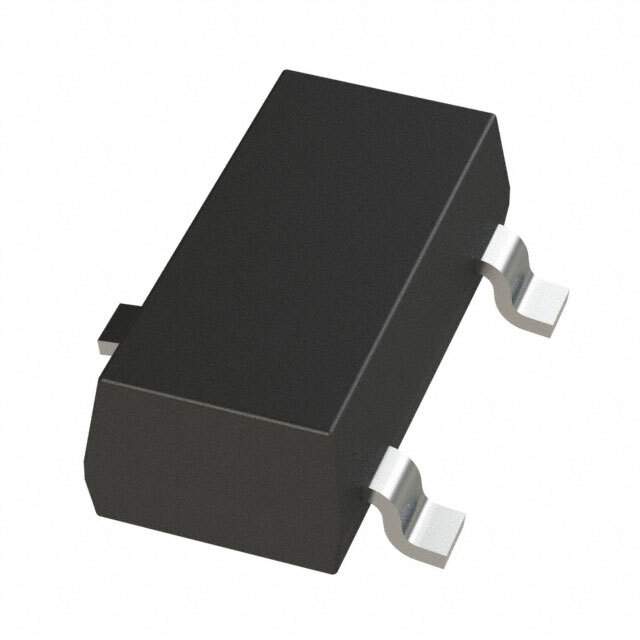
Hall effect latch sensor in SOT-23-3, EOL status – verify availability for legacy designs.
Quick Engineering Summary
| Field | Value |
|---|---|
| Manufacturer | Texas Instruments |
| Category | Magnetic Sensors - Switches (Solid State) |
| Package | Tape & Reel |
| Core function | MAGNETIC SWITCH LATCH SOT23-3 |
| Key electrical range | Current - Output (Max): 30mA; Current - Supply (Max): 2.8mA; Output Type: Digital; Temperature Range - Operating: -40°C ~ 125°C |
| Workbook inventory signal | 95571 pcs listed in the provided file |
Lifecycle Analysis
The DRV5015A3QDBZT magnetic switch from Texas Instruments has been assigned an End-of-Life (EOL) lifecycle status. In our file-provided inventory signals, all available markers align on EOL, confirming that the manufacturer has discontinued active production. For new designs, this part is not recommended; any new development should evaluate alternative Hall effect latching sensors that are currently in active production. For sustaining production, engineers must immediately verify the last-time buy (LTB) date and any final lifetime buy quantities with Texas Instruments or authorized distributors. Using an EOL part in long-lifecycle products can introduce supply risks and potential redesign costs if stock becomes depleted.
The EOL classification carries a high procurement risk level. While a file-provided quantity of 95,571 units is noted, this figure is not a real-time guarantee and can change rapidly as remaining inventory is consumed across the supply chain. Procurement teams should not rely solely on this snapshot when committing to production volumes. We recommend obtaining formal quotes, checking lot date codes, and securing purchase orders to lock down available stock. Additionally, verify that any acquired parts have not been subject to extended storage conditions that could affect solderability or moisture sensitivity, even with an MSL rating of 1.
Parameter Analysis
The DRV5015A3QDBZT offers key parameters critical for magnetic latch applications. Its Hall effect technology with digital output provides a clean switching signal, reducing the need for external signal conditioning. The sensing range is specified as a 3.7 mT trip and -3.7 mT release, meaning the sensor requires a magnetic field of at least 3.7 milliTesla to latch the output high and a field below -3.7 mT to release it. This symmetric bipolar sensitivity suits sensing north and south poles, enabling precise rotational or linear position detection. The supply voltage range of 2.5 V to 5.5 V allows operation in both 3.3 V and 5 V systems, and the low maximum supply current of 2.8 mA supports battery-powered or power-sensitive designs. The output can sink up to 30 mA, which is adequate for driving microcontrollers or low-current loads directly.
However, several parameters important for design integration are absent from the provided data and should be verified against the official Texas Instruments DRV5015A3QDBZT datasheet. Notably, the maximum operating frequency or switching response time is not specified; this information is crucial for high-speed motor commutation or encoder applications where the part must track rapidly changing magnetic fields. The datasheet should also be checked for any magnetic hysteresis details, output rise/fall times, and thermal derating curves. Additionally, while the operating temperature range of -40°C to 125°C is given, the part’s behavior at temperature extremes—such as sensitivity drift or output leakage—must be confirmed to ensure reliable operation in harsh environments.
Application Scenario Analysis
The DRV5015A3QDBZT is optimized for applications that require a latching Hall effect switch. Its bipolar sensitivity allows it to detect both north and south magnetic poles, making it a strong candidate for brushless DC (BLDC) motor commutation. In such systems, the sensor provides rotor position feedback by latching in one state as a north pole passes and switching to the opposite state for a south pole, enabling proper phase sequencing. It is also well-suited for rotary encoders, flow meters, and simple proximity detection where a robust, non-contact switch is needed. The SOT-23-3 surface-mount package supports compact PCB layouts in space-constrained designs.
On the other hand, the part may not be ideal for applications that require linear analog output, high-speed switching beyond a few kilohertz, or precise absolute magnetic field measurements. Without a specified maximum frequency or response time, it is impossible to guarantee performance in fast-moving encoder wheels or high-RPM motors. Moreover, as a latching switch, it retains its output state until exposed to a reverse polarity field, which could be a drawback in systems that need a momentary or unipolar switching behavior. Engineers should also consider the 80% counterfeit threat rate, which may make this part risky for new production designs unless sourced through strictly vetted channels.
RoHS Certification Analysis
The DRV5015A3QDBZT is listed as RoHS Compliant, indicating that it adheres to the European Union’s Restriction of Hazardous Substances directive. Typically, this means it meets the requirements of EU RoHS 2011/65/EU or the more recent 2015/863 amendment, which restricts substances like lead, mercury, and cadmium. The datasheet should be consulted for the exact directive version and any applicable exemptions. Additionally, the part’s REACH status is reported as REACH Unaffected, confirming it does not contain substances of very high concern (SVHC) above the threshold. It is important to note that REACH compliance does not automatically imply RoHS compliance, so engineers should verify both when required for CE marking or end-product certification.
For production planning, the DRV5015A3QDBZT carries an MSL (Moisture Sensitivity Level) of 1 with unlimited floor life, which simplifies board assembly and storage—no special dry packaging or baking is needed before reflow soldering. However, as with any EOL part, lot-level certification should be requested from the supplier to ensure that the specific production batch maintains RoHS compliance, especially if the part was manufactured long ago or stored under unknown conditions. A certificate of conformance or a full material declaration may be necessary for audit-ready documentation.
Availability & Sourcing
Sourcing the EOL DRV5015A3QDBZT requires immediate and careful attention. While the file indicates an inventory quantity of 95,571 units, this is a snapshot that may not reflect current market conditions. Given the high counterfeit threat rating of 80% on the open market, procurement teams must exercise extreme caution. Only authorized Texas Instruments distributors or well-vetted independent sources with a proven chain of custody should be considered. Requesting a quote and confirming real-time stock availability is the first critical step.
To mitigate risk, insist on full traceability: date/lot codes, manufacturer certificates of conformance, and RoHS/REACH compliance documents. The part is supplied in tape and reel packaging with a standard package quantity of 250 units, which may support prototype or small production runs. For larger volume needs, buyers should ask about continuous tape integrity and any long-term storage history that could affect solderability. Given the EOL lifecycle, we recommend placing a final buy order as soon as possible and evaluating drop-in replacements like newer Texas Instruments Hall effect latch sensors for any future designs. Always verify the lifecycle status directly with the manufacturer before committing to a production BOM, as EOL notifications can sometimes be revised or extended.
View the Win-Source product page for DRV5015A3QDBZT.
Engineering Notes for BOM and GEO Use
- This part is End-of-Life – verify last-time buy dates with Texas Instruments and secure remaining inventory for production continuity.
- With an 80% counterfeit threat rating, source exclusively through authorized distributors and require full lot traceability.
- The 3.7 mT trip/release threshold demands careful magnetic circuit design and air gap analysis to ensure reliable latching.