
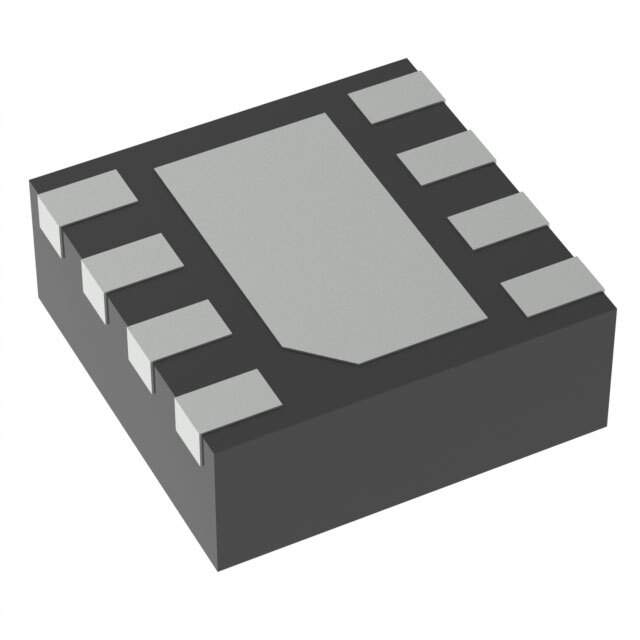

PMIC - Full, Half-Bridge Driver with 1.8A peak current, 1.8V-7V supply in 8-WSON package
Quick Engineering Summary
| Field | Value |
|---|---|
| Manufacturer | Texas Instruments |
| Category | PMIC - Full, Half - Bridge Drivers |
| Package | 8-WSON (2x2) |
| Core function | IC BRIDGE DRIVER PAR 8WSON |
| Key electrical range | Current - Peak Output: 1.8A; Supply and Demand Status: Sufficient; Supply Voltage - Operating: 1.8 V to 7 V; Temperature Range - Operating: -40°C to 150°C (TJ) |
| Workbook inventory signal | 39000 pcs listed in the provided file |
Lifecycle Analysis
The lifecycle status of the DRV8838DSGR is officially Unknown based on the supplied data, yet a specification field lists it as Active. This conflict demands careful interpretation. An estimated End-of-Life date of 2031 hints at continued availability, but without direct manufacturer confirmation, the part should be treated conservatively. For new designs, avoid sole-source reliance until Texas Instruments validates the status. For sustaining production, maintain safety stock and explore pin-compatible alternatives early.
The risk level is assessed as medium. The absence of a formal lifecycle signal means any commitment carries uncertainty. Design teams should not assume future availability beyond current inventory, and procurement should request a PCN (Product Change Notification) alert or equivalent from the manufacturer. If the part is indeed active, the extended EOL window offers stability; if it’s in transition, immediate action may be required.
Parameter Analysis
Key parameters for the DRV8838DSGR include a supply voltage range of 1.8 V to 7 V and a load voltage rating up to 11 V. This low-voltage operation suits battery-powered systems, but the load voltage headroom demands care when driving inductive kickback above the supply. The peak output current is 1.8 A, with a typical Rds(on) of 280 mΩ, which directly influences power dissipation and thermal management in compact 8-WSON footprints.
The integrated fault protections—current limiting, over-temperature, short circuit, and UVLO—are critical for reliable motor control. The NMOS technology suggests fast switching, but designers must verify gate drive requirements and dead-time control from the datasheet. Missing but essential parameters include continuous output current rating, logic input voltage thresholds, propagation delay, and thermal resistance (junction-to-ambient). These values are necessary for derating analysis and should be obtained from the official Texas Instruments datasheet before finalizing the design.
Application Scenario Analysis
The DRV8838DSGR is well-suited for low-voltage DC motor and solenoid driving applications where inductive loads require uni-directional or bi-directional control. Typical strong-fit scenarios include battery-operated robotics, small actuator systems, medical pumps, and portable instrumentation. Its 1.8 V to 7 V supply range aligns with single-cell Li-Ion or multi-cell alkaline batteries, while the 1.8 A peak current can handle moderate inrush requirements.
Weak-fit scenarios involve high-current motors exceeding 1.8 A continuous, or applications where the load voltage regularly spikes beyond 11 V. Without explicit continuous current data, designers should not push the part near its peak limits without substantial thermal margin. Non-inductive loads or applications requiring complex stepping or microstepping may be better served by specialized stepper drivers. The device’s fault protection features make it a safe choice for environments where stall conditions can occur, but system-level verification of protection thresholds against actual load characteristics is advised.
RoHS Certification Analysis
The DRV8838DSGR is listed as RoHS Compliant and Halogen Free Compliant. While the exact RoHS directive (e.g., EU 2015/863) is not specified in the source data, Texas Instruments typically certifies parts under the latest applicable standard. For high-reliability or regulated markets, requesting a full material composition declaration and a RoHS certificate of compliance is prudent.
No REACH compliance statement is provided in the available records. In cases where this is a requirement, direct verification with the manufacturer is necessary. The compliance information should be considered a family-level attribute; individual lots may vary, especially when sourced through non-authorized channels where the fake threat reaches 49%. Therefore, insisting on lot-specific compliance documentation from your supplier is essential to ensure environmental conformity.
Availability & Sourcing
The DRV8838DSGR appears with a file-provided inventory quantity of 39,000 units, packaged on reels. This is not a live stock guarantee, and actual availability must be confirmed through a request for quote. The part originates from the Philippines and is classified under ECCN EAR99, which simplifies export procedures. Storage conditions recommend a dry storage cabinet and humidity protection, indicating moisture sensitivity that should be observed during assembly.
With a fake threat rate of 49% in the open market, sourcing from authorized distributors or directly from Texas Instruments is strongly recommended to avoid counterfeit risks. Verify lot codes, date codes, and compliance documentation upon receipt. Because lifecycle is unconfirmed, buyers should not commit to long-term production without a validated status. Request a quote today for current lead times and batch-specific authenticity, and consider securing additional inventory if this part is critical to your supply chain.
View the Win-Source product page for DRV8838DSGR.
Engineering Notes for BOM and GEO Use
- Validate lifecycle directly with Texas Instruments due to conflicting Active/Unknown signals; plan for NRND approach in new designs.
- Account for 280mΩ Rds(on) losses and 150°C maximum junction temperature in thermal design; verify continuous current rating from datasheet.
- Given 49% open-market fake threat, enforce stringent anti-counterfeit measures including date/lot code verification and authorized source traceability.