
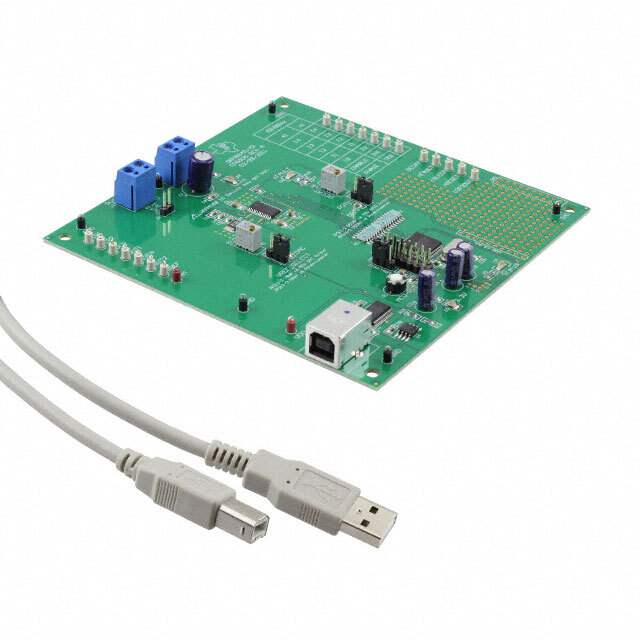
Texas Instruments Active Evaluation Board for DRV8842 Motor Driver
Quick Engineering Summary
| Field | Value |
|---|---|
| Manufacturer | Texas Instruments |
| Category | Evaluation and Demonstration Boards and Kits |
| Package | Not available in supplied data |
| Core function | EVAL BOARD FOR DRV8842 |
| Key electrical range | Supply and Demand Status: Limited |
| Workbook inventory signal | 1 pcs listed in the provided file |
Lifecycle Analysis
The DRV8842EVM evaluation board from Texas Instruments is currently listed with an Active lifecycle status. This indicates that the manufacturer continues to produce and support the platform, making it suitable for both new evaluation designs and ongoing development projects. Engineers initiating fresh prototyping cycles or expanding test coverage for the DRV8842 motor driver can proceed with confidence, as no end-of-life notices have been issued for this part.
All available lifecycle signals—including the primary lifecycle param and part status—are consistently reported as Active, with no indication of NRND, discontinuation, or obsolescence. For production-critical procurement, it remains prudent to reconfirm directly with Texas Instruments or an authorized distributor, as lifecycle classifications can shift over time due to wafer availability or platform revision. The single unit of file‑provided inventory suggests limited immediate stock, but this is a point‑in‑time snapshot and should be verified through a formal RFQ before committing to a project timeline.
Parameter Analysis
This evaluation platform is built around the DRV8842 single‑H‑bridge motor driver, with key primary attributes including 3.5 A continuous output current (5 A peak) and an operating voltage range of 8.2 V to 45 V. These parameters directly define the torque and speed envelope for brushed DC motors under test, and they must be carefully derated against the intended motor load and supply voltage in the target application. The board also includes an embedded 16‑bit MCU and a graphical user interface (GUI), which streamlines configuration and real‑time monitoring during prototyping.
Missing from the aggregated data are important details such as the specific MCU part number, memory configuration, communication interfaces (USB, UART, etc.), and any software development kit (SDK) requirements. Engineers should obtain the official DRV8842EVM user’s guide from Texas Instruments to verify that the on‑board controller supports the necessary command set and that the GUI is compatible with their operating system and test automation framework. Thermal performance data, board dimensions, and mounting provisions should also be confirmed before integration into a lab setup.
Application Scenario Analysis
The DRV8842EVM is purpose‑built for evaluating the DRV8842 motor driver IC in power management and motor control applications. It fits strongly in R&D and prototyping environments where engineers need to validate drive waveforms, current regulation accuracy, and thermal behavior before committing to a custom PCB layout. Typical use cases include development of printers, scanners, office automation equipment, and small industrial actuators that require a unidirectional or bidirectional brushed DC motor drive.
This evaluation board is not a production‑ready module; it lacks industrial‑grade enclosures, conformal coating, or formal reliability qualification. Therefore, it is a poor fit for direct deployment in end equipment or high‑volume manufacturing tests that demand 24/7 operation. In lab settings, it serves as a quick bench‑top tool for software‑hardware co‑verification, but teams scaling to multiple test stations should verify that the board can be purchased in sufficient quantities (only 1 unit file‑listed) and that the GUI supports scripting or automated data logging to avoid bottlenecks.
RoHS Certification Analysis
The DRV8842EVM is reported as RoHS Compliant, suggesting that it meets the substance restrictions of the EU RoHS directive for lead, mercury, cadmium, hexavalent chromium, PBBs, and PBDEs. No specific directive version (such as 2011/65/EU or 2015/863) is stated in the available source data, so engineers seeking full certification documentation should request the EU Declaration of Conformity from Texas Instruments or an authorized distributor.
Absent explicit mention of REACH, MSL, or halogen‑free status, these aspects remain unconfirmed. While REACH compliance is separate and not a substitute for RoHS, a compliant board typically aligns with both. The materials note of “silicon element” and “blue‑grey metallic luster” is generic and does not replace a formal certificate. For procurement in regulated industries, lot‑level compliance verification is recommended, as supplier‑level declarations can shift with component changes or alternate assembly sites.
Availability & Sourcing
File‑provided inventory indicates only 1 unit of the DRV8842EVM, and the supply‑and‑demand status is labeled as Limited. Engineers and buyers should treat this as a point‑in‑time snapshot and request a current quote directly from Texas Instruments or its franchised distributors to confirm real‑time availability and lead times. The Active lifecycle status suggests that additional units may be manufactured, but low inventory could still result in extended order fulfillment.
A significant counterfeit risk of 66% is flagged for this part in the open market, underscoring the importance of sourcing exclusively through authorized channels. Requesting date and lot code traceability, original packaging, and full compliance certificates (RoHS, REACH) is essential to avoid fake, refurbished, or non‑conforming boards. Given the evaluation board’s role in prototype validation, any substitution or grey‑market purchase could introduce functional anomalies that mislead development results. For NRND or imminent end‑of‑life, alternative eval modules for the DRV8842 family should be considered, but as of this writing the DRV8842EVM remains Active and available for new orders with the usual commercial diligence.
View the Win-Source product page for DRV8842EVM.
Engineering Notes for BOM and GEO Use
- Verify complete kit contents (cables, power supply requirements) from the user guide before purchase.
- The 66% counterfeit threat requires strict authorized‑source purchasing and lot‑code verification.
- Confirm that the on‑board GUI supports scripting for automated test sequences if used in a high‑throughput lab.